
How Social Media Quietly Rewires Your Brain Without You Noticing
The invisible psychology behind dopamine loops, outrage culture, and why your attention no longer feels like it belongs to you

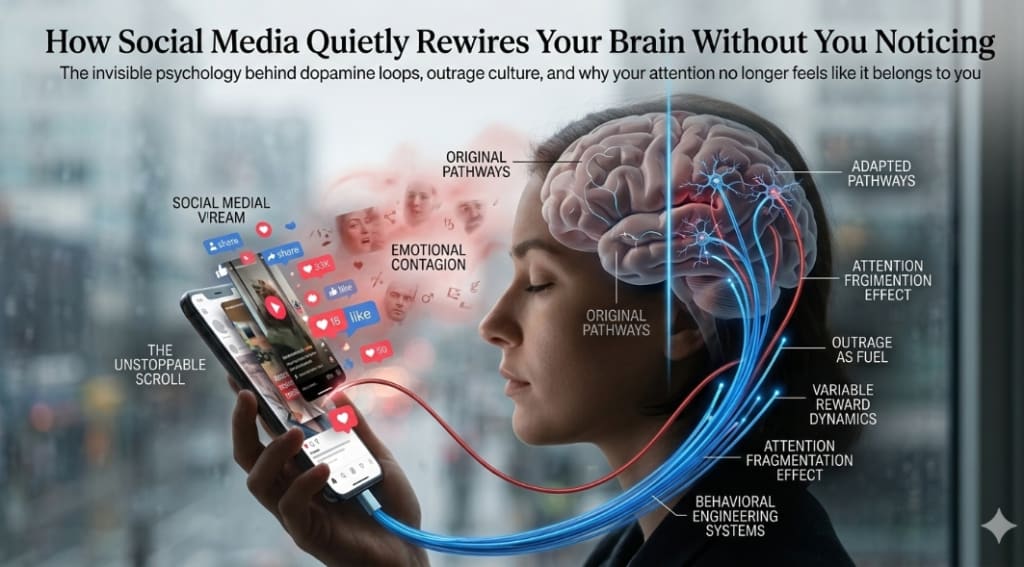
You wake up.
Before your feet touch the floor, your thumb is already scrolling.
No dramatic decision. No conscious plan. Just reflex.
A notification. A headline. A short video. A comment war. A like. Another scroll.
By the time you pause, twenty minutes have dissolved into pixels.
This is not weakness.
It is design.
Social media platforms are not neutral tools. They are behavioral engineering systems — carefully optimized environments built to shape attention, emotion, and habit. They do not simply entertain you. They train you.
And the training happens quietly.
The Dopamine Loop: The Brain’s Reward Circuit
Dopamine is often called the “pleasure chemical,” but that label is misleading. Dopamine is more about anticipation than pleasure. It spikes when we expect a reward.
Social media platforms are built on variable reward schedules — the same psychological mechanism used in slot machines. Sometimes your post gets massive engagement. Sometimes it gets little. Sometimes you find a brilliant video. Sometimes it is dull.
The unpredictability is the hook.
When rewards are inconsistent, the brain becomes more engaged. It keeps checking. It keeps refreshing. It keeps hoping.
Each notification becomes a tiny possibility of validation.
Over time, your brain starts associating scrolling with potential reward. The action becomes automatic. The expectation becomes wired.
You are not just using the app. Your neural pathways are adapting to it.
The Attention Fragmentation Effect
Attention is a limited cognitive resource. When you constantly shift between short videos, comments, headlines, and messages, your brain adapts to rapid context switching.
Long-form reading begins to feel heavier. Deep focus becomes uncomfortable. Silence feels empty.
This is not because you suddenly lost intelligence. It is because your brain optimizes for the environment it inhabits.
If your daily environment rewards speed, novelty, and constant stimulation, your brain strengthens those patterns.
Neuroplasticity — the brain’s ability to reorganize itself — is powerful. It helps you learn languages and skills. But it also means your habits shape your cognitive structure.
When every scroll offers something new, patience weakens.
Outrage as Fuel
Have you noticed how emotionally intense content spreads faster?
Anger. Shock. Moral outrage.
These emotions increase engagement because they trigger stronger physiological responses. Your heart rate changes. Your attention narrows. You feel compelled to react.
Platforms detect engagement — not truth. The algorithm prioritizes what keeps you interacting.
Controversial content generates comments. Comments signal activity. Activity signals relevance.
So outrage becomes amplified.
Over time, this shapes perception. You begin to see the world through extremes. Nuance disappears. Complex issues become simplified into emotional battles.
The platform does not “intend” to radicalize you. It optimizes for engagement. Emotional intensity just happens to be efficient at producing it.
Identity and Social Validation
Humans evolved in small tribes. Social approval once meant survival. Rejection carried serious consequences.
Today, that ancient wiring meets global digital visibility.
Likes, shares, and follower counts become quantifiable social feedback. The brain interprets these signals through evolutionary instincts.
Validation feels rewarding. Silence feels threatening.
This can subtly shift behavior. People post what performs well rather than what they truly believe. Self-expression becomes optimized for reaction.
Over time, identity can drift toward what receives applause.
When feedback loops are public and constant, authenticity competes with performance.
The Illusion of Choice
You may believe you are choosing what to watch. In reality, recommendation systems filter and rank content before you see it.
Algorithms analyze past behavior — what you watched, paused, liked, or commented on — and feed similar content back to you.
This creates echo chambers.
If you interact with fitness content, you see more fitness. If you engage with political commentary, you see more of that viewpoint. The system narrows your informational diet.
Gradually, your perception of what is “common” shifts. The world appears to align with the content stream you receive.
This is not a conspiracy. It is optimization logic.
But optimization for engagement is not optimization for balanced understanding.
The Short-Form Trap
Short videos dominate modern platforms. Fifteen seconds. Thirty seconds. Rapid cuts. Constant novelty.
This format conditions the brain to expect quick payoff.
When faced with slower processes — reading a book, studying, building a skill — motivation drops because the reward feels delayed.
Delayed gratification is a cornerstone of long-term achievement. Social media weakens tolerance for delay by constantly providing instant stimulation.
The result is subtle restlessness.
You are not bored. You are under-stimulated by anything that unfolds gradually.
Emotional Contagion
Emotions spread socially. Studies in psychology show that people can “catch” moods from others even without direct interaction.
On social media, emotional content is scaled globally. A wave of fear, anger, or excitement can ripple across millions within hours.
Repeated exposure to intense emotional content shapes baseline mood.
If your feed is filled with crisis, conflict, and outrage, your perception of reality skews toward instability.
If it is filled with curated perfection, your self-comparison intensifies.
In both cases, perception drifts from balanced reality.
Is the Brain Permanently Damaged?
The dramatic narrative says social media is destroying cognition.
The more accurate view is adaptation.
The brain adapts to repeated behavior. Change the behavior, and adaptation shifts again.
Neuroplasticity cuts both ways.
Attention span can be rebuilt. Deep focus can be retrained. Emotional regulation can be strengthened.
But awareness must come first.
You cannot counteract a pattern you do not recognize.
Reclaiming Attention
Attention is not just a productivity tool. It is the gateway to meaning.
Where attention goes, experience follows.
If attention is fragmented, experience feels fragmented.
Reclaiming it does not require abandoning technology. It requires intentional use.
Structured time blocks without notifications. Long-form reading sessions. Physical environments free from screens. Conscious selection of content rather than endless scrolling.
Small interventions compound.
The goal is not digital isolation.
It is cognitive sovereignty.
The Bigger Picture
Social media is one of the most powerful behavioral experiments in human history.
Billions of minds interacting with algorithmic systems that adapt in real time.
The outcome is not predetermined.
Platforms will continue optimizing for engagement. That is their economic model.
But individuals can optimize for clarity.
The deeper question is not whether social media rewires the brain.
It does.
The real question is whether you participate unconsciously or deliberately.
Because your brain is always learning.
The only uncertainty is who is doing the teaching.
About the Creator
Amanullah
✨ “I share mysteries 🔍, stories 📖, and the wonders of the modern world 🌍 — all in a way that keeps you hooked!”
Born Between Shame and Grace: My True Story of Adoption
Some lives begin with celebration. Mine began with silence. It was a late afternoon when an eighteen-year-old girl walked through the wind with her head lowered, carrying a secret that felt heavier than her own body. In a small town governed more by judgment than mercy, there was an unspoken rule: No father, no child. No scandal. No shame.
By Magma Star3 days ago in Psyche



Comments
There are no comments for this story
Be the first to respond and start the conversation.