
Modern Machine Learning Techniques Redefining AI Systems
Machine Learning Techniques Driving Modern AI

Let's be honest — most of us interact with AI every single day without really thinking about it. The moment your inbox filters out spam, your streaming app suggests the perfect show, or your bank flags a suspicious transaction before you even notice it — that's machine learning quietly doing its job. But what's actually happening under the hood? And why does it matter for you or your business?
That's exactly what we're going to break down. No jargon overload, no confusing diagrams — just a clear, honest look at the machine learning techniques reshaping entire industries and what they actually mean for businesses like yours.
The Key Machine Learning Techniques Driving Modern AI
It Wasn't Always This Smart
Old-school software followed instructions to the letter. You told it exactly what to do, and it did that — nothing more, nothing less. Useful, but painfully limited.
Machine learning changed the game. Instead of writing rules for every possible scenario, you feed the system data and let it figure things out on its own. The more data it sees, the sharper it gets. It's less like programming a calculator and more like training an apprentice who learns on the job and keeps getting better over time.
That fundamental shift — from hardcoded logic to learned intelligence — is what makes today's AI systems so flexible and, frankly, so impressive.
Supervised Learning: Learning the Right Answers First
Imagine teaching a child to identify animals by showing them pictures with labels. "This is a cat. This is a dog." After enough examples, they start getting it right on their own. Supervised learning works almost the same way.
You give the model labeled data — inputs paired with correct outputs — and it trains until it can make accurate predictions on new, unseen examples. It's the most commonly used ML approach for a good reason: it works really well when you have quality data.
Spam detection, loan approval systems, early cancer detection from medical scans — all of these run on supervised learning. The catch? The quality of your data determines the quality of your results. Feed it messy, incomplete data, and you'll get messy, unreliable predictions. But with clean, well-labeled datasets, supervised models can be remarkably powerful.
Unsupervised Learning: Letting the Data Speak for Itself
Sometimes you don't have labels. You just have a massive pile of raw data and a gut feeling there's something valuable in there. Unsupervised learning is built for exactly that situation.
These algorithms don't get told what to look for. They dig through the data and discover patterns, groupings, and structures on their own. And the results can be surprisingly insightful.
Take customer segmentation. A business might have years of purchase history but no clear way to categorize their audience. An unsupervised model can sift through that data and surface distinct groups — perhaps frequent buyers who love discounts, or occasional shoppers who only come back for premium products. No one told the model those categories existed. It found them by itself. That's the kind of discovery that leads to sharper marketing strategies, smarter product decisions, and a better overall customer experience.
Reinforcement Learning: Getting Better by Doing
Here's a technique that feels almost human. Reinforcement learning is based on the same principle behind how we learn to ride a bike or play a sport — try something, see what happens, adjust, and try again.
An RL agent takes actions in an environment and receives feedback: rewards when it does well, penalties when it doesn't. Over thousands or even millions of iterations, it learns to make decisions that maximise its rewards.
This is the technology behind AI systems that beat world champions at chess and Go, robotic arms that teach themselves to pick up objects, and real-time pricing engines that adjust based on demand, competition, and user behaviour. It's messy and slow to train, but for complex, real-world decision-making tasks, nothing comes close.
Deep Learning: The Engine Behind the Magic
Deep learning is where things get genuinely mind-bending. Inspired loosely by how the human brain processes information, deep learning uses layered neural networks — sometimes hundreds of layers deep — to make sense of complex data like images, audio, and text.
When you speak to a voice assistant and it actually understands you, that's deep learning. When a system reads customer reviews and accurately gauges whether the sentiment is positive or negative, that's deep learning too. The same technology drives facial recognition, real-time language translation, and the large language models that have taken the world by storm in recent years.
A few years ago, training these models required computing power that only the biggest tech companies could afford. Today, cloud infrastructure and powerful GPUs have levelled the playing field. Businesses of almost any size can access and deploy these capabilities — which is a genuinely big deal.
Transfer Learning: Why You Don't Always Start From Scratch
Training a deep learning model from zero is expensive. It takes months, massive datasets, and serious computing resources. Transfer learning is the practical shortcut that makes AI adoption realistic for most organisations.
The idea is simple: take a model that's already been trained on a huge, general dataset, and fine-tune it for your specific task. A model trained on billions of web pages already understands language deeply. You don't need to rebuild that understanding — you just teach it the particular nuances of your domain, whether that's legal documents, medical records, or customer service transcripts.
Transfer learning has compressed what used to take years into weeks. It's one of the biggest reasons AI adoption has accelerated so rapidly across so many different industries. For a more detailed breakdown of how these ML techniques behind modern AI solutions, it's well worth exploring further.
So What Does This Mean for Your Business?
Here's the honest truth: these techniques aren't competing with each other. The most effective AI systems layer them together — using supervised learning for prediction, unsupervised learning for discovery, reinforcement learning for decision-making, and deep learning for understanding complex inputs. Getting that combination right, for your specific use case, is where the real value lies.
That's also where experience matters. Working with a skilled AI development company means you're not just getting code — you're getting the judgement to choose the right approach, avoid common pitfalls, and build something that actually delivers results.
AI isn't coming. It's already here, already being used by your competitors, and already shaping what your customers expect. The businesses that thrive in the next decade won't necessarily be the ones with the biggest budgets — they'll be the ones that moved smart, moved early, and chose the right partners to build with.
About the Creator
Technoloader
Technoloader is a complete blockchain development company in India that provides end-to-end solutions in this field. We offer blockchain development, defi development, cryptocurrency wallet & exchange development and mlm development.
Keep reading
More stories from Technoloader and writers in The Chain and other communities.
IDO Launch Trends to Watch in 2026 — What's Changing and Why It Matters
Nobody predicted 2025 would slow down the IDO space the way it did. And yet — here we are. Projects got quieter. Investors got harder to convince. And launchpads that used to list almost anything started asking uncomfortable questions. Honestly? That was probably overdue.
By Technoloader15 days ago in The Chain
Crypto Coin: Architecture, Utility Models, and Market Dynamics Explained
The term Crypto coin refers to a native digital asset that operates on its own blockchain infrastructure, functioning as a medium of exchange, store of value, and programmable financial instrument. Unlike tokens that are deployed on existing chains, a Crypto coin underpins its network’s consensus, incentivization, and transaction validation layers. Understanding how a Crypto coin operates requires a multi-dimensional perspective that includes cryptographic security, economic design, governance structures, and regulatory implications.
By Siddarth D6 days ago in The Chain
The Power Behind Bitcoin
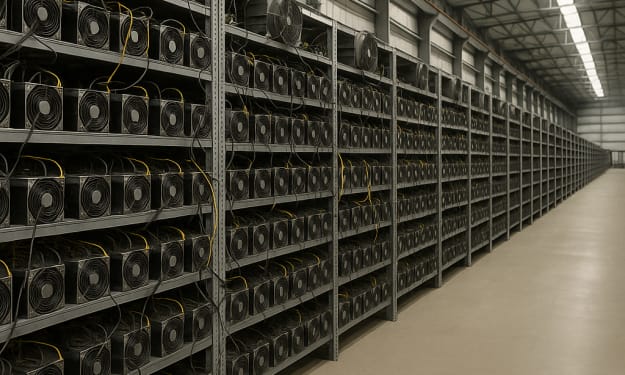
Bitcoin borrowed a word that does not belong to it. Mining sounds physical. It carries an image of dirt, steel, and effort. It suggests men who work in tunnels and move rock by the ton. When the public hears it, they picture a job that leaves a body tired in a way that makes sense. None of that exists in a modern Bitcoin facility. What you find instead is a heat-filled building lined with machines made for only one purpose. Each machine is a miner. One miner equals one computer. Thousands of them sit in rows, running without rest. Once a person understands that a miner is not a human but a device that never sleeps, the scale becomes easier to grasp. These machines fire through guesses at high speed. Each one is trying to match the one valid answer the network will accept. The winning machine earns the reward. All other miners (computers) try again. The entire operation is a probability race powered by electricity.
By Dr. Mozelle Martin7 days ago in The Chain
I wanted to title this something different, but worried that my chosen title might cause problems entering the United States in the future so this is the new title. It's the greatest title. No one has ever written a title better than this. (All titles unrelated to content).
Let me be honest. I am finding this difficult. Now, I like a challenge, a stretch, a bit of an obstacle course. “Write about the decline of the British Empire in the form of a narrative poem in which your protagonist is an artichoke” I read, and flex my fingers. “Write a haiku to evoke the sensation of sibilance using only the first half of the alphabet.” “Well”, I think to myself, “this should be fun.” But “write about a system that isn’t working”? A system that isn’t working? Now? In 2026? ONE system? My favourite system that isn’t working? The sexiest system that isn’t working? The one giving me the most angst day to day? The one giving me the most existential dread? I am, as I say, finding this difficult. I will own that I have contemplated writing a thousand words on why the steady “all on” setting on my fairy lights is the EIGHTH of seven options which must be sequentially activated to get there, because that is a system that some fool came up with and it definitely doesn’t work, and now who is paying the price, eh? But how can I write about my fairy lights when…. When…. When….
By Hannah Moore7 days ago in Humans



Comments
There are no comments for this story
Be the first to respond and start the conversation.