
Admission of Weakness by the World’s Most Powerful Navy? The U.S. Navy Scales Back Ambitions for Its Future Amphibious Armada
Rising costs and new battlefield threats force the U.S. Navy to rethink its amphibious fleet strategy amid changing doctrines of modern warfare.

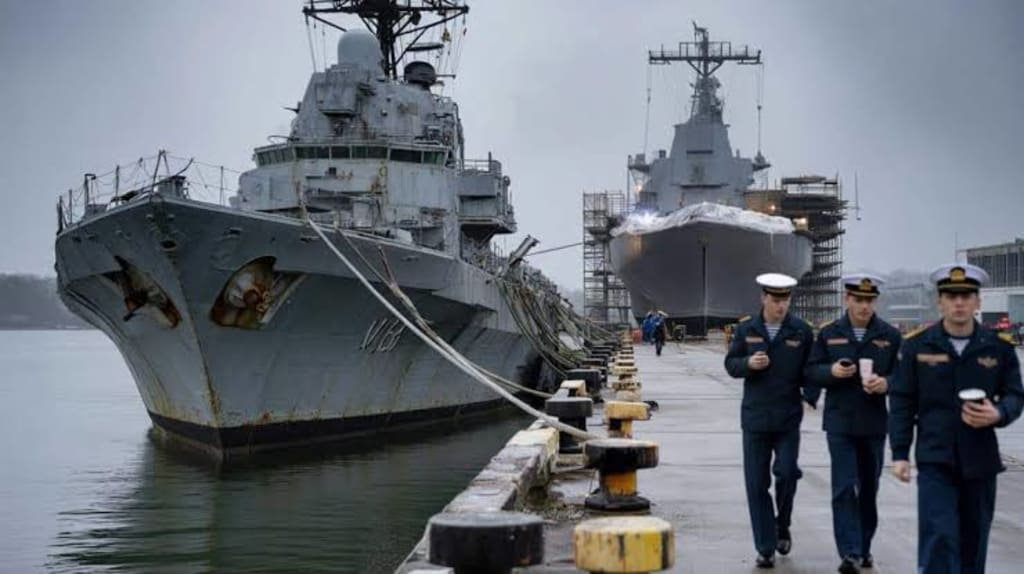
The United States Navy has long been regarded as the most powerful maritime force in history, projecting strength across every ocean and maintaining a global presence unmatched by any rival. Yet recent decisions to scale back plans for its future amphibious fleet have sparked debate among defense analysts: is this a pragmatic adjustment to new realities, or an admission that even the world’s strongest navy is facing limits to its ambitions?
For years, the U.S. Navy and Marine Corps envisioned a large and modern amphibious armada capable of deploying Marines rapidly across contested regions. These ships—designed to transport troops, vehicles, and aircraft—are essential for operations ranging from humanitarian relief to high-intensity conflict. However, rising costs, shipyard delays, and shifting strategic priorities have forced planners to reconsider how many such vessels the fleet truly needs and what role they should play in future wars.
At the heart of the shift is a changing view of warfare. Traditional amphibious assaults, once a central pillar of U.S. military doctrine, are increasingly seen as risky in an era dominated by long-range missiles, drones, and advanced surveillance systems. Potential adversaries can now detect and target large ships far from shore, making massive beach landings far more dangerous than in past conflicts. As a result, military leaders are exploring smaller, more agile platforms that can disperse forces rather than concentrate them in vulnerable formations.
Budget pressures have also played a major role. Building and maintaining large amphibious ships is enormously expensive. Each vessel can cost billions of dollars and requires a skilled workforce and long construction timelines. With competing demands from submarine programs, aircraft carriers, and next-generation destroyers, the Navy has had to make difficult choices. Reducing the size of the amphibious fleet allows resources to be redirected toward technologies viewed as more relevant to future conflicts, such as cyber warfare, unmanned systems, and missile defense.
The Marine Corps has been particularly affected by the new strategy. Traditionally dependent on amphibious ships for rapid deployment, the Marines are now restructuring around a concept known as “distributed operations.” This approach emphasizes smaller units operating across wide areas, supported by lighter and more flexible naval platforms. While proponents argue this makes forces harder to target and more adaptable, critics worry it could weaken the Marines’ ability to respond to large-scale crises.
Supporters of the Navy’s decision say the shift reflects realism rather than weakness. They argue that modern threats demand innovation, not adherence to Cold War-era fleet structures. By investing in fewer but more technologically advanced ships—and pairing them with unmanned vessels and long-range strike capabilities—the Navy aims to maintain dominance without relying on vulnerable, high-profile assets.
Still, concerns remain. Amphibious ships play a crucial role not only in war but also in diplomacy and disaster response. They provide visible reassurance to allies and serve as floating bases for humanitarian missions after earthquakes, hurricanes, and tsunamis. Scaling back their numbers could limit America’s ability to respond quickly to crises in distant regions, potentially reducing its global influence.
International observers are watching closely. Rivals may interpret the move as a sign that the U.S. is overstretched, while allies could worry about reduced support in times of need. At the same time, some see the changes as part of a broader evolution toward a leaner, more technologically sophisticated navy better suited to 21st-century challenges.
Whether this represents an “admission of weakness” depends largely on perspective. The U.S. Navy is not abandoning amphibious warfare altogether; it is redefining it. The goal is to balance traditional power projection with survivability and cost-effectiveness in a world of rapidly advancing military technology.
What is clear is that even the world’s most powerful navy must adapt. The decision to scale back its amphibious ambitions reflects a recognition that future conflicts will not look like those of the past. In this sense, the shift may be less about retreat and more about transformation—an effort to ensure that American sea power remains credible in an increasingly complex and contested global environment.
About the Creator
Fiaz Ahmed
I am Fiaz Ahmed. I am a passionate writer. I love covering trending topics and breaking news. With a sharp eye for what’s happening around the world, and crafts timely and engaging stories that keep readers informed and updated.
Keep reading
More stories from Fiaz Ahmed and writers in The Swamp and other communities.
British Military Base in Cyprus Targeted in Suspected Drone Attack
A British military base in Cyprus has been targeted in what authorities believe was a suspected drone attack, raising serious concerns about regional security and the vulnerability of strategic installations in the eastern Mediterranean. The incident marks a rare but alarming development involving one of the United Kingdom’s most important overseas military facilities. The base, located within the British Sovereign Base Areas on the island, reportedly detected an unidentified aerial object approaching its perimeter before defensive measures were activated. While no casualties were reported and damage appears to have been limited, the event has triggered an immediate security review and heightened alert levels across British forces stationed in the region. British officials have not publicly confirmed the origin of the drone or whether it was armed, but defense sources described the incident as a “serious security breach attempt.” Investigations are underway to determine who launched the device and whether it was part of a coordinated action linked to broader regional tensions. The eastern Mediterranean has recently seen increased military activity due to instability in the Middle East, making the incident particularly sensitive. The British bases in Cyprus play a vital role in intelligence gathering, air operations, and regional surveillance. They support missions related to counterterrorism, humanitarian relief, and the protection of shipping routes. Because of their proximity to conflict zones in the Middle East, these installations are considered strategically invaluable for the United Kingdom and its allies. Local authorities in Cyprus confirmed that airspace around the area was temporarily restricted following the incident. Residents in nearby communities reported hearing unusual sounds and seeing military helicopters patrolling the skies shortly afterward. While the Cypriot government emphasized that there was no immediate threat to civilians, it acknowledged that the attempted attack highlighted the growing risks posed by drone technology. Security analysts say the suspected drone attack reflects a broader trend in modern warfare. Unmanned aerial systems have become cheaper, more accessible, and increasingly capable of bypassing traditional defenses. Even heavily fortified military installations can be challenged by small, fast-moving drones that are difficult to detect with conventional radar systems. “This is a reminder that the nature of threats has changed,” one defense expert noted. “It no longer takes a missile or aircraft to test a base’s security. A small drone can cause disruption, gather intelligence, or deliver explosives with relatively low cost and high impact.” The timing of the incident has also drawn attention. It comes amid heightened tensions in the Middle East and increased Western military involvement in regional security operations. British forces have been active in monitoring airspace, supporting allies, and ensuring the protection of international shipping routes. Any attempt to target a UK base could be interpreted as a warning signal or an effort to probe defenses. Officials stressed that contingency plans worked as intended and that personnel followed established protocols. The base remains operational, and there has been no disruption to ongoing missions. However, the Ministry of Defence is expected to introduce additional counter-drone measures, including enhanced surveillance systems and electronic jamming equipment. Diplomatic channels are also being engaged. The UK government is reportedly coordinating with Cypriot authorities and allied intelligence services to assess whether the incident was linked to state actors, militant groups, or rogue operators. If evidence points to an organized attack, it could carry serious political consequences and further strain already fragile regional stability. For Cyprus, the event underscores its delicate position as a host to foreign military bases in a volatile neighborhood. While the island has long served as a hub for international security operations, it also faces the risk of becoming entangled in conflicts beyond its borders. As investigations continue, the suspected drone attack serves as a stark illustration of how modern threats are evolving. The episode has reinforced the need for advanced defense systems and close international cooperation to protect critical military infrastructure. In an era when drones can cross borders silently and strike with precision, even long-established bases are no longer immune. The incident in Cyprus is likely to prompt renewed debate over military preparedness, regional security, and the growing challenge posed by unmanned aerial warfare.
By Fiaz Ahmed about 14 hours ago in The Swamp
A Gathering of Evil Bosses
“I’m the queen of chin jutting while I smooth my hair, attacking, insulting, and deflecting to protect my appointer.” “Oh, please, Blondi, my hair is curled, highlighted, and longer than yours. I feature television commercials telling immigrants that we will give them a free plane ride home, and if they voluntarily turn themselves in, they will be allowed to legally apply for re-entry. It runs everywhere, and I look good in it! You can’t compete because of your blond hair. Mine is nicer, and my lips are prettier than yours.”
By Andrea Corwin 13 days ago in The Swamp
UN’s Türk Urges Dialogue After Deadly Clashes on Afghan-Pakistan Border
Deadly clashes along the volatile border between Afghanistan and Pakistan have once again exposed the fragility of regional stability, prompting urgent calls for restraint and diplomacy. Volker Türk, the United Nations High Commissioner for Human Rights, has urged both sides to engage in meaningful dialogue, warning that continued violence risks escalating tensions and worsening humanitarian conditions for civilians living in the conflict zone.
By Jameel Jamali4 days ago in The Swamp



Comments
There are no comments for this story
Be the first to respond and start the conversation.