
Explosion Shakes Tehran Amid State-Organised Rally After Israeli Warning
A blast during a mass pro-government demonstration highlights the growing danger for civilians as the Iran–Israel conflict intensifies.
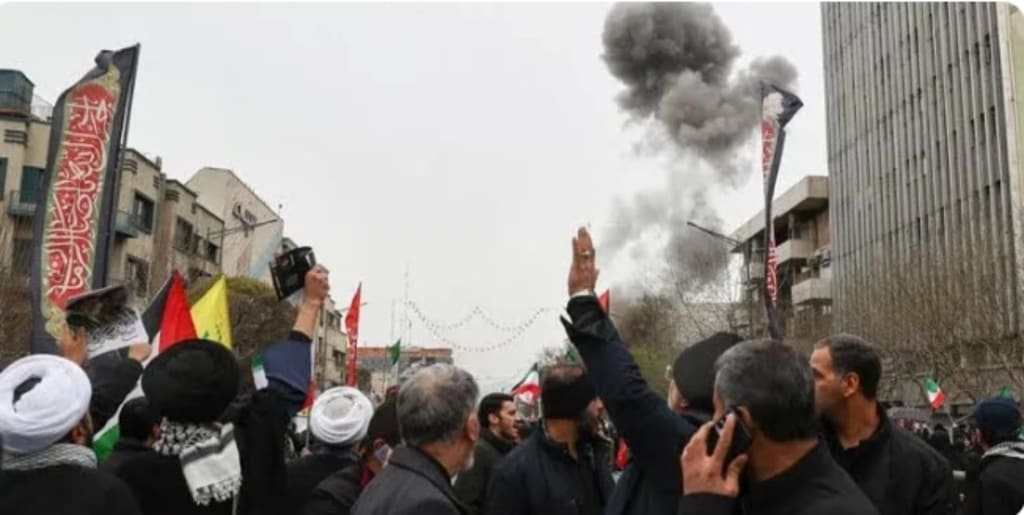
A powerful explosion shook central Tehran during a large state-organized rally, sending shockwaves through a crowd gathered to mark the annual Quds Day demonstration. The blast occurred shortly after Israel issued warnings that it might carry out operations in the area, raising fears that the already escalating conflict between Iran and Israel is increasingly spilling into public spaces.
The rally had drawn thousands of participants, many waving Iranian and Palestinian flags while chanting slogans condemning Israel and the United States. Quds Day, an annual event established after Iran’s 1979 revolution, is traditionally used by the government to demonstrate solidarity with Palestinians and opposition to Israel. This year’s march, however, unfolded under the shadow of war.
A Sudden Blast in a Crowded Square
Witnesses reported that the explosion occurred near a central gathering point where demonstrators had assembled for speeches and marches. Moments before the blast, crowds were chanting and waving banners. Then, according to eyewitness accounts, a loud explosion echoed across the area, followed by a plume of gray smoke rising above the streets.
Panic quickly spread among participants. Some people fled the area while others tried to locate family members in the confusion. Emergency responders and security forces rushed to the scene to control the situation and assess casualties.
Initial reports indicated that at least one person had been killed and several others injured, though authorities warned that the toll could change as more information emerged.
Images circulating on social media showed crowds dispersing while smoke lingered over the protest route. Despite the shock, many participants continued the march, reflecting the strong political symbolism attached to the event.
Israeli Warning Before the Explosion
The blast came shortly after Israel issued an unusual warning regarding potential military operations in central Tehran. The warning suggested that Israeli forces could target locations linked to Iran’s military or government infrastructure in the area.
Although Israel did not immediately confirm responsibility for the explosion, the timing of the warning fueled speculation that the blast might be connected to ongoing military operations. Israeli officials have repeatedly stated that their campaign focuses on weakening Iran’s military capabilities rather than targeting civilians.
The situation highlights the blurred lines that often emerge during modern warfare. Military targets located within densely populated cities can place civilians in harm’s way, especially during large public gatherings.
A Rally Meant to Show Strength
The Tehran rally itself was designed as a show of resilience by Iran’s leadership. In recent weeks, the country has faced intense military pressure following large-scale strikes linked to the widening regional conflict.
Government officials and senior figures attended the demonstrations, which took place not only in Tehran but also in other cities across the country. The rallies were intended to demonstrate national unity and defiance in the face of foreign attacks.
For Iran’s leaders, the symbolism of Quds Day carries particular significance during wartime. The event has historically been used to rally domestic support and reinforce Iran’s stance against Israel.
Despite the explosion and nearby strikes, Iranian state media continued broadcasting images of crowds marching through the streets, chanting slogans and waving flags.
Civilians Caught in the Middle
For ordinary residents of Tehran, however, the explosion added another layer of fear to daily life in a city already under strain from ongoing airstrikes.
In recent weeks, residents have reported frequent blasts, limited internet access, and growing anxiety as attacks hit different parts of the capital. Without air-raid sirens or consistent warning systems, many civilians rely on word of mouth or social media to track potential dangers.
The unpredictability of the strikes has changed daily routines across the city. Schools and businesses have closed in some areas, and many families are choosing to stay indoors unless absolutely necessary.
The explosion during the rally underscored how quickly large public gatherings can become dangerous in a war zone.
Escalating Regional Conflict
The blast in Tehran is part of a broader escalation that began earlier this year when Israel launched major strikes against Iranian targets. The campaign was aimed at weakening Iran’s military infrastructure and leadership amid long-running tensions over regional influence and weapons development.
The operation marked one of the most direct confrontations between the two longtime adversaries. Military strikes have targeted facilities in multiple Iranian cities, including Tehran, while Iran has responded with missile and drone attacks against Israeli and allied positions.
As the conflict intensifies, both sides have expanded their military actions while also waging an information war to shape public perception.
The explosion during the Tehran rally highlights the growing risk that civilian spaces could become entangled in the fighting.
The Symbolism of Quds Day in Wartime
Quds Day demonstrations have long served as a stage for political messaging. Established in 1979 by Iran’s revolutionary leadership, the event is held annually on the last Friday of Ramadan to express support for Palestinians and opposition to Israeli policies.
During times of conflict, the event often takes on heightened importance. Leaders use the rallies to signal resilience, unity, and determination in the face of external threats.
This year’s demonstrations were particularly significant because they occurred during an active war. For many participants, attending the rally was seen as a statement of defiance.
Yet the explosion showed how symbolic gatherings can also become vulnerable when tensions escalate into open conflict.
A City on Edge
In the aftermath of the blast, security forces increased their presence across central Tehran, sealing off certain areas and directing crowds away from the site of the explosion.
Authorities urged citizens to remain calm and promised a full investigation into the incident. At the same time, officials reaffirmed their commitment to continuing the demonstrations despite the attack.
For many residents, however, the event reinforced a troubling reality: the war that once seemed distant has firmly reached the streets of Tehran.
As the conflict between Iran and Israel continues to unfold, moments like the explosion at the rally illustrate how quickly geopolitical tensions can translate into danger for ordinary people.
In a war defined by missiles, airstrikes, and political brinkmanship, the line between military targets and civilian life is becoming increasingly fragile.
About the Creator
Parallel Protests
I haven't written for quite some time, but I have A LOT of thoughts about yesterday's protest rally against our government's involvement and complicity in America's war on Iran, on the harbourside of my home city Bristol, and I need to put them somewhere. My gorgeous girlfriend is always a loving and listening ear and sharing it all with her will always be a healthy and happy way of processing the mental and emotional weight, but getting it straight in my brain to share means writing it all down in straight lines, so, here we are and thanks for being here.
By Steph Cole11 days ago in The Swamp
Judge Rules Kari Lake Unlawfully Ran U.S. Media Agency, Voiding Layoffs
A federal judge has ruled that former Arizona political candidate Kari Lake unlawfully exercised authority over a U.S. government-funded media agency, a decision that has nullified a series of layoffs and triggered renewed debate about leadership and governance in publicly funded international broadcasting.
By Jameel Jamali6 days ago in The Swamp




Comments
There are no comments for this story
Be the first to respond and start the conversation.