
Iranian Missile Strike on Israel’s Beit Shemesh Kills Nine People
A Civilian Tragedy Amid Escalating Iran–Israel–US Conflict
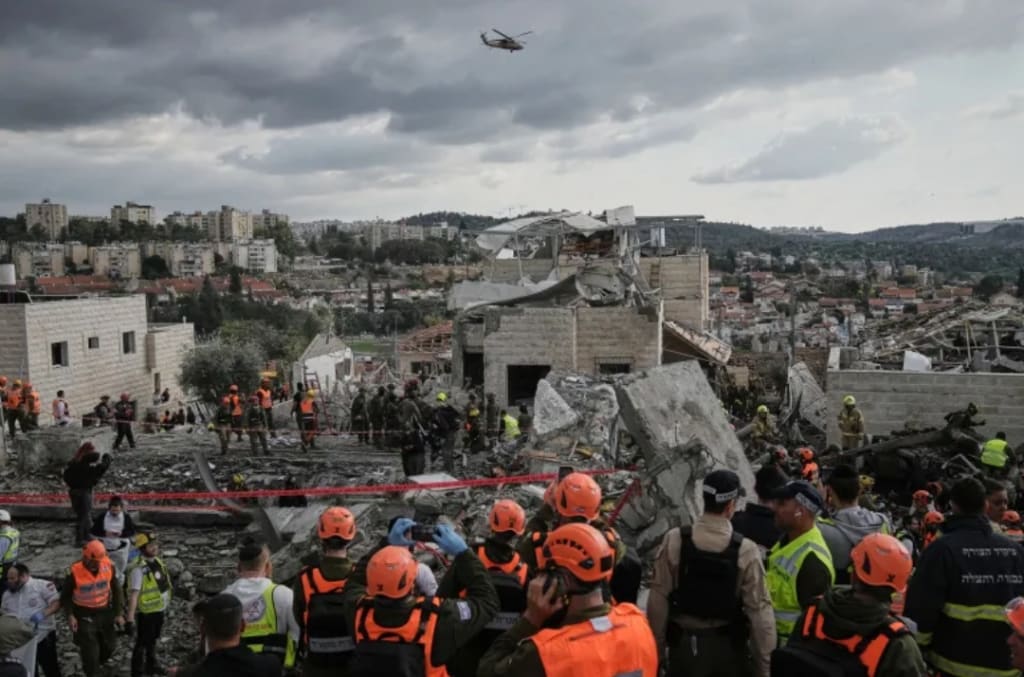
In one of the deadliest single attacks in the widening Middle East confrontation, an Iranian ballistic missile struck the Israeli city of Beit Shemesh on March 1, 2026, killing at least nine people and injuring dozens more. The assault — part of a broader Iranian offensive in retaliation to recent strikes on Iran — has intensified fears of a protracted regional war. �
World Israel News
The Attack on Beit Shemesh
Beit Shemesh, a city of roughly 160,000 people located about 30 km west of Jerusalem, was hit in the afternoon when an Iranian missile penetrated Israel’s air defenses and impacted a residential area, including a bomb shelter where civilians were seeking protection. �
World Israel News +1
Emergency services from Israel’s medical and rescue organizations — including Magen David Adom (MDA), United Hatzalah, and ZAKA — responded immediately. They worked through rubble and collapsed structures to recover bodies, evacuate the injured, and search for those still trapped. �
World Israel News
According to official reports, nine people were killed in the strike and dozens were wounded, including children and adults of all ages. Some of those critically injured were evacuated to hospitals in Jerusalem. �
Jerusalem Post
The missile also caused extensive damage to multiple buildings in the city. In addition to the shelter, apartment buildings and private homes were reported to have been severely damaged or destroyed. �
All Israel News
Why This Attack Was Deadly
Rocket and missile shelters are a central feature of Israeli civilian defense systems, designed to protect residents from incoming fire. However, a direct hit on a shelter — as occurred in Beit Shemesh — can overwhelm even robust protections. Initial investigations suggest that the shelter’s structure was unable to withstand the direct impact of the missile warhead. �
All Israel News
One police official told local media that most of the fatalities, tragically, occurred inside the shelter itself, where many had taken refuge in response to air-raid sirens. �
All Israel News
The Broader Offensive
The strike on Beit Shemesh came during a broader barrage of Iranian missile and drone launches directed at Israel and its allies. Iranian authorities had vowed retaliation following the killing of their Supreme Leader Ayatollah Ali Khamenei in a joint US-Israeli operation, which marked a historic escalation in the conflict. �
Al Jazeera +1
Iran’s military forces reportedly launched hundreds of ballistic missiles and unmanned aerial drones across Israeli airspace, pushing the limits of Israel’s air defenses — including Iron Dome, David’s Sling, and Arrow systems. While most incoming projectiles were intercepted, some penetrated the defense shield and reached populated areas, including Beit Shemesh and regions near Tel Aviv. �
Al Jazeera +1
In Tel Aviv, explosions shook residential neighborhoods and caused additional casualties, although casualties in these areas were reported to be lower than in Beit Shemesh. �
euronews
Civilian Toll and Human Impact
Beyond the nine fatalities, dozens of civilians were injured, with reports suggesting at least 20–28 people wounded in Beit Shemesh alone. Many were treated for varying degrees of injury — from minor wounds to serious trauma requiring hospitalization. �
World Israel News
The psychological impact on local communities has been profound. Residents described chaos and fear as air-raid sirens wailed and explosions rocked the city. Some families reported missing loved ones in the immediate aftermath, while others recounted scenes of frantic rescue efforts. �
Israel National News
Domestic and International Reactions
Israeli officials condemned the Iranian strike as a direct attack on civilians and pledged continued defensive measures. National and local leaders reiterated calls for unity and resilience in the face of sustained Iranian attacks. �
Jerusalem Post
International reactions have varied. Some nations have expressed support for Israel’s right to self-defense, while others have called for an urgent ceasefire and an end to escalating violence that threatens regional stability.
The United States, a close ally of Israel, has continued its strategic support, including military cooperation and diplomatic backing. However, international bodies have also warned of the humanitarian costs should the conflict continue to escalate.
Strategic Significance of Beit Shemesh
Beit Shemesh is strategically located near critical transportation routes and close to Jerusalem, making it symbolically and politically significant. A strike here underscores Iran’s capacity to target locations far beyond Israel’s northern border regions, reaching deeper into central and densely populated areas. �
Jerusalem Post
Iran’s Justification and Escalation
Iran’s government describes its actions as retaliation for foreign strikes on its territory, including the elimination of senior military and political leaders. Tehran asserts that its missile offensives are responses to what it views as acts of aggression by Israel and the United States. �
Reuters
Iranian state media and official statements presented the strikes as a demonstration of capability and resolve, signaling that Tehran can strike critical targets inside Israel in direct response to external military pressure.
Israel’s Defense and Future Risks
Despite Israel’s highly advanced missile defense systems, experts have noted that no defense is perfect, particularly against saturation attacks involving large salvos of missiles and drones. Even with a reported interception rate above 90 %, a small percentage of projectiles reaching ground level can have catastrophic consequences — as seen in Beit Shemesh. �
euronews
The recent attacks have highlighted both the strengths and limits of Israel’s defensive infrastructure, raising new questions about future preparedness and civil protection in the face of intensifying threats.
Humanitarian Concerns and Path Forward
As the conflict continues to unfold, humanitarian concerns grow. Civilians — in both Israel and Iran — have borne a significant toll, with casualties, psychological trauma, and damage to homes and infrastructure. International humanitarian organizations have called for increased protections for non-combatants and renewed diplomatic efforts to halt further escalation.
Many analysts warn that without de-escalation and meaningful dialogue, the cycle of retaliation could deepen, increasing the risk of a wider regional war involving multiple nations and armed groups.
Conclusion
The Iranian missile strike on Beit Shemesh that killed nine civilians marks a tragic and alarming chapter in the expanding conflict between Iran and Israel — with implications for regional stability and global security. As casualties mount and tensions rise, the urgency of diplomatic engagement and a return to restraint has never been clearer.
About the Creator
A Gathering of Evil Bosses
“I’m the queen of chin jutting while I smooth my hair, attacking, insulting, and deflecting to protect my appointer.” “Oh, please, Blondi, my hair is curled, highlighted, and longer than yours. I feature television commercials telling immigrants that we will give them a free plane ride home, and if they voluntarily turn themselves in, they will be allowed to legally apply for re-entry. It runs everywhere, and I look good in it! You can’t compete because of your blond hair. Mine is nicer, and my lips are prettier than yours.”
By Andrea Corwin 13 days ago in The Swamp
Smugglers in Small Boats Turn to Belgium’s Beaches
Belgian Coast Sees Unusual Rise in Migrant Crossings as Smuggling Networks Adapt In a shift that has alarmed authorities in Western Europe, organised smuggling networks are increasingly using Belgium’s North Sea beaches as launch points for small boat crossings targeting the United Kingdom. Traditionally, most small-boat crossings into the Channel have originated from French beaches near Calais and Dunkirk, but recent intelligence from Belgian law enforcement indicates a rise in attempts from Belgian coastal towns such as De Panne, Koksijde and Nieuwpoort. Belgian police and coastal units have recorded at least five confirmed small-boat launch attempts this year – a notable change from the previous year, when no crossings were registered in the Westkust Police zone. These developments point to adaptability among smuggling networks seeking to evade intensified patrols and intervention efforts by French and British authorities. New Routes, New Tactics Officials say the use of Belgian beaches for attempted crossings marks a tactical shift by smuggling gangs. Historically, Belgium’s coastal launch points have been unattractive to organisers due to the longer distance to the UK and stronger tidal currents compared with French routes. But with increased law enforcement pressure in France, some networks have pivoted to secondary routes, effectively dispersing their operations across a wider stretch of coastline. On one recent night near the marina at Nieuwpoort, law enforcement found 15 migrants in possession of a rubber inflatable, a small outboard motor and jerry cans of fuel. Only four of the group had life jackets, underlining the perilous conditions inherent to such attempts. Authorities believe the group intended to reach the UK, reflecting a continued strong draw toward that destination despite rising risk. Westkust Police spokespersons confirmed that atypical launch locations such as Koksijde and Nieuwpoort, which are far from the French border, are now showing smuggling activity previously unseen in official records. “In the past we saw attempts primarily at De Panne,” said Jarne Pollie, a journalist with state broadcaster VRT. “Now we are seeing activity further afield.” Smugglers Respond to Pressure Smuggling networks are known to adapt rapidly in response to enforcement actions. Cross-Channel migrants frequently use so-called “taxi boats” — craft that shuttle groups out to larger dinghies in open water — complicating efforts by police and navies to intercept them close to shore. These tactics, which originated along French coasts, may be filtering across the border into Belgium as organised crime cells adjust their operations to exploit any relative gaps in supervision. According to some analysts, stronger patrols and barriers on French beaches — combined with joint UK-French deterrence strategies — have likely encouraged smugglers to test new launching points. The UK government has allocated £1.3 million to assist Belgian police in bolstering coastal surveillance and preventing smuggling attempts from Belgian territory. Police in Belgium have also installed physical obstacles to make it harder for vehicles carrying small boats to access dunes and beachfront areas where launches might occur. These include reinforced concrete blocks and increased use of night-vision and thermal imaging equipment during patrols. Broader Criminal Networks and Enforcement The evolving picture along Belgium’s coast is part of a larger pattern of transnational smuggling operations that extend well beyond simple beach departures. Several high-profile prosecutions across Europe have underscored the scale of organised crime involvement: in late 2025 a court in Bruges sentenced a Turkish national and several associates to lengthy prison terms for supplying thousands of small boats and outboard motors to smuggling networks servicing Channel crossings. The equipment often moved through Belgium en route to launch sites, highlighting the country’s role as a logistical node in broader smuggling schemes. Border Security Report Further back in 2023, Belgian courts handed significant sentences to 20 suspects tied to a cross-border smuggling ring responsible for moving hundreds of migrants. Such operations have historically exploited Europe’s open borders and interconnected transportation networks to shift migrants from source regions through multiple countries before reaching launch points. Public Safety and Humanitarian Concerns Officials warn that the longer crossing distances from Belgian beaches — combined with overcrowded and ill-equipped craft — pose grave risks to migrants. The English Channel is among the world’s busiest shipping lanes, and small boats lacking effective navigation or safety gear face significant danger from commercial traffic and unpredictable sea conditions. Retired maritime professionals echo these concerns, pointing out that many migrants are forced to wade into the sea to reach waiting craft, increasing the chances of hypothermia, exhaustion and tragedy before the journey even begins. aol.com Outlook Belgian authorities are stepping up cooperation with French, Dutch and UK counterparts to monitor smuggling activity and intercept attempted crossings from the North Sea coast. Law enforcement officials are emphasising intelligence sharing, improved surveillance technologies and continued disruption of organised networks that orchestrate and profit from these hazardous voyages.
By Fiaz Ahmed 2 days ago in The Swamp
Review of 'Man on the Run'
My wife and I saw Man on the Run, a nearly 2-hour documentary on Amazon Prime, about Wings, Paul McCartney's group that flew around the world from shortly after The Beatles broke up in early 1970 to shortly after John Lennon was murdered at the end of 1980, making a Beatles reunion forever impossible.
By Paul Levinson3 days ago in Beat




Comments
There are no comments for this story
Be the first to respond and start the conversation.