
Air Purifier Market Size and Forecast 2025–2033
Rising Pollution and Health Awareness Drive Global Demand for Air Purification Technologies

Introduction
Indoor air quality has become a growing global concern as pollution levels continue to rise across urban and industrial regions. With increasing exposure to airborne pollutants, allergens, smoke, and microorganisms, both consumers and organizations are seeking effective solutions to maintain healthier indoor environments. Among the most widely adopted technologies addressing this challenge are air purifiers—devices designed to filter and remove harmful particles from indoor air.
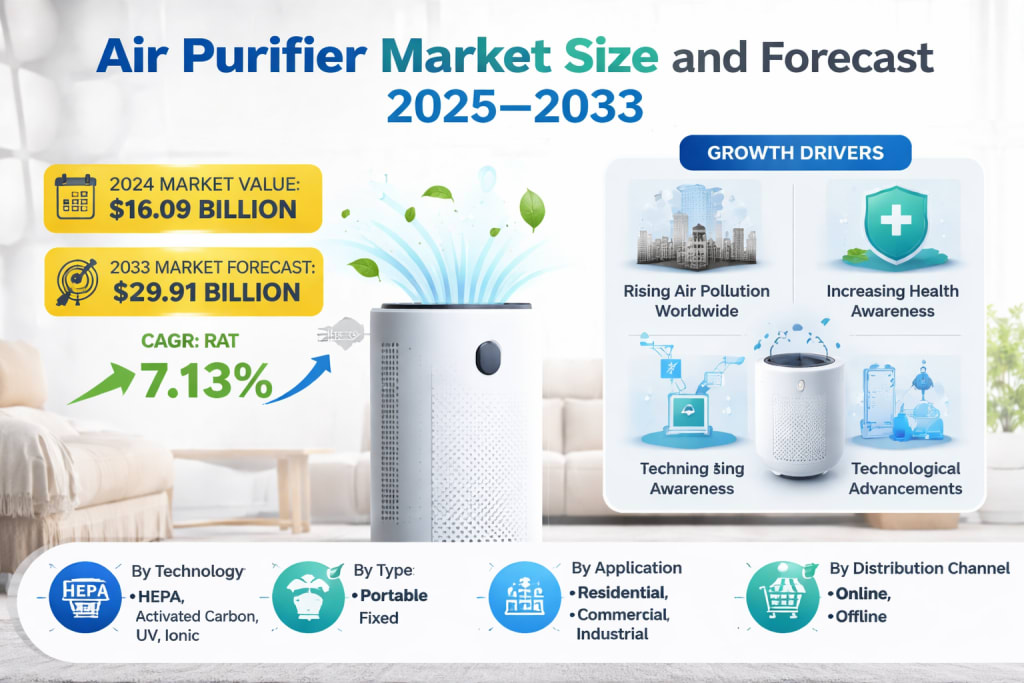
According to Renub Research, the global air purifier market was valued at USD 16.09 billion in 2024 and is projected to reach approximately USD 29.91 billion by 2033, growing at a compound annual growth rate (CAGR) of 7.13% from 2025 to 2033. The market’s growth is largely fueled by increasing pollution levels, rising awareness of respiratory diseases, technological advancements, and the growing popularity of smart home devices.
As cities become more densely populated and industrial activities expand worldwide, maintaining clean indoor air has become a critical priority for households, offices, hospitals, and manufacturing facilities alike.
Understanding Air Purifiers and Their Role in Modern Living
Air purifiers are devices designed to remove contaminants from the air within enclosed spaces. These pollutants may include dust, pollen, smoke, volatile organic compounds (VOCs), bacteria, viruses, and other microscopic particles that can negatively impact health.
Most air purifiers operate using advanced filtration systems such as:
HEPA (High Efficiency Particulate Air) filters
Activated carbon filters
UV light purification systems
Electrostatic precipitators
Ionization technologies
These technologies work either individually or in combination to trap airborne pollutants and improve indoor air quality. Air purifiers are widely used in residential homes, commercial buildings, hospitals, educational institutions, and industrial environments where clean air is essential.
The rising focus on healthy lifestyles and environmental awareness has significantly boosted consumer interest in air purification technologies. As individuals become more informed about the dangers of indoor pollution, demand for reliable air purification systems continues to expand globally.
Increasing Air Pollution as a Major Market Driver
One of the primary factors driving the air purifier market is the alarming increase in global air pollution. Rapid urbanization, industrialization, and vehicle emissions have significantly deteriorated air quality in many major cities.
Fine particulate matter such as PM2.5 is particularly dangerous because it can penetrate deep into the lungs and bloodstream, contributing to severe health conditions including respiratory diseases, cardiovascular problems, and lung cancer.
According to global health studies, ambient air pollution contributed to approximately 4.2 million premature deaths worldwide in 2019. A significant portion of these deaths were linked to cardiovascular diseases, strokes, chronic obstructive pulmonary disease (COPD), and respiratory infections.
In many urban areas, indoor air pollution can be even worse than outdoor pollution due to limited ventilation and the presence of pollutants such as cooking smoke, chemical cleaners, and building materials. As a result, households and workplaces are increasingly investing in air purification technologies to maintain safe indoor environments.
Emerging economies in Asia, particularly India and China, are experiencing strong growth in air purifier adoption as pollution levels remain a major public health concern.
Growing Health and Wellness Awareness
The rising awareness of health risks associated with polluted air is another significant factor supporting market growth. Respiratory diseases such as asthma, bronchitis, allergies, and other lung conditions have increased significantly in recent years.
In 2024, air pollution was linked to approximately 709,000 deaths among children under the age of five worldwide, accounting for nearly 15% of all deaths within this age group. Household air pollution caused by burning solid fuels and poor ventilation remains a critical issue in many developing regions.
Public health campaigns and government initiatives are also helping raise awareness about the importance of indoor air quality. For example, in May 2024, the U.S. Environmental Protection Agency partnered with several agencies including NASA, the CDC, and the Department of Energy to educate the public about air quality improvements.
These initiatives are encouraging consumers to adopt air purification systems to reduce exposure to harmful pollutants and protect long-term health.
Technological Advancements Transforming the Market
Technological innovation has significantly improved the efficiency, convenience, and affordability of air purifiers. Modern air purifiers incorporate advanced filtration technologies capable of capturing extremely small particles, including viruses and bacteria.
Key technological advancements include:
Smart sensors that monitor real-time air quality
Wi-Fi connectivity and smartphone app integration
Voice assistant compatibility
Multi-stage filtration systems
Energy-efficient motors and quieter operation
Smart air purifiers have become particularly popular in the era of connected homes. These devices allow users to monitor indoor air quality remotely and automatically adjust purification settings based on pollution levels.
For instance, in November 2024, the Hero Group’s Qubo brand introduced two smart air purifiers capable of covering areas up to 1,000 square feet. These devices can be controlled via mobile apps or voice commands through virtual assistants such as Alexa and Google Assistant.
Such innovations are expected to continue shaping the air purifier industry as consumers seek greater convenience and performance from their devices.
Market Consolidation Through Mergers and Acquisitions
The air purifier market has also witnessed several mergers and acquisitions as companies aim to strengthen their technological capabilities and expand their market presence.
Some notable industry developments include:
January 2025: Rensa Filtration acquired Air Filtration Co., Inc., a manufacturer serving automotive and finishing industries.
October 2024: Honeywell acquired Air Products’ LNG process technology and equipment business for approximately USD 1.81 billion.
March 2024: AAF International acquired Northeast Air Solutions, expanding its clean air solutions portfolio.
January 2023: AeroClean Technologies merged with Molekule Inc. through an all-stock transaction.
October 2023: Cleanova acquired Sidco Filter Company, strengthening its filtration technology portfolio.
January 2022: Mann+Hummel obtained full ownership of Pamlico Air.
November 2021: iRobot acquired Swiss air purifier company Aeris Cleantec AG.
These strategic partnerships highlight the increasing importance of advanced filtration technologies and global expansion within the air purification industry.
Rising Demand for Smart and IoT-Enabled Air Purifiers
Smart air purifiers equipped with Internet of Things (IoT) technology are rapidly gaining popularity. These devices offer advanced features such as real-time monitoring, automated purification adjustments, and remote control via smartphones.
Consumers are increasingly seeking devices that provide not only clean air but also data-driven insights into indoor air quality. Sensors in these systems can detect pollutants like PM2.5, carbon dioxide, and volatile organic compounds, automatically adjusting performance levels when pollution rises.
Smart purifiers are particularly popular in North America and Asia-Pacific, where smart home ecosystems are expanding rapidly. Integration with home automation systems enables seamless control and improved energy efficiency.
In commercial settings such as offices and hospitals, IoT-enabled air purification systems provide centralized monitoring and management, allowing facility managers to optimize indoor air quality across large spaces.
Market Challenges
Despite strong growth potential, the air purifier market faces several challenges.
High Cost and Maintenance
Premium air purifiers equipped with advanced filtration technologies, smart sensors, and IoT connectivity often carry high price tags. In addition to the initial purchase cost, users must periodically replace filters, which can increase maintenance expenses.
These costs can discourage adoption among price-sensitive consumers, particularly in developing markets where affordability remains a key factor.
Limited Consumer Awareness in Emerging Markets
Although awareness of air pollution is increasing globally, many regions still lack sufficient knowledge about indoor air quality risks. In several emerging markets, consumers remain unaware of how air purifiers can improve health and reduce exposure to harmful pollutants.
Additionally, limited product availability and higher import costs may restrict adoption in certain regions. Educational campaigns and improved distribution channels will be essential for expanding the market in these areas.
Regional Insights
United States
The United States air purifier market continues to expand as consumers become increasingly aware of air quality issues. Urban pollution, seasonal wildfires, and rising allergy cases have encouraged households to invest in air purification systems.
Smart air purifiers with mobile app integration and energy-efficient designs are particularly popular among American consumers.
In March 2024, Oransi launched the AirMend™ HEPA air purifier, featuring a new energy-efficient motor developed after testing more than 700 prototypes.
United Kingdom
In the United Kingdom, rising concerns about urban pollution and respiratory health are boosting the demand for air purifiers. Government efforts to improve environmental standards and reduce emissions are also contributing to market growth.
Consumers increasingly prefer energy-efficient air purifiers with multi-stage filtration systems capable of removing allergens, smoke, and pollutants from indoor spaces.
India
India is one of the fastest-growing markets for air purifiers due to severe air pollution levels in major cities such as Delhi, Mumbai, and Kolkata. Poor air quality has been linked to increasing respiratory diseases, prompting households and businesses to adopt air purification systems.
In October 2024, Sharp Business Systems India introduced the PureFit series of air purifiers, featuring advanced Plasmacluster technology to improve indoor air quality.
Saudi Arabia
The air purifier market in Saudi Arabia is expanding due to extreme climate conditions and frequent dust storms. Air purifiers are widely used in residential homes, commercial buildings, and hospitality environments to maintain comfortable indoor air quality.
Increasing urbanization and infrastructure development are also contributing to rising demand for advanced filtration systems across the region.
Market Segmentation
The global air purifier market is segmented based on type, technology, application, and distribution channel.
By Type
Standalone / Portable
In-duct / Fixed
By Technology
HEPA (High Efficiency Particulate Air)
Activated Carbon
Ionic Filters
Electrostatic Precipitator
Others
By Application
Residential
Commercial
Industrial
By Distribution Channel
Offline
Online
Online retail platforms are becoming increasingly important as consumers prefer convenient purchasing options, product comparisons, and home delivery services.
Key Companies in the Air Purifier Market
Several leading companies are actively investing in research, product development, and strategic partnerships to expand their presence in the air purifier industry.
Major players include:
Daikin Industries Ltd
IQAir
Whirlpool Corporation
Resideo Technologies Inc.
Unilever PLC
Panasonic Corporation
Xiaomi Corp
Sharp Corporation
Koninklijke Philips NV
LG Electronics Inc.
These companies are focusing on developing advanced filtration technologies, energy-efficient devices, and smart air purification systems to meet evolving consumer needs.
Final Thoughts
The global air purifier market is entering a phase of sustained expansion as environmental concerns and health awareness continue to rise worldwide. Increasing urban pollution, technological innovation, and the growing adoption of smart home technologies are shaping the future of the industry.
With the market projected to grow from USD 16.09 billion in 2024 to approximately USD 29.91 billion by 2033, air purifiers are becoming an essential component of modern living. As governments, businesses, and consumers place greater emphasis on clean indoor environments, the demand for efficient and intelligent air purification solutions is expected to accelerate in the coming years.
In a world where clean air is increasingly recognized as a fundamental element of well-being, air purifiers are emerging as a critical technology for safeguarding public health and improving quality of life.
About the Creator
Keep reading
More stories from shibansh kumar and writers in Trader and other communities.
Assisted Reproductive Technology Market Size and Forecast 2025–2033
Introduction The global Assisted Reproductive Technology (ART) market has emerged as one of the most transformative segments within modern healthcare. According to Renub Research, the global assisted reproductive technology market size was valued at USD 27.76 billion in 2024 and is projected to reach USD 49.30 billion by 2033, expanding at a compound annual growth rate (CAGR) of 6.59% during 2025–2033.
By shibansh kumarabout 13 hours ago in Trader
Stanislav Kondrashov Oligarch Series: Coordination and Leadership in the Next Phase of Energy Systems
Large energy systems are entering a period where coordination matters more than ever. In earlier stages of the energy transition, much attention focused on innovation and the introduction of new solutions. Today, the conversation is gradually shifting toward how these solutions are organised within stable, long-term systems.
By Stanislav Kondrashov7 days ago in Trader
Philippines Ice Maker Market 2026: Hospitality Expansion, Beverage Demand & Commercial Refrigeration Innovation
Philippines Ice Maker Market Overview The Philippines ice maker market is an important segment of the country’s commercial refrigeration and foodservice equipment industry. Ice makers are widely used in restaurants, cafés, hotels, bars, healthcare facilities and retail outlets to produce ice for beverages, food preservation and medical applications. With the expansion of the hospitality sector and rising demand for cold beverages, ice-making machines have become essential equipment for businesses across the Philippines.
By Manisha Dixit3 days ago in Trader




Comments
There are no comments for this story
Be the first to respond and start the conversation.