
Balloon Catheter Market Size & Forecast 2026–2034
Rising Cardiovascular Burden and Minimally Invasive Innovations Propel Global Growth

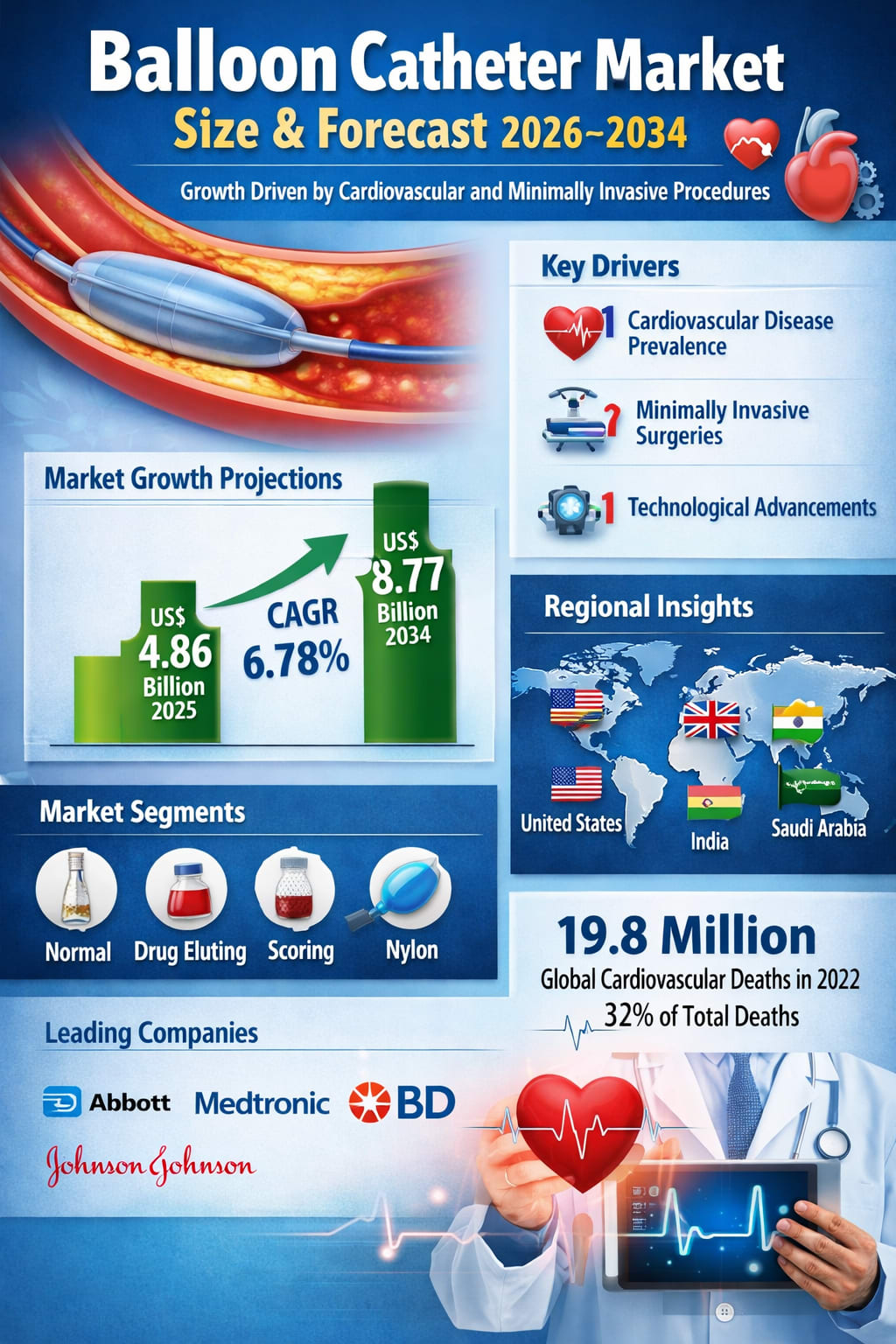
The global Balloon Catheter Market is entering a transformative growth phase, fueled by the rising incidence of cardiovascular and urological diseases, rapid expansion of minimally invasive surgical procedures, and continuous technological innovation. According to Renub Research, the market was valued at US$ 4.86 billion in 2025 and is projected to reach US$ 8.77 billion by 2034, expanding at a CAGR of 6.78% during 2026–2034.
As healthcare systems worldwide prioritize patient safety, faster recovery, and cost-efficient treatment solutions, balloon catheter technologies are increasingly becoming central to modern interventional procedures.
Balloon Catheter Market Outlook
A balloon catheter is a flexible medical device equipped with an inflatable balloon near its tip. It is designed to widen narrowed or blocked body passageways such as arteries, ureters, bile ducts, and other vascular structures. By inflating the balloon at the precise location of blockage, physicians can restore normal blood flow or open obstructed ducts with high accuracy.
Balloon catheters are widely used in:
Interventional cardiology
Peripheral vascular procedures
Urology
Gastroenterology
Gynecology
Their popularity has surged due to the increasing acceptance of minimally invasive techniques. These procedures typically result in:
Shorter hospital stays
Reduced risk of complications
Faster recovery times
Lower overall treatment costs
Additionally, technological innovations such as drug-coated balloons, high-pressure balloon systems, scoring balloons, and improved shaft designs have enhanced safety and clinical outcomes. Expanding healthcare infrastructure in emerging economies further strengthens global adoption.
Growth Drivers of the Balloon Catheter Market
1. Rising Prevalence of Cardiovascular and Peripheral Vascular Diseases
Cardiovascular diseases (CVDs) remain the leading cause of death globally. Factors such as aging populations, sedentary lifestyles, obesity, diabetes, and hypertension are contributing to the increasing incidence of coronary artery disease (CAD), peripheral artery disease (PAD), and renal artery stenosis.
In 2022, approximately 19.8 million people died from cardiovascular diseases, accounting for nearly 32% of all global deaths, with 85% of those deaths resulting from heart attacks and strokes.
Balloon catheters are essential in angioplasty procedures, where they help restore blood flow in blocked or narrowed vessels. As awareness about early intervention and preventive cardiology increases, procedural volumes continue to rise, driving demand across hospitals and specialty clinics.
2. Shift Toward Minimally Invasive and Outpatient Procedures
The global healthcare ecosystem is rapidly shifting toward minimally invasive techniques. Compared to open-heart surgery, balloon catheter-based angioplasty:
Reduces surgical trauma
Minimizes complications
Shortens recovery time
Lowers hospitalization costs
Hospitals and ambulatory surgical centers are increasingly performing balloon-based interventions on an outpatient basis. This trend aligns with cost-containment strategies adopted by healthcare systems worldwide.
In January 2024, Arthrex introduced TheNanoExperience.com to highlight nano arthroscopy advancements, reinforcing the broader trend toward minimally invasive innovation across medical specialties.
3. Technological Advancements and Product Innovation
Continuous research and development efforts have significantly improved balloon catheter design and functionality. Key innovations include:
Drug-eluting balloons
High-pressure non-compliant balloons
Semi-compliant materials
Nylon-based high-strength balloons
Scoring and cutting balloon technologies
Enhanced shaft and tip control mechanisms
In May 2025, Boston Scientific Corporation received CE Mark and FDA approval for its NC Quantum Apex PTCA Dilatation Balloon Catheter, reflecting rapid regulatory acceptance of next-generation devices.
Such technological enhancements improve precision, durability, burst resistance, and procedural success rates—fueling long-term market expansion.
Challenges Facing the Balloon Catheter Industry
Procedural Risks and Device-Related Complications
Despite technological progress, balloon catheter procedures are not risk-free. Potential complications include:
Vessel dissection
Vessel rupture
Restenosis
Balloon rupture
Improper dilation
Complex cases involving heavily calcified lesions require careful device selection. Inappropriate catheter choice or operator error can impact outcomes, posing a challenge for manufacturers and healthcare providers alike.
Pricing Pressure and Reimbursement Constraints
The balloon catheter industry faces strong pricing pressures due to:
Intense market competition
Cost containment policies
Budget limitations in public healthcare systems
Reimbursement variability across regions
Advanced devices, especially drug-coated and scoring balloons, are often more expensive. In regions with restrictive reimbursement frameworks, adoption of premium technologies may be limited.
Market Segment Insights
Normal Balloon Catheter Market
Normal balloon catheters represent the most widely used segment in interventional cardiology and peripheral procedures. Their advantages include:
Cost-effectiveness
Simplicity of design
Broad clinical applicability
They are commonly used in coronary, peripheral, and renal interventions. As cardiovascular disease prevalence rises, this segment continues to generate steady revenue globally.
Scoring Balloon Catheter Market
Scoring balloon catheters are designed with specialized scoring elements or wires that create controlled incisions in plaque during balloon inflation. This allows:
Predictable vessel expansion
Reduced balloon slippage
Enhanced treatment of calcified lesions
With growing demand for precision in complex interventions, scoring balloon adoption is increasing among interventional cardiologists.
Coronary Artery Disease Segment
The Coronary Artery Disease (CAD) segment remains a dominant indication area. Balloon catheters play a critical role in percutaneous coronary intervention (PCI), especially prior to stent placement.
Given the continued global burden of CAD and aging populations, this segment will remain a key revenue contributor during the forecast period.
Nylon Balloon Catheter Market
Nylon-based balloon catheters offer:
High burst pressure
Greater strength
Controlled dilation
Their superior mechanical properties make them suitable for demanding interventional procedures. Manufacturers increasingly prefer nylon for high-performance applications, ensuring strong growth prospects.
Clinics and Ambulatory Centers
The growing shift toward outpatient procedures has boosted demand in:
Clinics
Ambulatory Surgical Centers (ASCs)
Diagnostic centers
Shorter recovery times and cost advantages make balloon catheter procedures ideal for non-hospital settings, expanding the end-user landscape.
Regional Market Analysis
United States
The United States remains the largest market globally, driven by:
High cardiovascular disease prevalence
Advanced healthcare infrastructure
Strong reimbursement frameworks
Rapid adoption of new technologies
In October 2025, Cagent Vascular launched the Serranator PTA Serration Balloon Catheter in larger diameters, expanding treatment options for peripheral vessel diseases.
The country’s focus on reducing cardiovascular mortality continues to support sustained demand.
United Kingdom
The UK market is driven by:
NHS-led minimally invasive initiatives
Aging population
High angioplasty procedure volumes
In September 2024, CERENOVUS announced commercialization of EMBOGUARD balloon technology for endovascular treatments, including stroke care.
While cost-control measures remain strict, continued investments in medical innovation support long-term growth.
India
India’s balloon catheter market is expanding due to:
Increasing cardiovascular disease cases
Rapid growth in private hospitals
Expanding cardiology expertise
Medical tourism growth
In January 2025, Kossel Medtech launched Selethru® PTCA and Selethru® NC PTCA balloon dilatation catheters approved by CDSCO.
With expanding healthcare infrastructure and growing awareness, India represents a strong emerging opportunity market.
Saudi Arabia
Saudi Arabia’s market growth is supported by:
Rising cardiovascular disease burden
Vision 2030 healthcare reforms
Expansion of specialized cardiac centers
Government screening programs
In March 2024, the Saudi Ministry of Health launched a national cardiovascular screening initiative aimed at early detection of arterial blockages.
Government-led modernization efforts are expected to strengthen the Middle East & Africa region’s growth trajectory.
Competitive Landscape
The Balloon Catheter Market is moderately consolidated, with leading companies competing through innovation, regulatory approvals, strategic partnerships, and geographic expansion.
Key players include:
Abbott Laboratories
Becton Dickinson and Company
Cardinal Health
Teleflex Incorporated
Medtronic Plc.
Johnson and Johnson
Edwards Lifesciences Corporation
Stryker Corporation
Smith & Nephew
Each company is evaluated based on:
Corporate overview
Key leadership
Recent developments
SWOT analysis
Revenue performance
Competitive positioning
Technological differentiation and strategic expansion into emerging markets remain central competitive strategies.
Market Segmentation Overview
By Product Type:
Normal, Drug Eluting, Cutting, Scoring, Stent Graft, Others
By Indication:
Coronary Artery Disease, Peripheral Vascular Disease
By Raw Material:
Polyurethane, Nylon, Others
By End-User:
Hospitals, Clinics, Ambulatory Surgical Centers, Diagnostic Centers
By Region:
North America, Europe, Asia Pacific, Latin America, Middle East & Africa
Final Thoughts
The Balloon Catheter Market stands at the intersection of innovation, necessity, and evolving healthcare priorities. With cardiovascular diseases continuing to exert immense pressure on global healthcare systems, balloon catheter technologies remain indispensable in interventional medicine.
The projected rise from US$ 4.86 billion in 2025 to US$ 8.77 billion by 2034, at a CAGR of 6.78%, underscores sustained structural growth. Technological advancement, rising procedural volumes, and expanding healthcare infrastructure in emerging markets will remain the primary growth catalysts.
While challenges such as pricing pressures and procedural risks persist, ongoing innovation and regulatory support are expected to mitigate these concerns. As healthcare continues its transition toward minimally invasive and outpatient-based care models, balloon catheters will play an increasingly vital role in shaping the future of cardiovascular and vascular treatment worldwide.
About the Creator
United States Ice Cream Market Size and Forecast 2026–2034
The United States ice cream industry continues to hold a special place in the nation’s food culture. From family celebrations to summer road trips and late-night indulgences, ice cream is more than just a dessert—it is an experience deeply woven into American lifestyles. According to Renub Research, the United States Ice Cream Market is projected to grow from US$ 12.94 Billion in 2025 to US$ 17.96 Billion by 2034, registering a Compound Annual Growth Rate (CAGR) of 3.71% from 2026 to 2034.
By Sakshi Sharmaabout 3 hours ago in Trader
BSE Sensex – Market Trends, Insights, and Investment Strategies
BSE Sensex: India’s Key Market Indicator The BSE Sensex is India’s leading stock market index, representing 30 of the country’s largest and most financially stable companies listed on the Bombay Stock Exchange. For investors, traders, and market analysts, the Sensex is a critical tool to gauge market performance and understand economic sentiment.
By Hammad Nawaz3 days ago in Trader



Comments
There are no comments for this story
Be the first to respond and start the conversation.