
China Baby Food Market Size and Forecast 2026–2034
Rising Nutrition Awareness and Premiumization Drive China’s Baby Food Industry Toward US$ 36.15 Billion by 2034

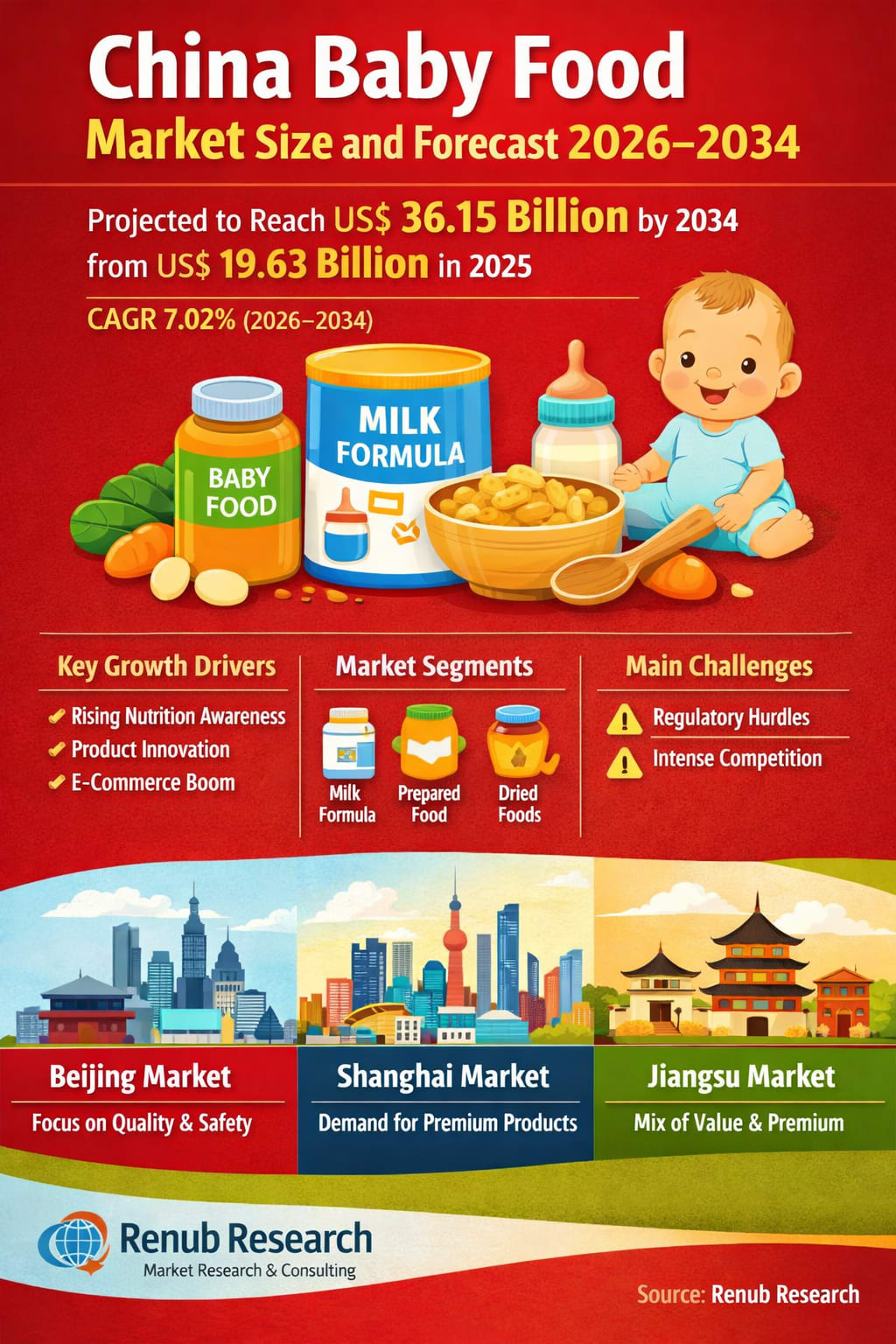
The China Baby Food Market is entering a transformative growth phase, supported by rising disposable incomes, rapid urbanization, and heightened awareness of infant nutrition. According to Renub Research, the market is projected to grow from US$ 19.63 billion in 2025 to US$ 36.15 billion by 2034, expanding at a CAGR of 7.02% from 2026 to 2034.
This growth trajectory reflects changing parental preferences, stronger regulatory oversight, and expanding distribution channels. From fortified milk formula to ready-to-eat purees and dried cereals, China’s baby food industry is increasingly defined by quality, safety, and innovation.
China Baby Food Industry Overview
Baby food includes specially formulated products designed for infants and toddlers, typically from birth to three years of age. These products include milk formula, prepared purees, cereals, dried snacks, and fortified options enriched with proteins, vitamins, minerals, DHA, probiotics, and other essential nutrients.
In China, infant nutrition has become a central concern for modern families. Parents are increasingly informed about developmental milestones and the role of balanced diets in cognitive development, immune support, and physical growth. As a result, demand for premium, safe, and nutritionally advanced baby food products continues to rise.
The market is supported by:
Increasing dual-income households
Growing middle-class population
Expanding e-commerce ecosystem
Strict government food safety regulations
Preference for branded and fortified products
Convenience and safety remain primary decision factors, especially in urban centers.
Growth Drivers of the China Baby Food Market
1. Rising Awareness of Infant Nutrition
Parental awareness regarding early-life nutrition is at an all-time high. Chinese caregivers are prioritizing products enriched with DHA, probiotics, iron, calcium, and essential vitamins to support brain development and immune health.
Scientific research and pediatric recommendations have encouraged the shift toward fortified formulas and functional baby foods. Enhanced labeling transparency and government-certified quality standards further increase consumer trust.
Urbanization and higher disposable incomes allow families to prioritize quality over price, boosting demand for premium baby food brands.
2. Product Innovation and Fortification
Innovation remains central to market expansion. Manufacturers are introducing:
HMO-enriched milk formulas
Organic and allergen-free purees
High-protein cereals
Probiotic-fortified dried snacks
Stage-specific nutritional blends
Convenience-focused packaging such as resealable pouches and single-serve packs supports busy urban lifestyles.
In June 2025, Nestlé’s Gerber brand launched its first HMO-fortified infant cereal in China, while Wyeth Nutrition introduced a locally produced HMO growing-up formula in 2023. These developments highlight the increasing scientific sophistication of the market.
3. Growth of E-Commerce and Specialty Retail
China’s advanced digital ecosystem significantly contributes to baby food sales. Online platforms offer:
Broader product selection
Access to imported brands
Subscription-based purchasing
Consumer reviews and educational content
Specialized mother-and-baby stores also play a vital role by offering curated product lines and nutritional guidance.
The combination of digital accessibility and offline credibility is expanding market reach across Tier-1, Tier-2, and emerging urban cities.
Challenges in the China Baby Food Market
1. Stringent Regulatory Environment
China maintains strict food safety regulations, particularly in the infant nutrition category. Manufacturers must comply with:
Nutritional content standards
Labeling requirements
Regular inspections
Import verification procedures
While these regulations strengthen consumer confidence, they increase operational costs and limit entry for smaller brands.
2. Intense Competition and Price Sensitivity
The market is highly competitive, with strong domestic players competing against international brands. While Tier-1 cities show strong demand for premium imports, Tier-2 and Tier-3 cities remain price-sensitive.
Companies must balance affordability with quality, continuously innovate, and invest in brand trust to maintain competitive advantage.
Product Segment Analysis
China Prepared Baby Food Market
Prepared baby foods, including ready-to-eat purees and snacks, are growing rapidly. Urban parents prefer convenient options that reduce preparation time while ensuring balanced nutrition.
Fortified, organic, and allergen-free products are gaining popularity. Packaging innovation further supports portability and ease of use.
As complementary feeding awareness grows, prepared baby food demand continues to strengthen.
China Dried Baby Food Market
Dried baby foods such as cereals and dehydrated snacks benefit from:
Long shelf life
Easy storage
Nutritional fortification
Manufacturers increasingly add probiotics, vitamins, and minerals to enhance product appeal. Imported dried foods maintain a premium perception among urban consumers.
The segment continues expanding due to practicality and balanced nutrition offerings.
China Milk Formula Market
Milk formula remains the largest and most competitive segment in China’s baby food market. Parents prioritize safety, scientific formulation, and brand reputation when selecting infant formula.
Products fortified with DHA, probiotics, and HMOs are particularly popular. Specialty formulas addressing sensitive digestion and premature infants also create growth opportunities.
Stronger safety regulations have restored consumer confidence in domestic brands while sustaining demand for premium imported formulas.
Distribution Channel Insights
Specialized Baby Food Stores
Specialized stores provide curated selections, expert advice, and assurance of authenticity. These outlets often stock premium and imported brands.
Loyalty programs and subscription models encourage repeat purchases, making this channel highly influential in urban markets.
E-Commerce
E-commerce remains a dominant force, enabling easy access to diverse product ranges. Online platforms offer transparency, user reviews, and direct brand engagement, particularly appealing to tech-savvy millennial parents.
Regional Market Insights
Beijing Baby Food Market
Beijing’s consumers emphasize quality, traceability, and regulatory compliance. Organic and additive-free products see strong demand. Ready-to-eat and development-stage products are particularly popular among working parents.
Shanghai Baby Food Market
Shanghai’s cosmopolitan population embraces global feeding trends. Parents prioritize ingredient purity, innovative blends, and functional nutrition. Premium imported brands perform strongly in this market.
Jiangsu Baby Food Market
Jiangsu reflects a mix of premium and value-driven consumption. Urban centers show increasing demand for fortified and organic products, while broader regions prioritize affordability and reliability.
Competitive Landscape
Key companies shaping the China baby food market include:
China Feihe Limited
China Mengniu Dairy Company Limited
Health and Happiness (H & H) International Holding Limited
Yashili International Holdings Ltd
China Modern Dairy Holdings Limited
The a2 Milk Company
These companies compete across product innovation, safety standards, brand trust, and distribution expansion. SWOT analysis, revenue growth, leadership strategies, and recent product developments define their competitive positioning.
Market Segmentation
By Product
Prepared Baby Food
Dried Baby Food
Milk Formula
Others
By Distribution
Specialized Stores
E-commerce
Supermarkets
By Cities
Beijing
Shanghai
Jiangsu
Fujian
Zhejiang
Tianjin
Guangdong
Inner Mongolia
Hubei
Chongqing
Rest of China
Future Outlook
The China baby food market is positioned for sustained growth through 2034. Key future trends include:
Expansion of HMO-fortified and functional nutrition products
Greater adoption of organic and clean-label formulations
Increased digital subscription models
Scientific stage-based nutrition solutions
Strengthening domestic brand innovation
With projected growth from US$ 19.63 billion in 2025 to US$ 36.15 billion by 2034, the market demonstrates strong resilience and adaptability.
Final Thoughts
China’s baby food industry reflects the country’s broader economic and social transformation. As incomes rise and parents become more informed, demand shifts toward premium, fortified, and safe infant nutrition products.
While regulatory complexity and competition remain challenges, innovation, digital accessibility, and growing consumer trust are accelerating expansion. Milk formula continues to dominate, but prepared and dried baby food segments are gaining momentum.
By 2034, China’s baby food market will not only be larger but also more sophisticated, science-driven, and consumer-focused — reinforcing its role as one of the most dynamic segments in the global FMCG landscape.
About the Creator
Mexico In-Vitro Diagnostics Market is Expected to Grow USD 3.6 Billion by 2034 | At CAGR 5.07%
Mexico In-Vitro Diagnostics Market Overview The Mexico In-Vitro Diagnostics (IVD) Market is witnessing steady expansion, driven by the rising burden of chronic diseases, increasing healthcare awareness, and improvements in medical infrastructure. In-vitro diagnostics play a crucial role in disease detection, monitoring, and preventive healthcare by enabling accurate laboratory testing of blood, tissues, and other biological samples.
By Kim Soo hyun6 days ago in Trader
I wanted to title this something different, but worried that my chosen title might cause problems entering the United States in the future so this is the new title. It's the greatest title. No one has ever written a title better than this. (All titles unrelated to content).
Let me be honest. I am finding this difficult. Now, I like a challenge, a stretch, a bit of an obstacle course. “Write about the decline of the British Empire in the form of a narrative poem in which your protagonist is an artichoke” I read, and flex my fingers. “Write a haiku to evoke the sensation of sibilance using only the first half of the alphabet.” “Well”, I think to myself, “this should be fun.” But “write about a system that isn’t working”? A system that isn’t working? Now? In 2026? ONE system? My favourite system that isn’t working? The sexiest system that isn’t working? The one giving me the most angst day to day? The one giving me the most existential dread? I am, as I say, finding this difficult. I will own that I have contemplated writing a thousand words on why the steady “all on” setting on my fairy lights is the EIGHTH of seven options which must be sequentially activated to get there, because that is a system that some fool came up with and it definitely doesn’t work, and now who is paying the price, eh? But how can I write about my fairy lights when…. When…. When….
By Hannah Moore5 days ago in Humans



Comments
There are no comments for this story
Be the first to respond and start the conversation.