
Clinical Trial Supplies Market Size & Forecast 2026–2034
Rising Global Research Activity and Supply Chain Innovation to Drive Market Toward US$ 5.37 Billion by 2034

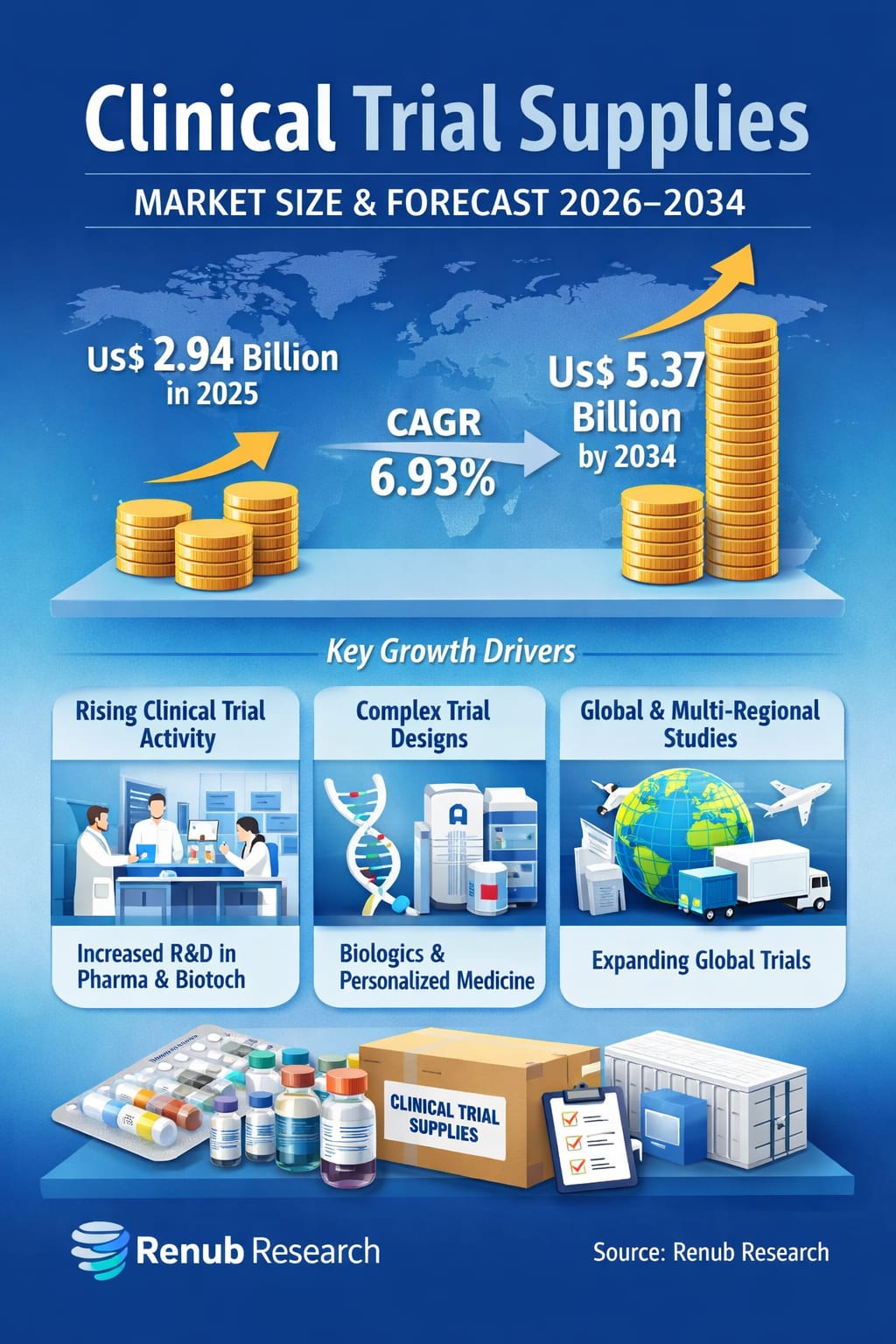
The global Clinical Trial Supplies Market is entering a transformative decade. According to Renub Research, the market is projected to grow from US$ 2.94 billion in 2025 to US$ 5.37 billion by 2034, expanding at a CAGR of 6.93% during 2026–2034.
This sustained growth reflects an evolving global drug development landscape characterized by rising clinical trial activity, increasing biologics research, complex multinational studies, and heightened regulatory scrutiny. As pharmaceutical, biotechnology, and medical device companies expand pipelines and pursue personalized medicine, the demand for specialized, efficient, and compliant clinical trial supply solutions is accelerating worldwide.
Clinical trial supplies have become more than just operational support—they are now a strategic pillar of modern clinical development.
Clinical Trial Supplies Market Outlook
Clinical trial supplies encompass all products and services required to conduct clinical research safely, efficiently, and in compliance with global regulatory frameworks. These include:
Investigational Medicinal Products (IMPs)
Comparator drugs
Placebos
Packaging and labeling materials
Ancillary supplies such as injectables and diagnostic kits
Storage, distribution, and returns management services
Effective supply management ensures that the right product reaches the right clinical site at the right time—while maintaining product integrity, patient safety, trial blindness, and regulatory compliance.
Over the past decade, clinical research has expanded rapidly across pharmaceuticals, biotechnology, and medical devices. The rise of biologics, cell and gene therapies, and precision medicine has introduced additional layers of complexity. These therapies often require specialized cold-chain logistics, smaller batch production, and highly controlled handling environments.
Furthermore, globalization of clinical trials—where studies are conducted across multiple countries and continents—has significantly increased reliance on professional supply chain partners. Regulatory standards differ by geography, import/export rules vary, and temperature-sensitive products must be handled seamlessly across borders.
As decentralized and adaptive trial models gain popularity, supply chain responsiveness and digital visibility are becoming critical differentiators in the competitive landscape.
Growth Drivers of the Clinical Trial Supplies Market
1. Rising Global Clinical Trial Activity and R&D Investments
Pharmaceutical and biotech companies are significantly increasing R&D investments to address unmet medical needs in oncology, rare diseases, immunology, neurology, and chronic illnesses.
As pipelines expand, so does the requirement for:
Investigational drug production
Comparator sourcing
Blinding and labeling services
Global logistics coordination
Emerging markets are also playing a growing role in multinational clinical trials, increasing demand for localized packaging, regulatory expertise, and distribution services.
Technological integration is further enhancing efficiency. For example, in January 2025, ICON plc announced the expansion of artificial intelligence tools designed to improve patient recruitment, data analysis, and clinical trial management efficiency. Such innovations accelerate trial timelines and reduce operational costs—boosting overall supply demand.
2. Increasing Complexity of Clinical Trial Designs
Modern clinical trials are no longer linear. Adaptive trials, decentralized models, biomarker-driven studies, and personalized therapies have reshaped supply strategies.
Biologic drugs and cell therapies require strict cold-chain management. Individualized dosing and small patient populations demand agile manufacturing and responsive inventory systems.
In February 2025, Novotech partnered with Wonju Severance Christian Hospital to strengthen research capabilities in South Korea. Collaborations like this highlight how infrastructure expansion directly drives supply chain innovation.
Clinical trial supply providers must now forecast patient enrollment variability, manage small production runs, and ensure zero stockouts—all while maintaining compliance.
3. Growth of Global and Multi-Regional Trials
Multinational trials allow faster patient recruitment and broader regulatory acceptance. However, they introduce significant logistical challenges:
Different labeling requirements
Diverse regulatory approvals
Variable temperature control standards
Complex import/export documentation
In October 2025, Precision BioSciences launched a Phase 1 trial at Massachusetts General Hospital for its gene-editing therapy PBGENE-HBV. Such advanced therapies demand sophisticated global supply frameworks.
Centralized manufacturing combined with regional distribution hubs is becoming the preferred model to maintain compliance and efficiency.
Challenges Facing the Market
Regulatory Complexity
Clinical trial supplies must comply with Good Manufacturing Practice (GMP), Good Distribution Practice (GDP), and country-specific regulations.
Documentation errors, labeling inconsistencies, or delayed import approvals can disrupt trial timelines. Constantly evolving regulations increase operational risk and cost burden.
Demand Forecasting and Supply Chain Disruptions
Patient enrollment uncertainty makes accurate forecasting difficult. Overproduction leads to waste; underproduction leads to costly delays.
Global shipping disruptions, geopolitical tensions, and raw material shortages further complicate logistics planning.
Key Market Segments
Clinical Trial Product Manufacturing
This segment focuses on the production of investigational medicinal products, comparators, and placebos. Flexible small-batch manufacturing and rapid scale-up capabilities are essential. Outsourcing to contract manufacturing organizations (CMOs) continues to rise due to cost efficiency and technical expertise.
Phase II Clinical Trial Supplies
Phase II trials represent a pivotal stage focused on efficacy and dosing. Supply demands increase significantly compared to Phase I. Precise forecasting, responsive distribution, and waste minimization are critical during this stage.
Oncology Clinical Trial Supplies Market
Oncology remains one of the most complex therapeutic areas. Cancer trials often involve immunotherapies, targeted biologics, and combination regimens requiring strict temperature control and individualized dosing.
Small patient populations, protocol amendments, and multinational coordination increase logistical challenges. Companion diagnostics further add supply requirements.
Given oncology’s dominance in global R&D spending, this segment continues to grow rapidly.
Cardiovascular Clinical Trial Supplies Market
Cardiovascular trials typically involve large patient populations and extended study durations. Steady investigational drug supply and long-term site management are essential.
Unlike oncology’s personalization focus, cardiovascular studies emphasize scale and consistency. As heart disease remains a leading global cause of mortality, supply demand remains stable and sustained.
Medical Device Clinical Trial Supplies
The medical device segment includes implants, diagnostic tools, monitoring equipment, and digital health technologies. Trials require accessories, software support, training materials, and device maintenance supplies.
With growth in minimally invasive procedures and wearable technologies, supply management for devices is becoming increasingly specialized.
Pharmaceutical Clinical Trial Supplies
Pharmaceutical trials represent the largest market segment. Compliance with GMP and GDP standards, along with region-specific packaging requirements, drives demand for experienced supply chain partners.
Outsourcing to third-party logistics providers reduces complexity and accelerates timelines.
Regional Insights
United States
The United States remains the largest clinical trial supplies market, supported by a robust healthcare ecosystem and extensive R&D investment.
In February 2024, the National Cancer Institute launched a Virtual Clinical Trials Office to enhance recruitment and operational efficiency.
Stringent FDA oversight ensures strong compliance standards, further driving demand for experienced supply providers.
United Kingdom
The UK maintains strong early-phase research capabilities. Regulatory reforms by Medicines and Healthcare products Regulatory Agency reduced approval timelines from 91 to 41 days in 2025, strengthening its global competitiveness.
Precision medicine and oncology remain major drivers.
India
India is emerging as a cost-efficient clinical research hub. Regulatory reforms under the New Drugs and Clinical Trials Rules (2019) have improved transparency and global alignment.
Bristol Myers Squibb has invested over US$100 million in India to expand early-stage drug development capabilities, signaling confidence in the country’s long-term potential.
Saudi Arabia
Saudi Arabia is investing heavily in healthcare infrastructure as part of national diversification strategies. Increasing focus on oncology and chronic disease research is boosting demand for clinical trial supply services in the region.
Competitive Landscape
Key players shaping the global market include:
Almac Group Ltd.
Biocair
DHL
Thermo Fisher Scientific Inc.
Marken
Parexel International Corporation
Sharp Services, LLC
PCI Pharma Services
These companies are investing in digital supply chain platforms, AI forecasting tools, expanded cold-chain capabilities, and global distribution networks to maintain competitive advantage.
Market Segmentation
By Service:
Product Manufacturing
Packaging, Labeling & Storage
Logistics & Distribution
By Phase:
Phase I
Phase II
Phase III
Others
By Therapeutic Area:
Oncology
Cardiovascular Diseases
CNS & Mental Disorders
Others
By End Use:
Medical Device Industry
Biopharmaceutical Industry
Pharmaceutical Industry
By Geography:
North America, Europe, Asia Pacific, Latin America, Middle East & Africa
Final Thoughts
The Clinical Trial Supplies Market is no longer a backend operational function—it has become a strategic growth enabler in global drug development.
With Renub Research projecting growth from US$ 2.94 billion in 2025 to US$ 5.37 billion by 2034, the market’s trajectory reflects the expanding scale, complexity, and globalization of clinical research.
As biologics, gene therapies, and decentralized trials reshape the pharmaceutical landscape, supply chain agility, regulatory expertise, and technological innovation will define competitive success.
About the Creator
Keep reading
More stories from shibansh kumar and writers in Trader and other communities.
Aerospace 3D Printing Market Size and Forecast 2026–2034
The global aerospace industry is entering a new era of digital manufacturing transformation, and additive manufacturing is at its core. According to Renub Research, the Aerospace 3D Printing Market is projected to reach US$ 14.04 billion by 2034, rising from US$ 3.83 billion in 2025, expanding at a robust CAGR of 15.53% between 2026 and 2034.
By shibansh kumara day ago in Trader
Australia Meat and Poultry Market Is Feeding a Nation — And the World
Ask most Australians what sits at the centre of a great meal and the answer tends to be consistent — quality meat. Whether it is a perfectly charred lamb chop at a backyard barbecue, a slow-roasted free-range chicken on a Sunday evening, or a grass-fed beef steak served at one of Sydney's acclaimed restaurants, meat and poultry occupy a place in Australian food culture that is simultaneously deeply traditional and actively evolving. It is a market that has fed a nation for generations — and is now feeding the world in growing volumes, while simultaneously responding to a generation of consumers demanding that their food be produced with greater care for health, animals, and the environment.
By Amélie Belle7 days ago in Trader
AGL.AX Stock Today, February 28: Wall St Funding Push, 14% Upside
AGL Energy Limited shares are attracting renewed attention on February 28 as investors reassess the company’s strategic direction, funding outlook, and valuation potential. Listed on the Australian Securities Exchange under the ticker AGL.AX, the stock is increasingly being viewed as a transition play within the energy sector rather than a traditional utility. This shift in perception is central to the argument for a possible 14% upside in the near-to-medium term.
By Hammad Nawaz4 days ago in Trader
Trickle Them Down, But Not Out
The thing about smart people is that they should know better, but alas, intelligence is not the same as wisdom. Not only do the mistakes of experts too short on vision—when they are not corrected—have the potential to do great and far-reaching damage, but they also undermine public confidence in the very notion of expertise. This is particularly so when expertise is wielded in defence of the rich and powerful as a cudgel against those laid low. As an academic, this lack of faith in “so-called experts” is painful to see as it plays out in the spread of dis-/misinformation, conspiracy theories, and anti-intellectualism writ large. But it is also an understandable impulse given the catastrophic failure of an economic ideology pushed by certain economic experts. Supply-side economics has shaped a broken system for the last half-century and has arguably done more to undermine the fabric of the American Dream than any policy framework of the past century.
By Cory Wright-Maley7 days ago in Humans




Comments
There are no comments for this story
Be the first to respond and start the conversation.