
Fast Food Market Size and Forecast 2026–2034
Global Industry Set to Reach US$ 1.51 Trillion by 2034 Amid Rising Urbanization and Digital Ordering Boom

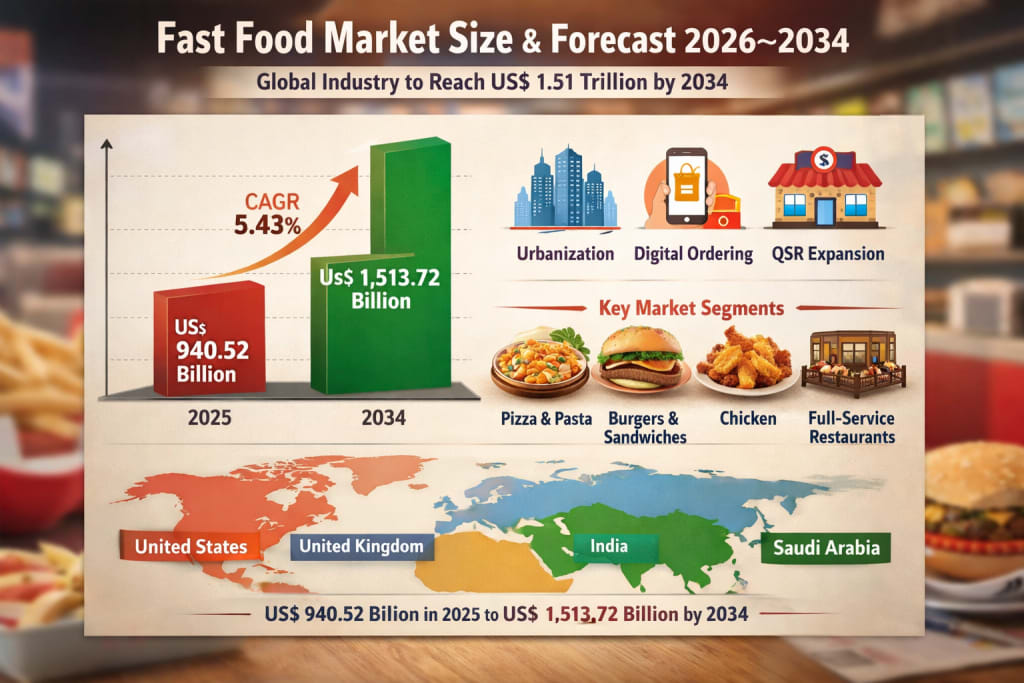
The global fast food market is entering a transformative growth phase, driven by urbanization, evolving consumer lifestyles, digital innovation, and the expanding footprint of quick-service restaurant (QSR) chains worldwide. As consumers increasingly prioritize convenience, affordability, and speed, the fast food industry continues to evolve in response to these changing preferences.
According to industry estimates, the fast food market is projected to grow from US$ 940.52 Billion in 2025 to US$ 1,513.72 Billion by 2034, expanding at a Compound Annual Growth Rate (CAGR) of 5.43% during 2026–2034. This steady growth trajectory reflects not only rising demand for ready-to-eat meals but also structural shifts in how consumers access food services globally.
Fast food refers to ready-to-eat or quickly prepared meals available at quick-service restaurants, drive-through outlets, food courts, kiosks, and takeaway counters. These meals are designed for convenience and minimal preparation time, enabling consumers to dine quickly or order on the go.
Popular fast food categories include burgers, sandwiches, pizza, pasta, fried chicken, tacos, noodles, seafood items, and fries. Most major brands emphasize standardized recipes and preparation methods to ensure consistent taste across global outlets. Combo meals, value pricing, and customizable menus further enhance consumer appeal.
Globally, fast food is gaining prominence due to:
Rapid urbanization
Increasing dual-income households
Expanding middle-class populations
Growth in online food delivery platforms
Franchise-based international expansion
The “convenience-driven” food service model is no longer a short-term trend—it is becoming a permanent fixture in global consumption behavior.
Growth Drivers of the Fast Food Market
1. Changing Lifestyles and Rising Demand for Convenience
One of the primary growth drivers is the transformation in consumer lifestyles. Longer working hours, increasing workforce participation (especially among women), and rising urban congestion have reduced the time available for home cooking.
Students, young professionals, and working families increasingly rely on quick meals that require minimal waiting time. Fast food offers:
Speed and accessibility
Affordable pricing
Predictable taste
Easy portability
As time becomes a premium commodity, convenience-based food solutions continue to dominate purchasing decisions.
2. Expansion of Quick-Service Restaurants and Franchising
The rapid expansion of QSR chains has significantly boosted market growth. Global brands are entering emerging markets and tier-2 and tier-3 cities through franchising models, which reduce capital risk while accelerating geographic penetration.
Major global players such as:
Starbucks Corp.
Domino's Pizza Inc.
Yum! Brands, Inc.
Restaurant Brands International Inc.
have successfully expanded across Asia, the Middle East, and Latin America by localizing menus while maintaining global brand identity.
Technological innovations in restaurant management systems, cloud-based POS platforms, and real-time inventory tracking are further improving operational efficiency and scalability.
3. Growth of Online Food Delivery and Digital Ordering
Digital transformation has reshaped the fast food ecosystem. Mobile applications, digital wallets, and third-party delivery aggregators have made ordering more seamless than ever.
Key benefits of digital ordering include:
Contactless transactions
Real-time order tracking
Personalized offers
Data-driven marketing campaigns
Online delivery has expanded consumer access beyond physical store locations, particularly in densely populated urban centers. The integration of AI-driven recommendations and loyalty programs is further strengthening customer retention.
Challenges in the Fast Food Market
Growing Health Awareness
Health consciousness is one of the biggest challenges facing the industry. Consumers are increasingly aware of the potential risks associated with high-calorie, high-sodium, and high-fat diets.
Concerns include:
Obesity
Cardiovascular diseases
Diabetes
In response, companies are introducing healthier options such as:
Plant-based alternatives
Gluten-free offerings
Low-calorie meal combos
Transparent nutritional labeling
Balancing taste, affordability, and health remains a critical strategic challenge.
Rising Operational Costs
The industry also faces mounting pressure from:
Rising raw material costs
Labor shortages and wage increases
Supply chain disruptions
Increased packaging costs
Rental inflation in prime urban locations
Maintaining competitive pricing while protecting profit margins is becoming increasingly complex for operators.
Segment Analysis
Pizza and Pasta Segment
Pizza and pasta remain globally popular due to their versatility and customization potential. Brands can easily adapt flavors to local tastes—such as paneer toppings in India or seafood-based variations in coastal markets—while maintaining standardized preparation methods.
The segment benefits from:
Strong delivery compatibility
Group meal appeal
Innovation in crust types and toppings
Major companies such as Papa John's International Inc. and Domino's Pizza Inc. continue to drive innovation in this space.
Burgers and Sandwiches Segment
Burgers and sandwiches dominate the fast food category globally due to their portability and strong brand presence. They are particularly popular among urban working populations seeking quick, affordable meals.
Companies like:
Wendy's
Restaurant Brands International Inc.
are constantly introducing new flavors, plant-based patties, and value deals to retain customer interest.
Full-Service Restaurants
Fast food full-service restaurants combine speed with table service, catering to families and social gatherings. These outlets provide:
Comfortable dining environments
Broader menu options
Affordable casual dining experiences
This segment remains particularly attractive in suburban and urban family markets.
Quick-Service Restaurants (QSRs)
QSRs represent the largest share of the global fast food market. Their focus on:
Drive-through convenience
Digital ordering
Delivery integration
Franchising scalability
makes them the backbone of market expansion.
Brands under Yum! Brands, Inc., including Kentucky Fried Chicken (KFC), continue to dominate this segment worldwide.
Regional Insights
United States
The United States remains one of the largest and most mature fast food markets globally. High disposable income, strong brand culture, and widespread drive-through infrastructure fuel demand.
Sustainability initiatives are gaining importance. For instance, Starbucks Corp. has introduced carbon reduction strategies and ethical sourcing programs to align with environmentally conscious consumers.
Innovation in plant-based products and digital loyalty systems keeps the US market dynamic and competitive.
United Kingdom
The UK market is experiencing steady growth driven by urban lifestyles and food delivery adoption. Regulatory emphasis on nutritional transparency is encouraging brands to reformulate menus with healthier ingredients.
Investment in outlet expansion by international players continues to strengthen competition.
India
India represents one of the fastest-growing fast food markets, driven by:
A young demographic profile
Rising disposable incomes
Expansion into tier-2 and tier-3 cities
Strong adoption of food delivery apps
Menu localization is a key strategy, with vegetarian and spice-adapted offerings attracting local consumers. Global chains are aggressively expanding through franchising partnerships.
Saudi Arabia
Saudi Arabia’s fast food market benefits from:
High youth population
Strong purchasing power
Growing tourism sector
Urban development initiatives
Premium fast food formats and international franchise brands are witnessing increased acceptance. Investments in local production facilities are improving supply chain resilience.
Competitive Landscape
The global fast food market features strong competition among international and regional players. Key companies analyzed across multiple viewpoints—including overview, key personnel, recent developments, SWOT analysis, and revenue analysis—include:
Starbucks Corp.
Papa John's International Inc.
Domino's Pizza Inc.
Wendy's
Performance Food Group
Yum! Brands, Inc.
Restaurant Brands International Inc.
Kentucky Fried Chicken (KFC)
Strategic initiatives include digital innovation, sustainability programs, menu diversification, and expansion into emerging economies.
Market Segmentation Overview
By Product:
Pizza/Pasta
Burgers/Sandwiches
Chicken
Asian/Latin American
Seafood
Others
By Application:
Full-Service Restaurants
Quick-Service Restaurants
Catering
Others
Geographic Coverage:
North America, Europe, Asia Pacific, Latin America, and the Middle East & Africa—covering 25 key country markets including the United States, Canada, Germany, France, UK, China, Japan, India, Brazil, Saudi Arabia, UAE, and South Africa.
Final Thoughts
The global fast food market is not merely expanding—it is transforming. Digital ordering platforms, urban lifestyle shifts, franchise scalability, and menu innovation are collectively shaping a resilient and adaptive industry landscape.
While health concerns and operational pressures present challenges, companies that invest in sustainability, healthier product offerings, and digital transformation will remain competitive.
With projections indicating growth from US$ 940.52 Billion in 2025 to US$ 1,513.72 Billion by 2034 at a CAGR of 5.43%, the fast food market stands as one of the most dynamic segments in the global food service industry.
As consumer priorities continue to evolve toward speed, value, and convenience, fast food is poised to remain an essential pillar of modern dining culture worldwide.
About the Creator
Australia Oat Milk Market 2026: Plant-Based Beverage Growth, Health Trends & Sustainable Consumption
Australia Oat Milk Market Overview The Australia oat milk market is expanding rapidly as consumers increasingly embrace plant-based and dairy-free alternatives driven by health, environmental and lifestyle considerations. Oat milk—a plant-derived beverage made from oats and water—is gaining traction as a creamy, nutritious substitute for traditional dairy milk. It is widely used in coffee, tea, smoothies, breakfast cereals and baking, and has become a staple within the rising plant-based consumption trend across Australia’s urban and regional populations. Growth is supported by rising lactose intolerance awareness, a surge in vegan and flexitarian diets, and expanded availability across retail and foodservice channels.
By Amyra Singh7 days ago in Trader
Top tipple tricks
Been thinking a lot about drinking, lately. Not least because of a recent episode of over-indulgence and the inevitable after effects. Some readers may recall the earlier articles I wrote about beating the booze. Here I set out an experiment in techniques for cutting down on my alcohol intake. The experiment was successful, the techniques worked, and I have armed myself with an arsenal of weapons in the war against the demon drink. I have yet to fire the first round however. It's all a question of timing (perhaps procrastination).
By Raymond G. Taylorabout 6 hours ago in Psyche



Comments
There are no comments for this story
Be the first to respond and start the conversation.