
Global Data Center Market Set to Reach US$ 613 Billion by 2033 Amid Cloud, AI, and Big Data Expansion
Rapid Digital Transformation and Rising Cloud Adoption Are Driving Massive Investments in Data Center Infrastructure Worldwide

Introduction
The global digital economy is expanding at an unprecedented pace, and data centers have become the foundation of this transformation. As businesses, governments, and consumers increasingly rely on digital platforms, the demand for secure, high-performance, and scalable computing infrastructure continues to rise.
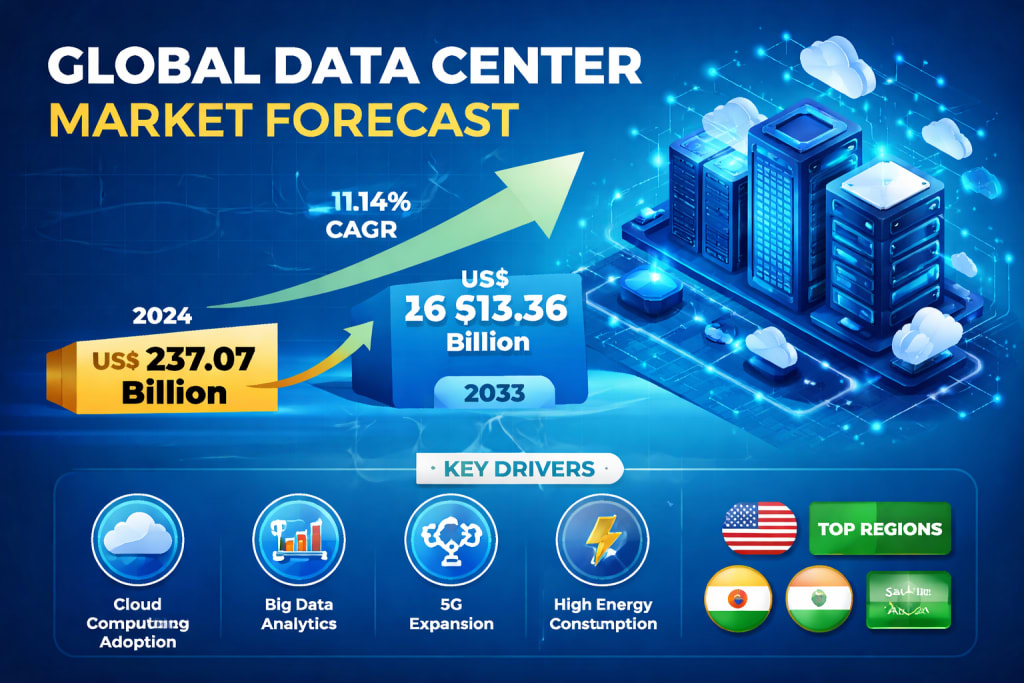
According to Renub Research, the global Data Center Market is projected to reach US$ 613.36 billion by 2033, growing from US$ 237.07 billion in 2024, registering a compound annual growth rate (CAGR) of 11.14% between 2025 and 2033. This impressive growth is driven by the widespread adoption of cloud computing, the rapid expansion of big data analytics, increasing use of artificial intelligence, and the surge in connected devices across industries.
Modern data centers are no longer just storage facilities. They are complex digital ecosystems that enable organizations to manage enormous volumes of data while ensuring speed, reliability, and cybersecurity. As digital transformation accelerates worldwide, investments in advanced data center infrastructure are expected to increase significantly.
Understanding the Role of Data Centers in the Digital Economy
A data center is a specialized facility that houses computing infrastructure including servers, storage systems, networking equipment, and software applications. These facilities are designed to process, store, and distribute large volumes of digital data with high levels of reliability, performance, and security.
In today’s interconnected world, data centers play a crucial role in supporting technologies such as:
Cloud computing platforms
Artificial intelligence (AI) systems
Internet of Things (IoT) networks
Big data analytics
Online streaming services
E-commerce platforms
Businesses rely on these infrastructures to ensure uninterrupted digital services and seamless user experiences.
The growth of online platforms, remote work environments, video streaming services, and social media networks has significantly increased global data traffic. As a result, organizations are investing heavily in scalable and energy-efficient data centers to manage this data explosion.
The rollout of 5G connectivity and increasing adoption of IoT devices are also contributing to rising demand for distributed computing infrastructure, including hyperscale and edge data centers.
Key Drivers Accelerating the Global Data Center Market
1. Growing Adoption of Cloud Computing
Cloud computing remains one of the most important drivers of data center expansion worldwide. Organizations are rapidly transitioning from traditional IT systems to cloud-based platforms due to the flexibility, scalability, and cost efficiency they provide.
Cloud infrastructure allows businesses to access computing resources on demand without maintaining their own hardware. This shift has led to a surge in demand for hyperscale data centers operated by major cloud service providers.
Remote work trends, digital transformation initiatives, and cloud-based applications are further strengthening this demand. Enterprises increasingly rely on cloud infrastructure for storage, application hosting, and data analytics.
In emerging economies like India, cloud adoption is accelerating quickly. Industry reports suggest that around 40% of organizations in India are expected to adopt cloud services, creating strong demand for data center infrastructure.
At the same time, India’s data center capacity is projected to grow significantly—from 770 MW in 2022 to nearly 1,500 MW by 2025, highlighting the scale of infrastructure investments underway.
2. Explosion of Big Data Analytics
The digital world generates enormous volumes of data every second. From social media activity and mobile applications to IoT sensors and online transactions, data generation has reached unprecedented levels.
Organizations are increasingly using big data analytics to gain insights, improve decision-making, enhance customer experiences, and optimize business operations.
To process these massive datasets, companies require high-performance computing environments supported by advanced data centers. These facilities enable organizations to manage complex analytics workloads efficiently and securely.
Technology firms are continuously developing tools to support data analytics innovation. For example, new AI-driven platforms are emerging that allow developers to analyze synthetic datasets, compare performance metrics, and optimize AI application outputs.
As big data continues to grow across industries such as finance, healthcare, retail, and telecommunications, the demand for advanced data center infrastructure will continue to expand.
3. Expansion of 5G Technology
The rollout of 5G networks is transforming global connectivity by enabling ultra-fast data transfer speeds and significantly reducing network latency.
5G technology supports applications such as:
Autonomous vehicles
Smart city infrastructure
Industrial automation
Remote healthcare services
Real-time data analytics
These applications generate massive volumes of data that must be processed rapidly and securely.
To support this increased data traffic, telecommunications companies are investing in high-capacity data centers and distributed computing infrastructure. Edge data centers are becoming particularly important because they process data closer to the user, reducing latency and improving performance.
As global 5G deployments accelerate, data centers will play an increasingly critical role in supporting next-generation digital services.
Challenges in the Global Data Center Market
High Energy Consumption and Environmental Impact
Despite their importance, data centers face growing criticism due to their significant energy consumption. Servers, cooling systems, and networking equipment require large amounts of electricity to operate continuously.
As the number of data centers increases globally, concerns about carbon emissions and environmental sustainability are also rising.
To address these challenges, technology companies and governments are investing in energy-efficient data center designs, renewable energy sources, and innovative cooling technologies.
Green data centers powered by solar, wind, and other renewable energy sources are becoming a major trend in the industry. However, balancing performance requirements with sustainability goals remains a complex challenge.
Rising Construction and Operational Costs
Building a modern data center requires enormous capital investment. Expenses include:
Land acquisition
Construction and infrastructure development
Advanced server hardware
Cybersecurity systems
Power and cooling infrastructure
Operational costs also remain high due to electricity consumption, maintenance requirements, and specialized workforce needs.
These costs can be particularly challenging for smaller organizations attempting to build their own data center infrastructure. As a result, many businesses are increasingly turning to colocation or cloud services to reduce operational complexity.
Industry Applications Driving Data Center Demand
Telecom Data Center Market
The telecommunications sector represents one of the largest users of data center infrastructure. With mobile internet usage growing rapidly and 5G networks expanding worldwide, telecom operators require powerful data centers to manage massive volumes of network data.
Data centers enable telecom companies to improve network reliability, reduce latency, and enhance user experiences across communication platforms.
E-Commerce Data Center Market
The rapid expansion of e-commerce has significantly increased demand for data storage and processing infrastructure.
Online retail platforms rely on data centers for:
Order processing systems
Customer databases
Inventory management
Payment processing
Real-time analytics
These facilities allow e-commerce companies to manage large spikes in traffic during sales events and ensure smooth operations.
For example, cloud providers continue to expand infrastructure in key markets to support digital commerce and AI workloads.
Cloud Data Center Market
Cloud data centers are among the fastest-growing segments of the industry. These facilities provide scalable computing power for businesses looking to modernize their IT systems.
Benefits of cloud data centers include:
Flexible computing resources
Enhanced cybersecurity
Disaster recovery capabilities
Reduced IT infrastructure costs
Cloud platforms also support hybrid and multi-cloud environments, enabling organizations to distribute workloads across multiple providers.
Colocation Data Center Market
Colocation services are gaining popularity among enterprises seeking cost-effective IT infrastructure solutions.
In a colocation model, businesses rent space in a shared data center facility where they can install their own servers while benefiting from:
Power supply
Cooling systems
Physical security
Network connectivity
This model reduces infrastructure costs while ensuring reliable performance.
The increasing adoption of cloud computing, IoT applications, and low-latency connectivity requirements is accelerating the growth of the colocation data center market.
Small and Medium Enterprise (SME) Data Center Market
Small and medium-sized enterprises are increasingly adopting data center services to support digital operations.
SMEs benefit from data center solutions because they provide:
Scalable computing infrastructure
Cost-efficient storage
Secure IT environments
Access to advanced technologies
Hybrid cloud systems and virtualization technologies are making it easier for smaller businesses to adopt digital infrastructure without large upfront investments.
Regional Outlook of the Data Center Market
United States
The United States remains the global leader in the data center industry due to its advanced technological ecosystem and the presence of major technology companies.
The country hosts some of the world’s largest data centers supporting cloud computing, artificial intelligence, and e-commerce services.
Innovation in energy-efficient infrastructure and renewable energy integration is also helping the U.S. maintain its leadership position.
United Kingdom
The United Kingdom is one of Europe’s major data center hubs, supported by strong IT infrastructure and growing demand for cloud services.
Industries such as finance, healthcare, and government rely heavily on data center infrastructure in the country.
Strict data protection regulations and compliance with privacy standards also contribute to the reliability and security of UK data centers.
India
India’s data center market is expanding rapidly due to increasing internet penetration, smartphone adoption, and the government’s Digital India initiative.
The rapid growth of e-commerce, digital payments, and cloud services is driving demand for large-scale data center facilities across the country.
Global technology companies are investing heavily in India to support the country's growing digital economy.
Saudi Arabia
Saudi Arabia is emerging as a significant data center hub in the Middle East due to large-scale digital transformation initiatives under Vision 2030.
The government is investing heavily in digital infrastructure to diversify the economy and attract international technology companies.
New data center projects across the region are expected to support cloud computing, artificial intelligence, and IoT applications.
Market Segmentation Overview
The global Data Center Market is segmented across several categories:
By Component
Hardware
Software
By Type
Colocation
Hyperscale
Edge
Others
By Enterprise
Large Enterprises
Small and Medium Enterprises
By End User
Cloud Service Providers
Technology Providers
Telecom
Healthcare
BFSI
Retail & E-commerce
Entertainment & Media
Energy
Others
Leading Companies in the Global Data Center Market
Several technology and infrastructure companies play key roles in developing and managing data center ecosystems worldwide. Major players include:
Delta Electronics, Inc.
Cisco Systems, Inc.
Equinix, Inc.
Fujitsu Ltd.
General Electric
Hitachi, Ltd.
Schneider Electric
Siemens AG
These companies continue to invest in innovative technologies, sustainable infrastructure, and global expansion strategies to meet the growing demand for data center services.
Final Thoughts
The global data center market is entering a transformative phase driven by rapid technological advancements and the growing digitalization of industries worldwide.
With the rise of cloud computing, artificial intelligence, big data analytics, and 5G connectivity, the need for scalable and secure data infrastructure is stronger than ever. Governments and enterprises are investing heavily in next-generation data centers to support this digital transformation.
Although challenges such as energy consumption and high operational costs remain, advancements in green technologies and energy-efficient designs are helping address these concerns.
As the digital economy continues to evolve, data centers will remain the backbone of global connectivity, enabling innovation across industries and shaping the future of technology.
About the Creator
Device-as-a-Service Market: Transforming IT Infrastructure Through Flexible Technology Solutions
Device-as-a-Service Market: The Future of Flexible IT Infrastructure The Device-as-a-Service (DaaS) market is emerging as a transformative model in the modern IT landscape. Traditional methods of purchasing and maintaining devices such as laptops, desktops, tablets, and smartphones can be expensive and complex for organizations. Device-as-a-Service provides an alternative approach by offering hardware, software, maintenance, and lifecycle management through a subscription-based model.
By James Smith4 days ago in Trader
Commercial Vehicle Market Size and Forecast 2025–2033
The global commercial vehicle market is entering a period of steady and transformative growth as transportation networks evolve to support modern economic activities. According to industry estimates, the market is expected to grow from US$ 839.97 billion in 2024 to approximately US$ 1,388.10 billion by 2033, registering a compound annual growth rate (CAGR) of 5.74% between 2025 and 2033.
By shibansh kumarabout 23 hours ago in Trader



Comments
There are no comments for this story
Be the first to respond and start the conversation.