
Global LiDAR Market Size and Forecast 2026–2034
Autonomous Mobility, Smart Infrastructure, and 3D Intelligence Drive the Next Wave of Growth

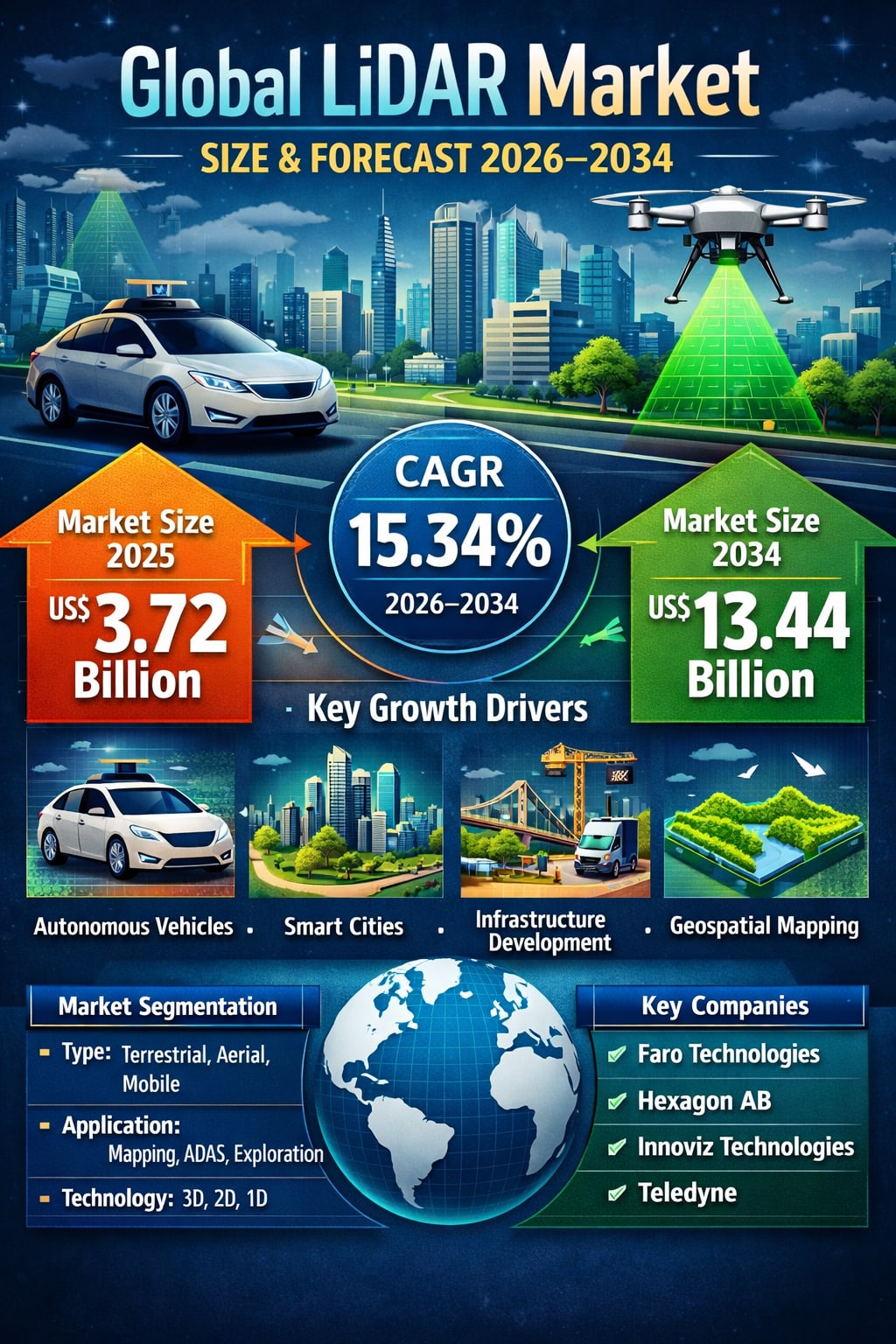
The global LiDAR market is entering a transformative decade. Driven by accelerating adoption in autonomous vehicles, smart city projects, infrastructure modernization, and high-precision geospatial mapping, LiDAR technology is evolving from a niche surveying tool into a critical enabler of digital intelligence.
According to Renub Research, the global LiDAR market is projected to grow from US$ 3.72 Billion in 2025 to US$ 13.44 Billion by 2034, registering a compound annual growth rate (CAGR) of 15.34% between 2026 and 2034. This strong upward trajectory reflects increasing global demand for precise 3D mapping, sensor innovation, and automation-driven technologies.
As industries pursue digital transformation, LiDAR has become a foundational tool in shaping how machines interpret and interact with the physical world.
LiDAR Market Overview
LiDAR (Light Detection and Ranging) is a remote sensing technology that uses laser pulses to measure distances and generate detailed three-dimensional models of objects and environments. By emitting laser beams and calculating the time it takes for the reflected signal to return, LiDAR systems construct highly accurate spatial data.
This precision has made LiDAR indispensable in applications such as:
Topographic and land surveys
Forestry management
Urban planning
Environmental monitoring
Transportation infrastructure
Autonomous mobility
LiDAR systems can be mounted on drones, vehicles, aircraft, tripods, and even satellites, enhancing their flexibility across industries. With improvements in solid-state LiDAR, miniaturization, cost efficiency, and AI-driven analytics, the technology has expanded well beyond its traditional uses.
Today, LiDAR stands at the crossroads of mobility, infrastructure, automation, and digital mapping—fueling rapid market growth worldwide.
Growth Drivers of the LiDAR Market
1. Rapid Adoption in Autonomous Vehicles and ADAS
One of the strongest catalysts for LiDAR growth is its integration into autonomous vehicles and Advanced Driver Assistance Systems (ADAS). LiDAR provides high-resolution, real-time 3D vision that allows vehicles to detect obstacles, track pedestrians, interpret road geometry, and accurately measure distances—even in challenging lighting conditions.
Unlike camera-only systems, LiDAR delivers depth perception independent of ambient light, enhancing reliability in night driving and adverse weather.
In 2024, Volkswagen announced the L4 ID. Buzz AD microbus designed for Level 4 autonomy. The company plans to deploy 500 vehicles for ride-hailing trials in partnership with Uber in Los Angeles by 2026, with full autonomous operations targeted for 2027. Such developments underscore how LiDAR is central to autonomous mobility strategies.
As automotive manufacturers and technology firms intensify investments in self-driving ecosystems, LiDAR demand continues to accelerate. Miniaturization and cost reductions in solid-state LiDAR are further supporting its integration into mass-production vehicles.
2. Expanding Use in Mapping, Surveying, and Infrastructure Development
LiDAR plays a pivotal role in mapping and infrastructure development due to its ability to generate high-precision 3D terrain and structural models. Governments and construction firms increasingly use LiDAR for:
Urban master planning
Transportation corridors
Power line inspections
Flood modeling
Environmental surveys
The rise of smart city initiatives globally has amplified demand for accurate spatial data. Emerging markets, particularly in Asia and the Middle East, are heavily investing in infrastructure modernization—creating fertile ground for LiDAR adoption.
In April 2024, Hesai Group partnered with Marelli Holdings to integrate advanced LiDAR systems into next-generation automotive headlamp designs. The collaboration reflects the push toward compact, aerodynamically optimized LiDAR solutions in modern vehicles.
Drone-mounted LiDAR systems have also significantly reduced operational costs, making high-quality mapping accessible to a broader user base.
3. Technological Advancements and Cost Reduction
Continuous innovation remains a key market enabler. Developments in:
Solid-state LiDAR
MEMS-based systems
Photonic integration
Semiconductor laser systems
AI-powered data processing
are enhancing performance while lowering size, power consumption, and cost.
In August 2024, YellowScan partnered with Nokia to integrate LiDAR scanners into 5G-based drone networks for telecommunications tower and utility inspections. Such integrations highlight how LiDAR is becoming part of intelligent, connected ecosystems.
As manufacturing scales up and technology matures, LiDAR systems are becoming more affordable—expanding adoption into robotics, industrial automation, consumer electronics, and security systems.
Challenges Facing the LiDAR Market
High Cost and Integration Complexity
Despite technological progress, LiDAR systems remain relatively expensive compared to camera and radar-based sensing alternatives. Large-scale automotive deployment still faces cost barriers.
Moreover, LiDAR requires sophisticated hardware and software integration, including data processing platforms and sensor fusion systems, which increases complexity.
Competition from Alternative Sensing Technologies
Radar and advanced computer vision technologies are evolving rapidly. Some autonomous vehicle developers prioritize camera-centric or radar-centric approaches to reduce cost and complexity.
To maintain its competitive edge, LiDAR manufacturers must continue demonstrating superior accuracy, reliability, and safety advantages—especially in mission-critical applications.
Key Segment Insights
LiDAR Laser Market
Lasers form the backbone of LiDAR systems, generating the pulses used for distance measurement. Innovations in semiconductor and eye-safe longer-wavelength lasers are gaining traction in automotive and urban applications.
Improved efficiency and cost-effectiveness in laser systems are strengthening this segment’s growth prospects.
LiDAR Camera Market
LiDAR cameras integrate sensing and imaging technologies to deliver enhanced environmental perception. These systems are increasingly deployed in autonomous vehicles, surveillance networks, and industrial robotics.
Growing demand for intelligent detection and imaging solutions is driving strong expansion in this segment.
LiDAR Corridor Mapping Market
Corridor mapping focuses on linear infrastructure such as:
Roads
Railways
Pipelines
Transmission lines
LiDAR enables rapid and precise mapping across extensive areas, improving infrastructure planning and maintenance efficiency.
As global infrastructure spending rises, corridor mapping remains a high-growth application area.
LiDAR Exploration Market
In mining, oil & gas, archaeology, and environmental exploration, LiDAR identifies geological features and surface changes with exceptional precision.
In archaeology, LiDAR can reveal hidden structures beneath vegetation. In mining, it supports resource planning and terrain modeling. The increasing emphasis on data-driven exploration is boosting demand in this segment.
3D LiDAR Market
The demand for 3D spatial intelligence is rising across autonomous driving, construction, and smart city projects. 3D LiDAR systems enhance environmental awareness and object modeling.
Advancements in AI integration and solid-state design are accelerating the 3D LiDAR segment’s growth globally.
Regional Analysis
United States
The United States represents one of the most advanced LiDAR markets globally. Adoption is strong across autonomous vehicles, aerospace, defense, mapping, and disaster response.
In January 2025, Sony and Honda collaborated to introduce the Afeela EV in Japan and the United States by 2026, integrating advanced AI-powered autonomous features. Government initiatives and private-sector innovation continue to support market expansion.
United Kingdom
The UK market is growing steadily, driven by infrastructure planning, flood risk management, rail monitoring, and heritage conservation.
In January 2026, US-based GeoCue partnered with UK drone solutions provider Coptrz to distribute TrueView LiDAR sensors and LP360 software across the UK—strengthening the ecosystem for geospatial intelligence.
India
India’s LiDAR market is expanding rapidly due to large-scale infrastructure initiatives, railway modernization, smart city development, and digital land mapping projects.
Drone-enabled LiDAR systems are increasingly deployed for surveying challenging terrains. Although cost sensitivity remains a challenge, government-led infrastructure growth continues to stimulate adoption.
Saudi Arabia
Saudi Arabia’s Vision 2030 initiative is accelerating LiDAR deployment across smart city construction, transportation infrastructure, oil & gas monitoring, and desert terrain mapping.
In February 2025, Lumotive announced a strategic partnership with E-Photonics to advance LiDAR and 3D sensing manufacturing in Saudi Arabia, reinforcing regional growth prospects.
Market Segmentation
By Type:
Terrestrial
Aerial
Mobile
Short Range
By Components:
LASER
Inertial Navigation System
Camera
GPS/GNSS Receiver
MEMS
By Application:
Corridor Mapping
Engineering
Environment
Exploration
Advanced Driver Assistance Systems
Others
By Technology:
3D
2D
1D
By Range:
Short Range
Medium Range
Long Range
Regional Coverage:
North America, Europe, Asia Pacific, Latin America, Middle East & Africa
Competitive Landscape
The global LiDAR market is characterized by technological innovation and strategic partnerships. Key players include:
Faro Technologies Inc.
Hexagon AB
Vaisala Oyj
Sick AG
Teledyne Technologies Inc.
Innoviz Technologies Ltd.
LeddarTech Inc.
NV5 Global Inc.
All key players have been analyzed from three viewpoints:
Overview
Recent Developments
Revenue Analysis
Strategic collaborations, product innovation, and geographic expansion remain central to competitive positioning.
Final Thoughts
The LiDAR market is transitioning from a specialized surveying technology into a core enabler of autonomous systems and intelligent infrastructure. With global revenues expected to rise from US$ 3.72 Billion in 2025 to US$ 13.44 Billion by 2034, the sector reflects strong long-term structural growth.
Autonomous mobility, smart cities, digital mapping, and industrial automation are redefining how data is captured and interpreted. While challenges such as cost pressures and competitive sensing technologies persist, ongoing innovation in solid-state LiDAR, AI integration, and photonics will likely sustain momentum.
As industries worldwide move toward automation, connectivity, and precision intelligence, LiDAR is positioned not just as a supporting technology—but as a foundational pillar of the digital future.
About the Creator
Sakshi Sharma
Content Writer with 7+ years of experience crafting SEO-driven blogs, web copy & research reports. Skilled in creating engaging, audience-focused content across diverse industries.
Keep reading
More stories from Sakshi Sharma and writers in Trader and other communities.
Organic Baby Food Market Size and Forecast 2026–2034
The global parenting landscape is undergoing a quiet but powerful transformation. Today’s parents are more informed, more cautious, and more committed to ensuring optimal nutrition for their children from day one. This shift in consumer behavior is significantly reshaping the global baby food industry—especially the organic segment.
By Sakshi Sharmaa day ago in Trader
Stanislav Kondrashov on the U.S. Dollar’s Rebound and the New Balance of Global Safe-Haven Assets
Periods of global uncertainty often reshape the behaviour of currencies and commodities. In recent weeks, the U.S. dollar has shown renewed strength, particularly against currencies such as the euro and the Swiss franc. This shift has drawn attention because it suggests that the dollar may once again be acting as a stabilising force during a time of international tension and economic caution.
By Stanislav Kondrashova day ago in Trader
Philippines Packaging Market 2026: E-Commerce Growth, Sustainable Materials & Consumer Goods Expansion
Philippines Packaging Market Overview The Philippines packaging market is expanding steadily as the country’s consumer goods, food processing and e-commerce industries continue to grow. Packaging plays a critical role in product protection, transportation, branding and shelf appeal across industries such as food and beverages, pharmaceuticals, cosmetics and household products. As consumer lifestyles become more convenience-driven and retail distribution channels diversify, demand for reliable and innovative packaging solutions is increasing across the Philippine economy.
By Manisha Dixit5 days ago in Trader




Comments
There are no comments for this story
Be the first to respond and start the conversation.