
Global Transdermal Skin Patches Market Size and Forecast 2026–2034
Non-Invasive Drug Delivery Gains Momentum as Chronic Disease Burden Accelerates Worldwide

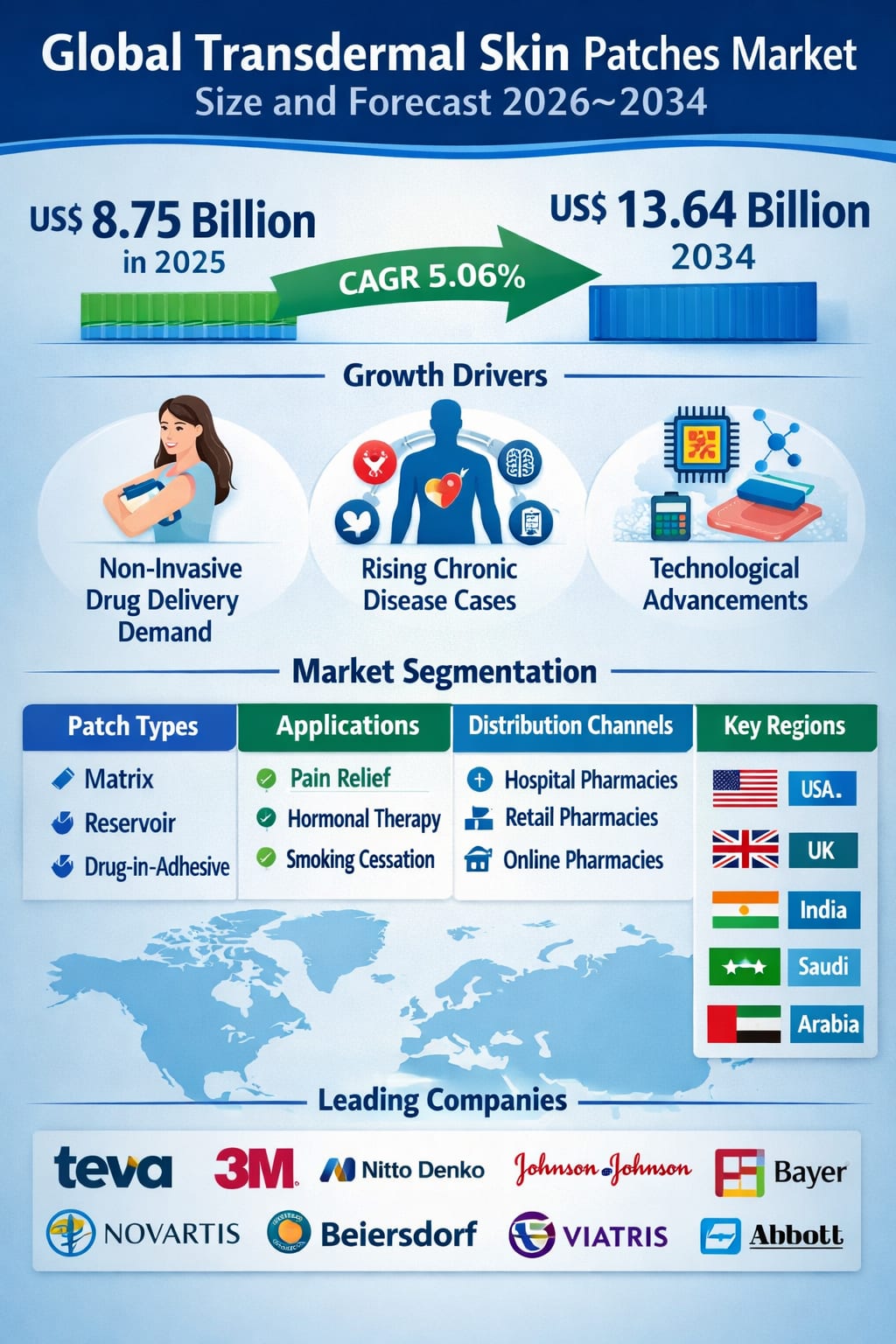
The Global Transdermal Skin Patches Market is entering a dynamic growth phase as healthcare systems worldwide increasingly prioritize patient-friendly drug delivery solutions. According to Renub Research, the market is projected to expand from US$ 8.75 billion in 2025 to US$ 13.64 billion in 2034, growing at a compound annual growth rate (CAGR) of 5.06% between 2026 and 2034.
The growing preference for minimally invasive therapies, rising chronic disease prevalence, and significant technological breakthroughs in patch design are reshaping how medications are delivered. As healthcare providers shift toward improving patient compliance and reducing treatment complexity, transdermal skin patches are emerging as a reliable, efficient, and increasingly mainstream therapeutic option.
Global Transdermal Skin Patches Market Overview
Transdermal skin patches are advanced drug delivery systems designed to administer medication through the skin directly into the bloodstream at a controlled rate over a fixed duration. A typical transdermal patch consists of several layers, including a drug reservoir or matrix, adhesive layer, backing membrane, and release liner.
One of the primary advantages of these systems is their ability to maintain stable plasma drug concentrations while bypassing the liver’s first-pass metabolism. This improves bioavailability and reduces systemic side effects often associated with oral medications.
Transdermal patches are widely used in pain management, hormonal therapy, motion sickness, cardiovascular treatment, and smoking cessation programs. Their non-invasive nature, ease of use, and reduced dosing frequency significantly enhance patient adherence, particularly among elderly and chronically ill populations.
Advances in material science, microneedle technology, and drug-release mechanisms are further expanding the range of medications suitable for transdermal delivery. As healthcare models become more patient-centric, the global adoption of these systems continues to rise steadily.
Key Growth Drivers in the Transdermal Skin Patches Market
Rising Demand for Non-Invasive and Patient-Friendly Drug Delivery
Modern healthcare consumers increasingly seek treatments that minimize discomfort and inconvenience. Transdermal patches eliminate the need for injections and reduce gastrointestinal side effects linked with oral drugs.
Elderly patients, pediatric populations, and individuals with swallowing difficulties particularly benefit from patch-based therapies. Healthcare professionals also favor these systems because they reduce dosing errors and provide consistent therapeutic outcomes.
In October 2022, XPhyto Therapeutics Corp announced a development update for its Rotigotine transdermal patch through its German subsidiary Vektor Pharma TF GmbH, showcasing continued innovation in patch technology. Such developments demonstrate growing industry confidence in this drug delivery format.
Increasing Prevalence of Chronic Diseases
The global burden of chronic diseases such as cardiovascular disorders, diabetes, neurological conditions, obesity, and chronic pain is a major catalyst for market expansion. These conditions often require sustained medication levels over extended periods.
In the United States alone, approximately 129 million individuals are estimated to live with at least one serious chronic condition. Continuous drug delivery through transdermal patches helps maintain therapeutic levels without frequent dosing, making them highly suitable for chronic disease management.
As global populations age and sedentary lifestyles contribute to higher disease incidence, the demand for long-term, stable, and patient-friendly drug delivery systems will continue to rise.
Technological Advancements in Patch Design and Drug Formulation
Innovation remains central to the market’s long-term trajectory. Improvements in polymer science, adhesive technologies, and controlled-release systems have significantly enhanced patch performance.
Emerging technologies such as microneedle patches and iontophoresis are enabling delivery of larger and more complex molecules. These innovations expand therapeutic possibilities beyond traditional small-molecule drugs.
In September 2023, Corium, LLC reported positive study results for ADLARITY, the first FDA-approved donepezil transdermal system for mild to severe Alzheimer’s disease. This milestone highlights how advanced patch systems are entering complex therapeutic areas once dominated by oral formulations.
Market Challenges
Limited Drug Compatibility and Skin Permeability Issues
Despite promising growth, not all drugs are suitable for transdermal administration. Molecules must possess specific molecular weight, lipophilicity, and potency characteristics to effectively penetrate the skin barrier.
Poor permeability may reduce therapeutic effectiveness, while certain formulations may trigger local skin reactions. Overcoming these scientific limitations remains a priority for pharmaceutical developers.
Skin Irritation and Regulatory Complexity
Some patients experience redness, itching, or allergic dermatitis from adhesives or drug components. Long-term use can sometimes lead to localized irritation.
Moreover, regulatory frameworks governing transdermal systems are stringent, requiring comprehensive safety and efficacy documentation. These regulatory requirements increase development timelines and costs, potentially limiting smaller players from entering the market.
Segment Analysis
Matrix Transdermal Skin Patches
Matrix patches represent one of the most widely adopted formats. In this system, the drug is uniformly dispersed within a polymer matrix that controls release through diffusion.
Matrix patches are thinner, more flexible, and less prone to dose dumping compared to reservoir systems. Manufacturing efficiency and cost-effectiveness further contribute to their growing adoption worldwide.
Pain Relief Transdermal Skin Patches
Pain management remains one of the largest application segments. Chronic pain conditions such as arthritis, musculoskeletal disorders, and neuropathic pain continue to rise globally.
Transdermal patches deliver analgesics steadily, reducing systemic side effects and lowering dependency on oral opioids. With aging populations and increasing emphasis on non-opioid therapies, this segment is expected to maintain strong growth.
Hormonal Therapy Transdermal Skin Patches
Hormonal therapy patches are extensively used in menopause management, contraception, and hormone replacement therapy. By bypassing first-pass liver metabolism, transdermal systems lower the risk of certain side effects associated with oral hormones.
Growing awareness around women’s health and long-term hormone management is sustaining demand in this segment.
Distribution Channel Insights
Hospital Pharmacies
Hospital pharmacies remain a dominant distribution channel due to high prescription volumes. Transdermal patches are commonly used in postoperative care, cardiovascular management, and chronic pain therapy.
Hospitals also provide patient education and monitoring, reinforcing safe and effective patch use.
Online Pharmacies
Digital healthcare adoption has significantly boosted online pharmacy sales. Consumers value convenience, privacy, and home delivery services.
Telemedicine expansion and supportive regulatory policies are accelerating online purchases of prescription patches, positioning e-pharmacies as an increasingly important channel.
Regional Insights
United States
The United States represents one of the most mature and lucrative markets for transdermal skin patches. Advanced healthcare infrastructure, high chronic disease prevalence, and strong R&D investment drive sustained growth.
In August 2023, Yaral Pharma launched Lidocaine Patch 5%, expanding non-opioid pain management options in the U.S. market. Growing home healthcare services and patient awareness further support long-term demand.
United Kingdom
The UK market benefits from a strong public healthcare system emphasizing patient-centered care. Transdermal patches are widely used for chronic disease management and hormone therapy.
In September 2023, the twice-weekly rivastigmine patch “Zeyzelf” was approved in the UK for Alzheimer’s dementia management, marking a significant milestone in therapeutic innovation.
India
India’s market is expanding due to rising chronic disease prevalence, urbanization, and growing healthcare infrastructure in Tier II and Tier III cities.
With approximately 77 million diabetes cases and 220 million hypertension cases, the need for continuous and stable medication delivery is substantial. Domestic pharmaceutical manufacturing and government initiatives are improving accessibility, though affordability and awareness gaps remain challenges in rural regions.
Saudi Arabia
Saudi Arabia’s healthcare modernization initiatives are fostering adoption of advanced drug delivery systems. Rising lifestyle-related diseases and government-backed healthcare expansion are driving demand for transdermal therapies in hospitals and private clinics.
Competitive Landscape
The global market is characterized by strong participation from major pharmaceutical and healthcare companies. Key players include:
Teva Pharmaceutical Industries Ltd
3M Company
Nitto Denko Corporation
Johnson & Johnson
Luye Pharma Group
Bayer
Novartis AG
Beiersdorf AG
Viatris Inc.
Abbott Laboratories
These companies compete through innovation, strategic partnerships, product portfolio expansion, and regulatory approvals. Company evaluations typically cover overview, key leadership, recent developments, strategies, product offerings, and financial insights.
Market Segmentation
By Type:
Matrix
Reservoir
Drug-in-Adhesive
Other Types
By Application:
Pain Relief
Smoking Reduction & Cessation
Overactive Bladder
Hormonal Therapy
Others
By Distribution Channel:
Hospital Pharmacies
Retail Pharmacies
Online Pharmacies
By Region:
North America, Europe, Asia Pacific, Latin America, Middle East & Africa
Final Thoughts
The global transdermal skin patches market is steadily transforming modern drug delivery. With a projected rise from US$ 8.75 billion in 2025 to US$ 13.64 billion by 2034, supported by a CAGR of 5.06%, the market reflects strong structural demand driven by chronic disease management and patient-centric healthcare trends.
Technological innovation, demographic shifts, and digital healthcare integration are collectively shaping the future of this sector. While challenges such as skin compatibility and regulatory complexities persist, ongoing R&D investments and improved patch technologies are likely to overcome these barriers.
About the Creator
Sakshi Sharma
Content Writer with 7+ years of experience crafting SEO-driven blogs, web copy & research reports. Skilled in creating engaging, audience-focused content across diverse industries.
Keep reading
More stories from Sakshi Sharma and writers in Trader and other communities.
Global Smart Textile Market Size & Forecast 2026–2034
The global smart textile market is entering a transformative decade. According to Renub Research, the Global Smart Textile Market size is anticipated to escalate from USD 5.12 billion in 2025 to USD 23.5 billion by 2034, expanding at a remarkable CAGR of 18.45% between 2026 and 2034.
By Sakshi Sharmaa day ago in Trader
US Steel Tubes Market is Expected to Grow USD 748.54 Million by 2033 | At CAGR 1.30%
A Steady Outlook for the US Steel Tubes Market Steel tubes remain a foundational component across multiple industries in the United States. From infrastructure development and energy pipelines to automotive frames and industrial machinery, steel tubing plays a critical structural and mechanical role. While the sector is not experiencing rapid expansion, it continues to advance steadily through technological improvements, evolving supply chains, and sustained industrial demand.
By Kim Soo hyunabout 9 hours ago in Trader
Australia Cold Chain Monitoring Solutions Market 2026: Temperature Control Innovation, Food Safety Compliance and Pharma Logistics Growth
Australia Cold Chain Monitoring Solutions Market Overview Australia’s cold chain monitoring solutions market is experiencing significant growth as industries prioritise product integrity, real-time visibility and compliance across temperature-sensitive supply chains. Cold chain monitoring solutions — including IoT-enabled sensors, RFID trackers, cloud software and analytical platforms — ensure that perishable goods such as food, pharmaceuticals and biologics maintain optimal conditions from production to point of use. Rising regulatory requirements, expanding e-commerce grocery demand and increased pharmaceutical distribution activity are supporting the adoption of advanced monitoring systems that optimise quality, minimise spoilage and enhance traceability.
By Amyra Singha day ago in Trader
Tatt~Master
— Assembly Line Tatt Machine ~ Impressions to Impress — As I begin to understand more about the Tattoo Phenomenon. I've written silly, yet verbatim, dating site anecdotes in 'Frazzled.' So let me ask you: Would you be More attracted to someone slathered with tattoos, or Less?
By Jay Kantor2 days ago in Humor




Comments
There are no comments for this story
Be the first to respond and start the conversation.