
Interactive Whiteboard Market Size and Forecast 2025–2033: Digital Classrooms and Smart Collaboration Fuel Global Growth
Touch-Enabled Learning and Workplace Innovation Drive the Interactive Whiteboard Market Toward USD 9.37 Billion by 2033

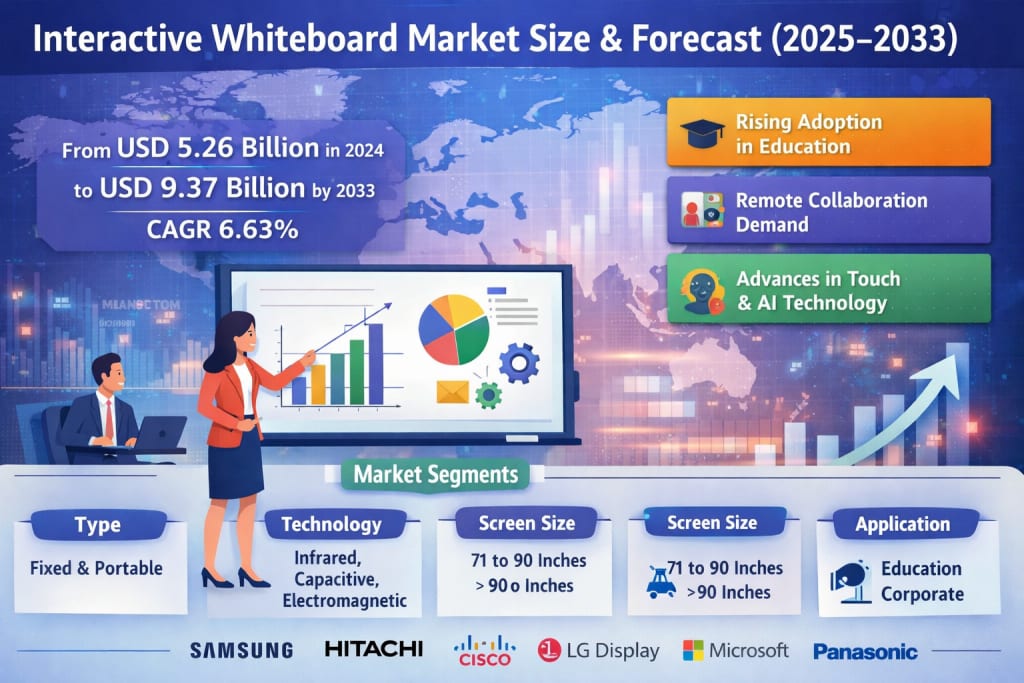
The global education and corporate collaboration landscape is undergoing a rapid digital transformation. At the center of this shift is the interactive whiteboard (IWB)—a powerful tool that blends traditional presentation methods with advanced digital interactivity. From smart classrooms to corporate boardrooms, interactive whiteboards are revolutionizing how information is shared, taught, and discussed.
According to Renub Research, the global interactive whiteboard market is projected to grow from USD 5.26 billion in 2024 to USD 9.37 billion by 2033, expanding at a compound annual growth rate (CAGR) of 6.63% during the forecast period. The market’s expansion is fueled by rising digital learning initiatives, increasing demand for collaborative workplace technologies, and rapid advancements in touch-screen display technologies.
Governments, educational institutions, and corporations worldwide are increasingly investing in digital collaboration infrastructure. These investments are not only enhancing learning experiences but also enabling organizations to adopt more efficient and engaging communication tools.
Interactive Whiteboard Market Overview
An interactive whiteboard (IWB) is a large touch-sensitive display system that connects to a computer and projector or operates as a standalone digital panel. Users can control and interact with digital content directly on the screen using touch, stylus pens, or gesture-based commands.
Interactive whiteboards combine hardware and software capabilities to enable real-time collaboration and multimedia integration. Teachers, presenters, and professionals can annotate documents, display videos, conduct presentations, and collaborate on shared content simultaneously.
In education, IWBs transform traditional classrooms into interactive learning environments. Teachers can integrate multimedia resources such as animations, graphics, videos, and real-time data to make lessons more engaging. Students benefit from hands-on participation and dynamic visual explanations that improve knowledge retention.
In corporate environments, interactive whiteboards serve as collaborative hubs for meetings, brainstorming sessions, and presentations. Teams can share screens, edit documents in real time, and communicate effectively across remote locations.
With integrated tools such as video conferencing, cloud collaboration, and digital annotation, IWBs are rapidly becoming essential productivity tools across industries.
Advantages of Interactive Whiteboards
Interactive whiteboards offer several advantages that enhance communication, engagement, and productivity across sectors.
One of the most significant benefits is improved engagement and interactivity. Traditional teaching tools such as chalkboards or projectors often limit interaction. In contrast, IWBs allow users to write, draw, move objects, and manipulate multimedia elements directly on the screen.
Another major advantage is support for remote collaboration. As hybrid work and online learning models become increasingly common, interactive whiteboards allow participants to collaborate in real time regardless of location.
These systems also improve information retention. Studies suggest that visual and interactive learning environments help students and professionals understand concepts more effectively.
Furthermore, IWBs help streamline communication and save time. Instead of switching between multiple devices or tools, presenters can access documents, share screens, annotate ideas, and conduct video meetings all on one platform.
Because of these benefits, organizations are gradually replacing traditional tools such as flip charts, static projectors, and whiteboards with interactive digital displays.
Future Outlook of the Interactive Whiteboard Market
The future of the interactive whiteboard market appears highly promising as digital collaboration technologies continue to evolve.
The growing adoption of hybrid learning models in education and remote collaboration tools in corporate environments will remain key growth drivers. Educational institutions are investing heavily in smart classrooms that integrate interactive displays, AI-powered learning tools, and digital content platforms.
At the same time, companies are implementing advanced collaboration technologies to support distributed teams and global operations.
Technological innovations such as AI-enabled whiteboards, cloud integration, gesture recognition, and high-resolution multi-touch displays are expected to enhance the usability and efficiency of IWBs.
Additionally, the rising availability of interactive educational software, collaborative work platforms, and smart productivity applications will further strengthen the market.
As digital transformation accelerates globally, interactive whiteboards are expected to become standard tools for both modern classrooms and workplaces.
Key Growth Drivers in the Interactive Whiteboard Market
Rising Adoption in Educational Institutions
Education remains the largest application segment for interactive whiteboards. Schools and universities are increasingly integrating digital technologies into classrooms to improve teaching effectiveness and student engagement.
Interactive whiteboards allow educators to deliver multimedia-based lessons that combine text, video, audio, and interactive activities. This approach helps students understand complex subjects more effectively.
Governments worldwide are also promoting digital education initiatives to enhance learning outcomes. Smart classroom programs and e-learning policies are encouraging educational institutions to adopt interactive display technologies.
In March 2022, Vedantu, an online tutoring platform, introduced its advanced interactive learning platform called Whiteboard Audio Video Environment (W.A.V.E 2.0). The system uses artificial intelligence and machine learning to improve engagement and enhance learning outcomes.
Such technological advancements are significantly accelerating the adoption of interactive whiteboards in the education sector.
Growing Need for Remote Collaboration
The shift toward remote work and hybrid learning models has created a strong demand for digital collaboration tools.
Interactive whiteboards enable teams and students to collaborate virtually by allowing participants to share ideas, annotate documents, and conduct presentations in real time.
Companies are increasingly investing in advanced collaboration technologies to improve communication and productivity among distributed teams.
For instance, in March 2024, Cisco Systems Inc. introduced the Cisco Board Pro G2, an advanced collaboration device designed to enhance remote teamwork. The board integrates video conferencing, digital collaboration tools, and enhanced security features.
Such innovations are driving widespread adoption of interactive whiteboards across corporate offices, training centers, and conference rooms.
Technological Advancements and Smart Features
Continuous technological advancements are significantly improving the performance and capabilities of interactive whiteboards.
Modern IWBs feature high-resolution displays, multi-touch functionality, wireless connectivity, and seamless integration with smartphones, tablets, and laptops.
Cloud connectivity is another key innovation that enables users to store, share, and access content remotely.
In January 2024, Boxlight launched the MimioPro G Interactive Flat Panel, a Google EDLA-certified display designed for modern classrooms. The panel includes advanced security features such as password protection, two-step authentication, and encrypted data storage.
The device also incorporates a high-precision infrared touch frame, antimicrobial glass surface, and stylus technology that replicates the feel of traditional writing.
Such technological developments continue to enhance the usability and adoption of interactive whiteboards worldwide.
Challenges in the Interactive Whiteboard Market
Despite strong growth potential, the market faces several challenges.
One of the major barriers is the high initial investment required for installation and equipment. Interactive whiteboards often require compatible hardware, software licenses, and maintenance services, making them expensive for smaller organizations.
Educational institutions in developing countries, in particular, may struggle to allocate sufficient budgets for these technologies.
Another challenge is the lack of technical training and expertise among users. Teachers and employees must receive proper training to utilize the full capabilities of interactive whiteboards.
Without adequate training, these advanced tools may remain underutilized, limiting their overall effectiveness.
Portable Projection Interactive Whiteboards
Portable projection interactive whiteboards are gaining popularity due to their flexibility and mobility.
Unlike fixed systems, portable IWBs can project interactive content onto any flat surface. Users can interact with the projected display using stylus pens or touch-based devices.
These systems are particularly useful for mobile professionals, training workshops, and temporary classroom setups.
Their portability and affordability make them attractive alternatives for organizations seeking flexible digital collaboration solutions.
Infrared Interactive Whiteboards
Infrared technology is widely used in interactive whiteboards due to its accuracy and reliability.
Infrared sensors detect touch points on the screen and allow multiple users to interact simultaneously. This multi-touch capability makes these boards ideal for collaborative learning and group discussions.
Infrared-based IWBs are also relatively cost-effective and require minimal maintenance compared to other technologies.
As a result, they remain highly popular among educational institutions and corporate environments.
71 to 90 Inches Interactive Whiteboard Segment
Interactive whiteboards between 71 and 90 inches represent a rapidly growing segment within the market.
Larger displays offer improved visibility and allow multiple users to interact simultaneously. These boards are widely used in classrooms, conference rooms, and training facilities.
The increasing demand for high-definition displays with advanced touch capabilities is driving the growth of this segment.
Organizations prefer these larger boards because they enhance presentations, improve audience engagement, and support collaborative work environments.
Regional Market Insights
United States
The United States remains one of the largest markets for interactive whiteboards. The widespread adoption of digital learning technologies in K-12 schools, universities, and corporate offices continues to drive market growth.
In January 2024, Newline Interactive partnered with Merlyn Mind, an AI-powered education technology company, to integrate AI capabilities into interactive display panels.
Such partnerships are helping expand the functionality and adoption of interactive whiteboards across the country.
United Kingdom
The United Kingdom is experiencing strong growth in interactive whiteboard adoption due to government initiatives promoting digital literacy and smart classrooms.
Educational institutions are integrating advanced technologies such as AI, virtual reality, and digital learning platforms to enhance teaching methods and personalize student learning experiences.
India
India’s interactive whiteboard market is expanding rapidly due to increasing investments in smart classrooms and digital education initiatives.
Government programs promoting e-learning and digital infrastructure are encouraging schools and universities to adopt interactive technologies.
In September 2024, SMART Technologies launched its SMART Board MX Series and GX Series interactive displays in Delhi, targeting educational institutions and corporate organizations.
China
China’s market growth is driven by large-scale investments in smart education infrastructure. Both urban and rural schools are increasingly adopting interactive whiteboards to improve teaching quality and digital literacy.
Corporate organizations in China are also using these boards to support digital collaboration and training programs.
Middle East and Emerging Markets
Countries such as Saudi Arabia, UAE, and Brazil are gradually increasing their investments in digital education and collaboration technologies.
Government initiatives supporting smart cities, knowledge economies, and digital transformation strategies are expected to accelerate market growth in these regions.
Major Companies in the Interactive Whiteboard Market
Leading companies in the global interactive whiteboard industry are focusing on innovation, partnerships, and product development to strengthen their market positions.
Key companies include:
Hitachi Ltd
Panasonic Corporation
LG Display
Samsung Electronics
Cisco Systems
Alphabet Inc.
Microsoft Corporation
These companies continue to invest in research and development to introduce advanced interactive display solutions for education and enterprise applications.
Market Segmentation
The Interactive Whiteboard Market is segmented based on several key factors:
By Type
Fixed Projection
Portable Projection
By Technology
Infrared
Resistive
Capacitive
Electromagnetic
Others
By Screen Size
Greater than 90 inches
71 to 90 inches
50 to 70 inches
Less than 50 inches
By Application
Education
Corporate
Commercial
Others
By Geography
North America
Europe
Asia-Pacific
Latin America
Middle East & Africa
Final Thoughts
Interactive whiteboards are transforming the way people learn, collaborate, and communicate in modern environments. As digital technologies become more integrated into everyday education and business operations, the demand for interactive display solutions will continue to grow.
With innovations in AI, cloud collaboration, and touchscreen technology, interactive whiteboards are evolving into powerful tools that enhance productivity, creativity, and knowledge sharing.
As organizations worldwide invest in digital transformation initiatives, the interactive whiteboard market is poised for strong and sustained growth through 2033.
About the Creator
Philippines Animal Health Market 2026: Livestock Expansion, Veterinary Innovation & Biosecurity Awareness
Philippines Animal Health Market Overview The Philippines animal health market plays an essential role in supporting the country’s livestock, poultry and companion animal sectors. Animal health products and veterinary services are critical for improving livestock productivity, ensuring food safety and preventing the spread of animal diseases. As demand for meat, dairy and poultry products continues to rise, farmers and livestock producers are increasingly investing in veterinary healthcare solutions to maintain animal welfare and farm efficiency.
By Manisha Dixit7 days ago in Trader
BTC USD: Secrets Traders Use to Predict Big Price Moves
BTC USD continues to be one of the most watched cryptocurrencies in the world. Every day, traders and investors look at BTC USD charts to understand where the price might go next. While many people only see price rises and falls, the real opportunities come from recognizing patterns and signals that most ignore. They will reveal simple BTC USD secrets that can help anyone watch the market more clearly. These tips are easy to follow and useful for beginners and experienced traders alike. For readers wanting more guidance on cryptocurrency trading, check our detailed guide on Crypto Trading Tips for Beginners.
By hamza mirza5 days ago in Trader




Comments
There are no comments for this story
Be the first to respond and start the conversation.