
Lead Acid Battery Market Size & Forecast 2026–2034
Automotive Demand, Backup Power Expansion, and Recycling Strength to Sustain Long-Term Industry Growth

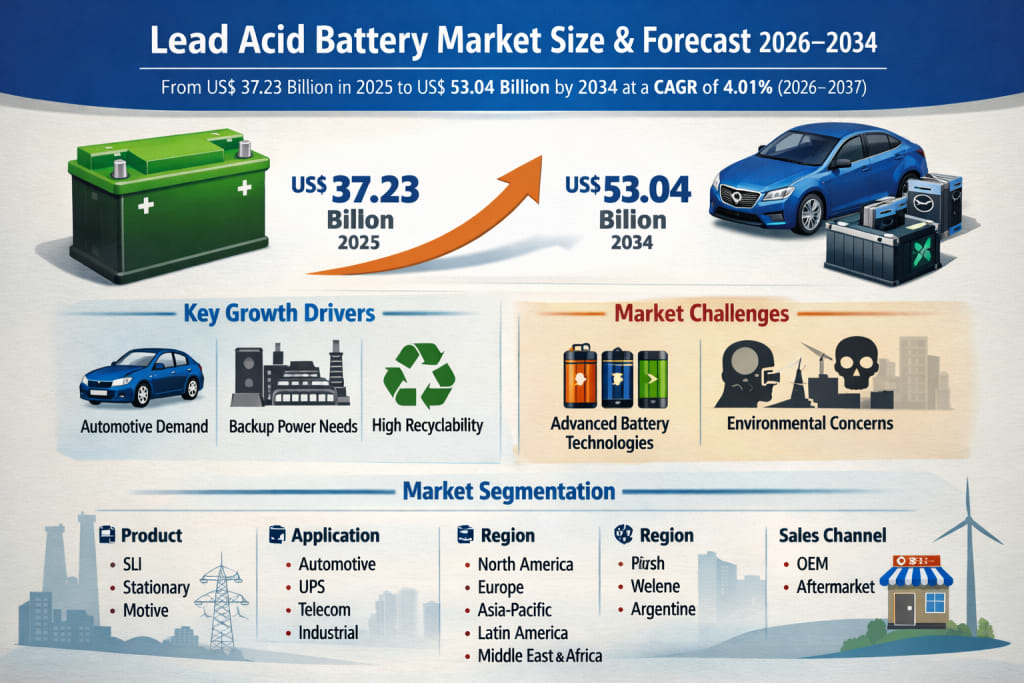
The global Lead Acid Battery Market, valued at US$ 37.23 billion in 2025, is projected to reach US$ 53.04 billion by 2034, expanding at a steady CAGR of 4.01% during 2026–2034. Despite the rapid rise of advanced battery chemistries, lead acid batteries continue to dominate several essential applications, particularly in automotive starting systems, industrial backup, telecommunications, and renewable energy storage.
The market’s resilience lies in its unmatched recyclability, low production cost, established supply chain, and proven reliability. While lithium-ion and emerging sodium-ion technologies gain attention, lead acid batteries remain deeply embedded in global infrastructure, especially across developing economies and cost-sensitive segments.
Lead Acid Battery Market Outlook
Lead acid batteries are secondary (rechargeable) batteries that utilize lead dioxide as the positive electrode, sponge lead as the negative electrode, and sulfuric acid as the electrolyte. As one of the oldest commercial battery technologies, they continue to power industries worldwide due to their durability, simplicity, and affordability.
Their ability to deliver high surge currents makes them indispensable for:
Starting, Lighting, and Ignition (SLI) systems
Uninterruptible Power Supply (UPS) units
Telecom infrastructure
Industrial equipment
Renewable energy storage
Forklifts and material handling systems
While newer chemistries promise higher energy density, lead acid batteries maintain a strong position in stationary and automotive applications where cost-effectiveness and reliability outweigh compactness.
Growth Drivers in the Lead Acid Battery Market
1. Strong Automotive and Transportation Demand
The automotive sector remains the largest contributor to lead acid battery consumption. Internal combustion engine (ICE) vehicles rely on lead acid batteries for ignition and electrical systems. Even with the global shift toward electrification, ICE vehicles still dominate many regions.
According to the International Energy Agency, global EV sales reached 14 million units in 2023, marking a 35% year-on-year increase. However, the global vehicle fleet still includes a massive base of conventional vehicles, ensuring strong replacement battery demand.
Lead acid batteries are also widely used in:
Hybrid vehicles (auxiliary systems)
Commercial fleets
Two-wheelers
Off-road and agricultural vehicles
Replacement demand, particularly in emerging economies with expanding vehicle ownership, continues to underpin steady growth.
2. Rising Demand for Backup Power and Industrial Applications
The rapid digital transformation across industries is increasing reliance on uninterrupted power systems. Lead acid batteries remain the preferred solution in:
Data centers
Telecom towers
Hospitals
Manufacturing facilities
Banking infrastructure
They offer scalability, reliability, and cost advantages for stationary backup systems.
For example, Toshiba Corporation introduced its SCiB™ 24V battery pack as a lithium-ion alternative capable of replacing existing lead-acid systems in automotive and marine applications. While lithium solutions are emerging, the installed base of lead acid batteries remains extensive, ensuring continued demand.
3. High Recyclability and Circular Economy Benefits
Lead acid batteries boast one of the highest recycling rates among all battery technologies—often exceeding 95% in developed markets. This closed-loop ecosystem significantly reduces environmental impact and raw material costs.
In August 2025, ACE Green Recycling introduced an innovative physical separation system that preserves valuable alloying elements like antimony and tin. The company is also establishing one of North America’s largest green battery recycling parks in Texas.
Such innovations reinforce supply chain sustainability and support regulatory compliance, enhancing long-term market viability.
Market Challenges
Competition from Advanced Battery Technologies
Lithium-ion batteries offer higher energy density, longer cycle life, and lighter weight. As costs decline, lithium-ion continues expanding into applications once dominated by lead acid batteries.
This intensifying competition forces manufacturers to focus on:
Cost-sensitive segments
Stationary backup systems
Replacement markets
Hybrid vehicle auxiliary batteries
While displacement risk exists, lead acid batteries maintain advantages in affordability and recycling infrastructure.
Environmental and Health Concerns
Lead is a hazardous material. Improper recycling and manufacturing practices can cause environmental and health risks. Governments enforce strict regulations regarding handling, transportation, and disposal.
Developing countries face challenges in maintaining structured recycling systems, which could restrict market growth if compliance standards are not met.
Segment Insights
SLI Lead Acid Battery Market
SLI batteries represent a dominant segment in automotive applications. Designed for high burst current output, they remain essential for ICE vehicle ignition systems.
Growing vehicle fleets and replacement cycles in emerging economies continue to drive SLI battery demand.
Flooded Lead Acid Battery Market
Flooded batteries are widely used in automotive, industrial, and renewable storage systems. Their advantages include:
Low initial cost
Simple design
High tolerance to overcharging
Suitability for heavy-duty operations
Although maintenance requirements limit adoption in certain environments, advancements in plate technology have improved durability.
OEM Lead Acid Battery Market
OEM sales involve direct supply to vehicle manufacturers. Strong partnerships between battery producers and automotive OEMs ensure stable contracts and predictable demand.
Lead acid batteries remain integral to conventional vehicle architecture and hybrid auxiliary systems. Growth in automotive production—especially across Asia-Pacific—supports steady expansion.
Automotive Lead Acid Battery Market
The automotive segment spans passenger cars, commercial vehicles, and two-wheelers. Replacement cycles are critical revenue drivers, given the limited lifespan of SLI batteries.
Start-stop vehicle technologies also continue to rely heavily on enhanced flooded and VRLA batteries.
Telecom Lead Acid Battery Market
Telecommunication infrastructure requires reliable backup power to ensure network continuity. Lead acid batteries power:
Telecom towers
Base stations
Data transmission hubs
Rapid telecom expansion in rural and developing regions sustains long-term demand.
Regional Market Insights
United States Lead Acid Battery Market
The U.S. market remains mature and stable, supported by automotive replacement demand and strong industrial applications. High recycling rates enhance sustainability and cost efficiency.
Emerging technologies are also entering the landscape. In December 2025, Unigrid Inc. announced sodium-ion starter battery solutions, signaling evolving competition.
Despite such advancements, lead acid batteries remain dominant in backup and SLI segments.
United Kingdom Lead Acid Battery Market
Automotive replacement demand and UPS systems in healthcare and data centers drive the UK market. Strong environmental regulations ensure high recycling compliance.
Meanwhile, battery manufacturing investments are accelerating. Tata Sons announced plans for a 40GW battery cell gigafactory in the UK, supporting electric mobility initiatives. While focused on advanced chemistries, traditional battery technologies continue serving conventional vehicle fleets.
India Lead Acid Battery Market
India represents one of the fastest-growing markets due to:
Rapid urbanization
Expanding automobile production
Frequent power outages
Rising telecom penetration
In August 2025, Solance Industries launched the Solance Plus series, designed for improved life cycles and performance under extreme conditions.
Cost sensitivity and replacement demand make India a critical growth engine for the global market.
Saudi Arabia Lead Acid Battery Market
Saudi Arabia’s demand stems from automotive usage, telecom towers, oil & gas operations, and infrastructure projects. Harsh climatic conditions increase battery replacement frequency.
In January 2026, Contemporary Amperex Technology Co. Limited (CATL) inaugurated a major after-sales service facility in Riyadh, highlighting growing regional battery activity. Nevertheless, lead acid batteries remain widely preferred due to their affordability and proven reliability.
Market Segmentation Overview
By Product:
SLI
Stationary
Motive
By Construction Method:
Flooded
Valve Regulated Sealed Lead–Acid (VRLA)
By Sales Channel:
OEM
Aftermarket
By Application:
Automotive
UPS
Telecom
Others
By Region:
North America (U.S., Canada)
Europe (France, Germany, Italy, Spain, UK, Belgium, Netherlands, Turkey)
Asia-Pacific (China, Japan, India, Australia, South Korea, Thailand, Malaysia, Indonesia, New Zealand)
Latin America (Brazil, Mexico, Argentina)
Middle East & Africa (South Africa, Saudi Arabia, UAE)
Competitive Landscape
Leading players shaping the industry include:
EnerSys
Exide Industries Limited
GS Yuasa Corporation
HBL Power Systems Limited
Leoch International Technology Limited
Panasonic Holdings Corporation
Teledyne Technologies Incorporated
Companies are focusing on product innovation, recycling enhancements, cost optimization, and strategic partnerships to sustain competitiveness.
Final Thoughts
The Lead Acid Battery Market may not be the newest technology in the energy storage ecosystem, but it remains one of the most resilient and economically vital segments globally. With strong demand from automotive SLI systems, expanding telecom infrastructure, and rising industrial backup requirements, the industry is positioned for stable, moderate growth through 2034.
Valued at US$ 37.23 billion in 2025 and forecasted to reach US$ 53.04 billion by 2034, the market’s steady 4.01% CAGR reflects its foundational role in global power systems.
While advanced chemistries like lithium-ion and sodium-ion gain prominence, lead acid batteries continue to offer unmatched recyclability, established supply chains, and affordability. In many regions—especially emerging economies—they remain indispensable.
About the Creator
Point of Sale Terminal Market Size & Forecast 2026–2034
Introduction The global Point of Sale (POS) terminal market is undergoing a powerful transformation, driven by the rapid shift toward digital payments, the expansion of modern retail and hospitality, and the growing need for faster, safer, and more integrated transaction systems. What was once a simple cash register has evolved into a sophisticated business management platform that connects payments, inventory, customer data, and analytics into one seamless ecosystem.
By shibansh kumar7 days ago in Trader



Comments
There are no comments for this story
Be the first to respond and start the conversation.