
Philippines Digital Twin Market 2026: Smart Infrastructure, Industry 4.0 & AI-Driven Simulation
How IoT integration, smart manufacturing initiatives and digital transformation strategies are reshaping the Philippines’ digital twin industry

Philippines Digital Twin Market Overview
The Philippines digital twin market is an emerging segment of the country’s advanced technology and industrial automation ecosystem. A digital twin is a virtual representation of a physical asset, system or process that uses real-time data, simulation models and analytics to monitor performance, predict maintenance needs and optimize operations. These technologies are increasingly used in industries such as manufacturing, urban planning, energy, transportation and healthcare.
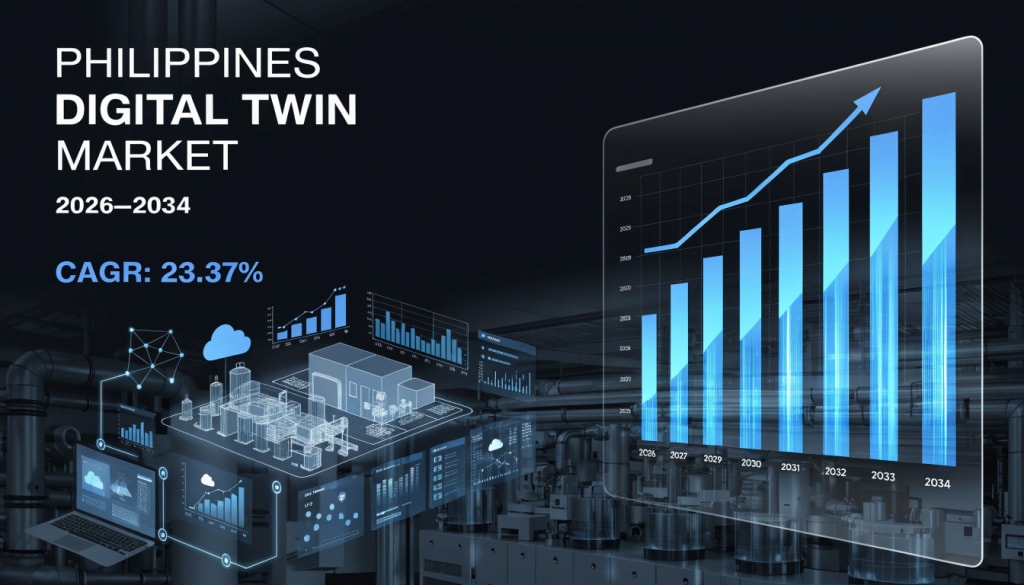
According to IMARC Group, the Philippines digital twin market size reached USD 130.2 Million in 2025 and is projected to reach USD 908.3 Million by 2034, exhibiting a compound annual growth rate (CAGR) of 23.37% during 2026–2034. The market is expanding rapidly due to increasing adoption of Industry 4.0 technologies, growing investments in smart infrastructure and the integration of artificial intelligence (AI), Internet of Things (IoT) and cloud computing platforms.
The rapid digital transformation of industries and rising interest in predictive analytics solutions are further accelerating the adoption of digital twin platforms across enterprises and government infrastructure projects in the Philippines.
Key Market Drivers
Increasing Adoption of Industry 4.0 Technologies
Manufacturing companies in the Philippines are increasingly adopting Industry 4.0 technologies to improve productivity and reduce operational costs. Digital twin systems allow manufacturers to create virtual models of production lines, enabling real-time monitoring and predictive maintenance of machinery.
Government Initiatives for Digital Transformation
Government programs aimed at strengthening digital infrastructure and smart city development are encouraging the deployment of advanced technologies such as digital twins. Initiatives promoting collaboration between international technology providers and local institutions are helping accelerate innovation in this sector.
Integration of AI, IoT and Cloud Computing
Digital twin platforms rely heavily on technologies such as IoT sensors, AI analytics and cloud computing systems. These technologies allow organizations to collect real-time data, analyze performance and simulate different operational scenarios to improve decision-making.
Growing Demand for Predictive Maintenance
Industries such as energy, transportation and manufacturing are increasingly using digital twins to detect equipment failures before they occur. Predictive maintenance reduces downtime, extends equipment lifespan and lowers operational costs.
Request a Sample Report with the Latest 2026 Data & Forecasts
What the Opportunities Are
The Philippines digital twin market presents strong opportunities as businesses increasingly adopt advanced simulation technologies and data-driven operational strategies.
Expansion of Smart City Infrastructure
Smart city initiatives require advanced technologies for monitoring infrastructure such as transportation networks, utilities and public services. Digital twin systems enable city planners to simulate urban environments and optimize infrastructure management.
Growth of Digital Twin Applications in Energy and Utilities
Energy companies are deploying digital twins to monitor power plants, transmission networks and renewable energy facilities. These systems help improve operational efficiency while reducing energy losses.
Increasing Use in Construction and Real Estate
Digital twins are increasingly used in building design, infrastructure development and real estate management. Virtual building models allow engineers and architects to simulate structural performance and optimize building operations.
Development of Digital Twins for Healthcare Systems
Healthcare providers are exploring digital twin technologies to improve patient monitoring, medical device management and hospital infrastructure planning.
Integration with 5G and Edge Computing
The deployment of 5G networks and edge computing infrastructure is enabling faster data processing and real-time analytics for digital twin platforms, supporting large-scale industrial applications.
Growth of AI-Powered Simulation Platforms
Artificial intelligence is improving digital twin simulations by enabling more accurate predictive models and automated decision-making systems.
Recent News and Developments
June 2025: Engineering firm Arup launched a digital twin initiative for the Pasig River, integrating satellite data, weather models, and environmental datasets to track plastic waste flows and support large-scale river clean-up and environmental planning efforts.
November 2025: Researchers from the University of the Philippines developed an AI-powered digital twin of the country’s watersheds and wetlands under the AI-SWaMP project to monitor pollution, predict water movement, and support disaster-risk management and environmental protection.
December 2025: The Philippines digital twin market was valued at about USD 105.30 Million in 2024 and is projected to reach USD 877.64 Million by 2033, reflecting strong adoption of virtual modeling technologies for predictive maintenance and smart infrastructure planning.
2026: Digital twin technologies are increasingly being adopted across manufacturing, infrastructure, and smart city projects in the Philippines, enabling real-time simulation and optimization of assets through AI, IoT, and advanced analytics platforms.
Why You Should Know About the Philippines Digital Twin Market?
The Philippines digital twin market is rapidly emerging as a key technology sector within the country’s digital transformation landscape. Digital twin platforms enable businesses and governments to simulate real-world environments, improve operational efficiency and make data-driven decisions.
With projected growth from USD 130.2 Million in 2025 to USD 908.3 Million by 2034, the market demonstrates strong expansion potential driven by Industry 4.0 adoption, smart infrastructure investments and the increasing use of AI-powered simulation technologies.
As organizations continue to embrace digital transformation and advanced analytics, the Philippines digital twin industry is expected to play a crucial role in shaping the future of smart infrastructure and intelligent industrial systems.
About the Creator
Keep reading
More stories from Manisha Dixit and writers in Trader and other communities.
Philippines Electric Vehicle Market 2026: Clean Mobility Adoption, Charging Infrastructure & Government Incentives
Philippines Electric Vehicle Market Overview The Philippines electric vehicle (EV) market is emerging as a rapidly expanding segment of the country’s transportation and clean energy ecosystem. Electric vehicles—including battery electric vehicles (BEVs), plug-in hybrid electric vehicles (PHEVs) and hybrid electric vehicles (HEVs)—offer environmentally friendly alternatives to conventional internal combustion engine vehicles. With increasing awareness of sustainable mobility and rising fuel costs, both consumers and businesses are gradually transitioning toward electric transportation solutions.
By Manisha Dixitabout 6 hours ago in Trader
Australia Smart Home Market Size and Forecast 2026–2034
Introduction The Australia Smart Home Market is experiencing remarkable growth as households increasingly adopt connected technologies designed to improve convenience, safety, and energy efficiency. Smart devices are transforming traditional homes into digitally connected living spaces where lighting, climate control, entertainment systems, and security devices can be managed through mobile applications, voice commands, or automated schedules.
By Sakshi Sharma4 days ago in Trader
A System That Isn’t Working Challenge Winners
Systems promise order. They organize behavior, distribute opportunity, and suggest that if everyone follows the rules, things will work. The entries in A System That Isn’t Working look closely at what happens when that promise begins to slip.
By Vocal Curation Team5 days ago in Resources


Comments
There are no comments for this story
Be the first to respond and start the conversation.