
Protein Ingredients Market Companies Analysis
Plant-Based Innovation, Sustainability Goals, and Corporate Expansion Driving a US$ 89.21 Billion Industry by 2033

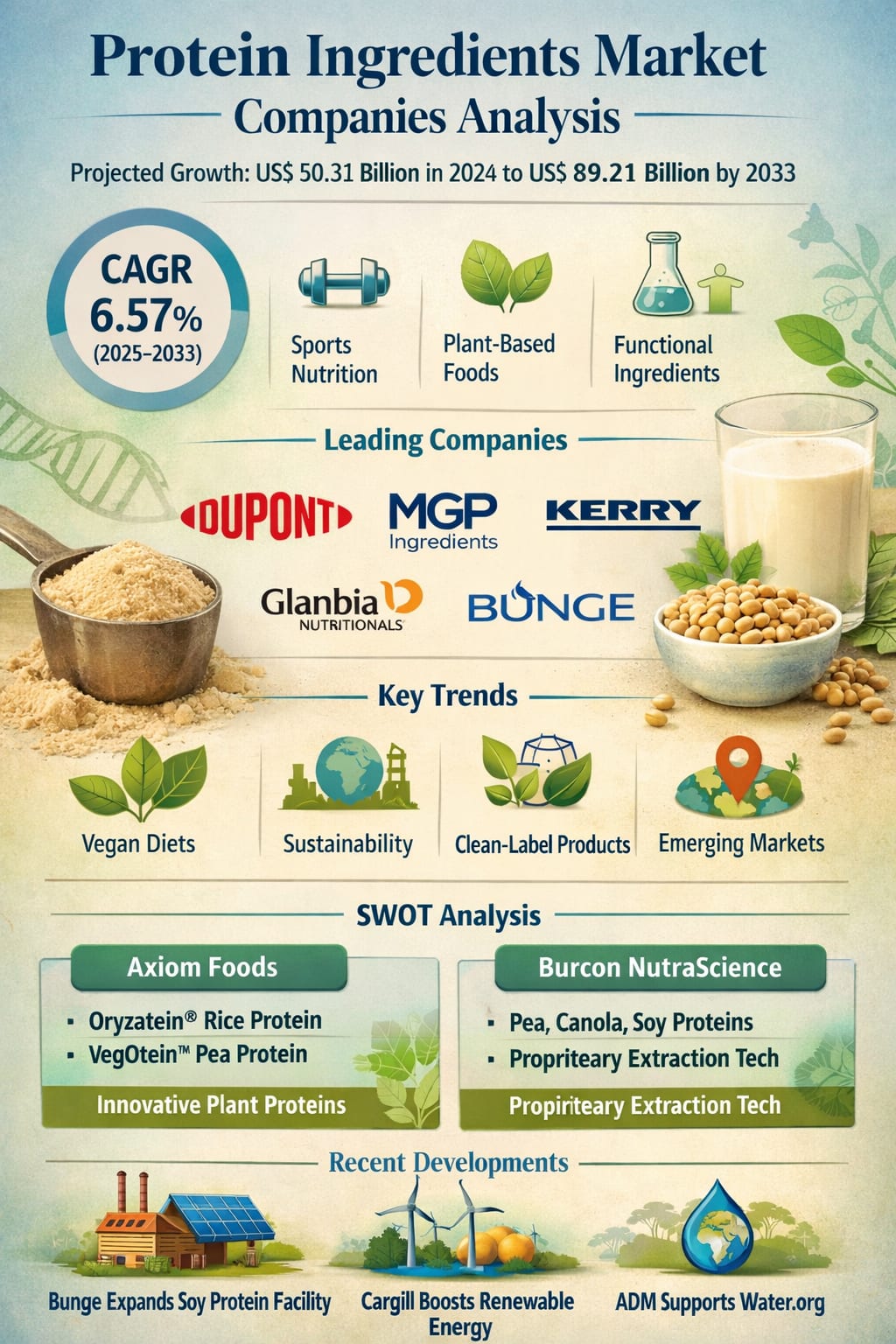
The global Protein Ingredients Market is entering a transformative decade. According to Renub Research, the industry is projected to grow from US$ 50.31 Billion in 2024 to US$ 89.21 Billion by 2033, reflecting a compound annual growth rate (CAGR) of 6.57% between 2025 and 2033.
This steady expansion is fueled by evolving consumer dietary patterns, increased awareness of health and wellness, rising demand for plant-based proteins, and growing applications across food, beverage, nutraceutical, and animal nutrition sectors.
From soy and whey proteins to emerging sources like pea, rice, canola, and sunflower, protein ingredients are now central to global nutrition innovation. Major corporations are expanding their footprints, strengthening sustainability initiatives, and investing heavily in technological advancements to capture the growing demand.
Below is a comprehensive company-level analysis of the leading players shaping the protein ingredients ecosystem.
Market Overview
Protein ingredients are derived from both animal sources (whey, casein, egg, collagen) and plant sources (soy, pea, rice, hemp, canola). These ingredients are widely used in:
Sports and clinical nutrition
Functional beverages
Dairy alternatives
Bakery and confectionery
Meat alternatives
Infant nutrition
Animal feed
Urbanization, rising disposable income, veganism, lactose intolerance prevalence, and the clean-label movement have significantly boosted demand.
Technological advancements in protein extraction and purification have enhanced solubility, digestibility, and taste profiles—key factors influencing market growth.
Leading Companies in the Protein Ingredients Market
1. DuPont de Nemours, Inc.
Established: 1802
Headquarters: Wilmington, Delaware, USA
DuPont is a global science-based innovation leader offering advanced materials and specialty ingredients across diverse industries. Within protein ingredients, DuPont focuses on food and nutrition solutions integrated into its broader bioscience and material technology platforms.
Business Model & Operations
DuPont serves sectors including food & beverage, healthcare, aerospace, electronics, construction, and clean energy. Its protein solutions support functional food applications, texture enhancement, and nutritional fortification.
Strategic Focus
Technological innovation
Sustainable material development
Industry-diverse integration
Advanced food science capabilities
DuPont’s deep R&D ecosystem strengthens its competitive positioning in protein ingredient innovation.
2. MGP Ingredients
Established: 1941
Headquarters: Atchison, Kansas, USA
MGP Ingredients is recognized for specialty wheat proteins and starches alongside premium distilled spirits.
Core Strength
Specialty wheat protein portfolio
Strong distribution network
Diversified ingredient offerings
The company supplies ingredient products to bakery and packaged food manufacturers globally. Its wheat proteins enhance texture, structure, and nutritional content in food applications.
Geographic Presence
Operations extend across the United States, Canada, Mexico, Japan, Thailand, and the UK.
3. Kerry Group plc.
Established: 1972
Headquarters: Tralee, Ireland
Kerry Group is a global leader in taste and nutrition solutions, combining protein ingredients with bioactives, enzymes, and fermented components.
Product Portfolio
Protein fractions
Lipids and enzymes
Probiotics
Beverage concentrates
Functional nutrition ingredients
Sustainability Strategy
Aligned with UN Sustainable Development Goals (SDGs):
Goal 2 – Zero Hunger
Goal 3 – Good Health & Well-being
Goal 12 – Responsible Consumption & Production
In 2023:
Reached 1.25 billion consumers with balanced nutrition solutions
Reduced Scope 1 & 2 emissions by 48%
Reduced food waste by 39%
Kerry’s sustainability-first strategy enhances long-term brand value and regulatory resilience.
4. Glanbia Plc.
Established: 1997
Headquarters: Kilkenny, Ireland
Glanbia specializes in sports and performance nutrition.
Product Lines
Dairy and non-dairy proteins
Ready-to-drink beverages
Nutrition bars
Vitamin and mineral premixes
Brands
Optimum Nutrition, Isopure, BSN, Nutramino, Amazing Grass, think!
Strategic Advantage
Strong distribution across mass retail, online platforms, and specialty channels globally.
Glanbia benefits from rising sports nutrition demand and high-protein functional foods.
5. Bunge Limited
Established: 1818
Headquarters: Chesterfield, Missouri, USA
Bunge is a global agribusiness and food company with strong protein meal and oilseed processing operations.
Product Portfolio
Oilseeds
Vegetable oils
Protein meals
Milling products
Fertilizers
Recent Development
In May 2025, Bunge invested EUR 484 million in a soy protein concentrate facility in Morristown, Indiana. This strategic expansion strengthens its plant-based protein manufacturing capabilities.
Bunge’s global supply chain provides scale advantages in protein sourcing and processing.
SWOT Analysis Highlights
Axiom Foods
Strength – Innovative Portfolio
Axiom Foods produces patented plant proteins such as:
Oryzatein® rice protein
VegOtein™ pea protein
These products are allergen-friendly, chemical-free, and clinically validated to rival whey protein performance.
Opportunity – Expanding Plant-Based Demand
The surge in veganism and clean-label trends offers immense growth potential. Strategic partnerships with food manufacturers can further accelerate expansion.
Burcon NutraScience
Strength – Proprietary Extraction Technology
Burcon’s patented technologies enable production of high-purity proteins from:
Pea
Canola
Soy
Hemp
Sunflower
Opportunity – Strategic Collaborations
Licensing technology and forming commercial alliances with major food producers positions Burcon strongly in plant-based innovation.
CHS Inc.
Strength – Diversified Portfolio
CHS operates across agronomy, grain marketing, and energy sectors, providing revenue stability.
Opportunity – Technology Adoption
Precision agriculture, automation, and sustainable energy investments create long-term growth pathways.
Other Major Companies in the Market
Archer Daniels Midland Co.
Cargill, Incorporated
Roquette Frères
Tessenderlo
Crop Energies AG.
Axiom Foods
Puris
Burcon NutraScience
CHS, Inc.
These companies collectively shape global protein supply chains through vertical integration, ingredient innovation, and sustainability leadership.
Sustainability & Renewable Energy Initiatives
Cargill
In March 2024, Cargill expanded its renewable energy capacity by 42%, adding 300 MW of solar and wind energy, bringing its total to 716 MW. This supports its 2025 greenhouse gas reduction goals.
ADM
On March 22, 2024, ADM pledged US$ 1 million to Water.org to improve global water and sanitation access.
Kerry Group
Continues investing in carbon reduction, sustainable sourcing, and waste minimization.
Sustainability has become a competitive differentiator in the protein ingredients market, influencing purchasing decisions and regulatory alignment.
Revenue & Strategic Assessment
Revenue Drivers
Rising demand for plant-based foods
Growth in sports nutrition
Expansion of dairy alternatives
Clean-label preference
Emerging markets urbanization
Key Threats
Raw material price volatility
Regulatory pressures
Climate change impact on crop yield
Intense competition
Competitive Strengths
R&D investment
Proprietary extraction technologies
Global supply chain networks
Strong distribution partnerships
Forecast Analysis (2025–2033)
The protein ingredients market is forecast to maintain consistent growth due to:
Increasing protein fortification in mainstream food
Expansion of flexitarian diets
Government focus on sustainable agriculture
Alternative protein research acceleration
Investment in novel plant-based formulations
By 2033, plant proteins are expected to gain a larger share of total protein ingredient revenue, narrowing the gap with animal-based proteins.
Asia-Pacific and North America are projected to be key growth regions, supported by urbanization, health awareness, and processed food consumption.
Final Thoughts
The Protein Ingredients Market is transitioning from a traditional agribusiness-driven sector into a high-innovation, sustainability-focused global industry.
With the market projected to reach US$ 89.21 Billion by 2033, companies that combine:
Technological advancement
Clean-label innovation
Sustainable sourcing
Renewable energy adoption
Strategic partnerships
will likely dominate the competitive landscape.
Global leaders such as DuPont, Kerry Group, Glanbia, Bunge, ADM, and Cargill are leveraging their scale and R&D capabilities, while innovative firms like Axiom Foods and Burcon NutraScience are disrupting the plant-based protein space through patented technologies.
As consumer preferences continue shifting toward health-conscious and environmentally responsible nutrition, protein ingredients will remain a foundational pillar of the global food and beverage economy.
About the Creator
In-Vitro Diagnostics Enzymes Market Expands with AI-Driven Precision and Next-Gen Diagnostic Innovation
In-Vitro Diagnostics Enzymes Market Overview In-vitro diagnostic enzymes are specialized biological catalysts used in laboratory tests performed outside the human body to detect diseases, infections, metabolic disorders, and genetic conditions. These enzymes are essential components in clinical chemistry analyzers, polymerase chain reaction (PCR) testing kits, biosensors, and immunoassay platforms.
By James Smith4 days ago in Trader
Australia Laboratory Centrifuge Market Expands with Rising Diagnostic and Research Demand
In 2024, the Australia laboratory centrifuge market was valued at approximately USD 50.1 million, and is expected to grow to USD 68.7 million by 2033, exhibiting a compound annual growth rate (CAGR) of 3.20% during the 2025–2033 period. This forecast underscores steady expansion driven by rising clinical testing demand, growing biotechnology research and continuous investment in advanced laboratory infrastructure across Australia. Laboratory centrifuges are fundamental tools in clinical diagnostics, biomedical research and pharmaceutical R&D — used for blood separation, molecular analysis and cell biology workflows.
By Amélie Belle5 days ago in Trader




Comments
There are no comments for this story
Be the first to respond and start the conversation.