
Urinary Tract Infection Treatment Market Size and Forecast 2025–2033
Rising Infection Burden, Antibiotic Innovation, and Expanding Healthcare Access to Drive Steady Global Growth

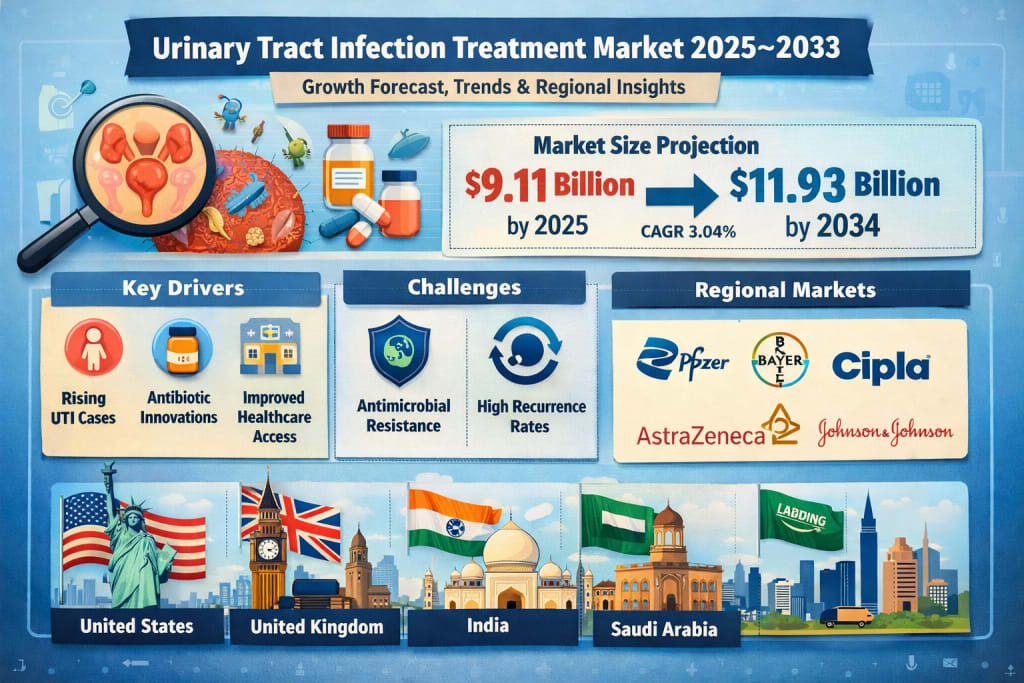
The global Urinary Tract Infection (UTI) Treatment Market continues to demonstrate resilient growth as infection prevalence rises across all age groups and healthcare systems intensify their focus on timely diagnosis and effective antimicrobial therapy. According to Renub Research, the Urinary Tract Infection (UTI) Treatment Industry is anticipated to reach US$ 9.11 billion in 2025, expanding further to US$ 11.93 billion by 2034, registering a CAGR of 3.04% between 2026 and 2034.
This steady expansion reflects multiple underlying forces: increasing UTI incidence, growing elderly and diabetic populations, better diagnostic access, and pharmaceutical innovation in both antibiotic and non-antibiotic therapies. As global healthcare systems grapple with antimicrobial resistance (AMR), the UTI treatment market is evolving into a space where innovation, stewardship, and accessibility must coexist.
Understanding Urinary Tract Infection Treatment
Urinary tract infection treatment encompasses therapeutic approaches aimed at eliminating bacterial infections affecting the urinary system — including the bladder, urethra, ureters, and kidneys. UTIs are predominantly caused by Escherichia coli (E. coli), though other organisms such as Proteus mirabilis and Staphylococcus saprophyticus also contribute significantly.
Standard treatment protocols primarily involve antibiotics to eradicate infection, alongside analgesics to relieve symptoms such as dysuria (burning sensation during urination), urgency, and frequency. In recurrent cases, physicians may recommend preventive regimens, probiotics, cranberry extracts, hydration management, and lifestyle modifications.
UTIs rank among the most common bacterial infections globally, affecting women disproportionately due to anatomical susceptibility. Children, elderly individuals, catheterized patients, and immunocompromised populations are also at heightened risk.
Growing awareness about early diagnosis, along with better availability of primary healthcare services, has led to increased physician consultations and prescription volumes worldwide. At the same time, the emergence of antimicrobial resistance has catalyzed innovation in alternative therapeutic strategies.
Key Growth Drivers in the UTI Treatment Market
1. Rising Prevalence Across All Age Groups
One of the strongest growth catalysts for the UTI treatment industry is the expanding global burden of urinary tract infections. UTIs affect millions annually, particularly:
Women (due to shorter urethral anatomy)
Elderly individuals
Patients with diabetes
Catheterized or hospitalized patients
Individuals with compromised immune systems
According to the National Institutes of Health (NIH), UTIs are among the leading causes of morbidity globally. Increasing geriatric populations, sedentary lifestyles, chronic diseases, and hospital admissions are intensifying case numbers.
Recurrent UTIs (rUTIs) further amplify demand, as patients often require prolonged or repeated treatment courses. This directly contributes to sustained pharmaceutical consumption and expanded therapeutic portfolios.
2. Advancements in Antibiotics and Alternative Therapies
The pharmaceutical industry continues to innovate to address resistant strains and improve safety profiles.
Major global companies such as Pfizer, Merck & Co., Inc., AstraZeneca, Bayer AG, and GlaxoSmithKline PLC are investing in novel antimicrobial agents and combination therapies.
Recent developments include:
Next-generation fluoroquinolones with improved resistance coverage
Narrow-spectrum antibiotics for antimicrobial stewardship
Immunotherapy-based preventive approaches
Probiotic and microbiome-focused interventions
Non-antibiotic agents such as methenamine formulations
In September 2024, Mankind Pharma introduced home-based UTI self-testing kits, enhancing early detection and empowering patients with faster diagnosis.
In April 2024, Pivya (pivmecillinam) tablets received U.S. approval for uncomplicated UTIs caused by susceptible bacterial strains, further strengthening therapeutic diversity.
3. Improved Healthcare Access and Awareness
Healthcare accessibility has expanded significantly across emerging economies. Telemedicine, online pharmacies, retail clinics, and primary care networks are making UTI diagnosis and treatment more accessible than ever.
The Centers for Disease Control and Prevention (CDC) reports that approximately 75% of healthcare-associated UTIs are linked to urinary catheter use. With hospital stays often involving catheterization, infection control programs are emphasizing early identification and prompt treatment.
Greater public awareness regarding UTI symptoms — particularly among women — is driving earlier intervention, which improves treatment outcomes and boosts medication demand.
Key Challenges in the UTI Treatment Market
Antimicrobial Resistance (AMR)
The misuse and overuse of antibiotics have led to resistant bacterial strains. AMR complicates treatment protocols and increases healthcare costs. Developing new antibiotics is time-intensive and expensive, requiring substantial R&D investment.
High Recurrence and Compliance Issues
Recurrent UTIs pose a significant burden. Poor adherence to antibiotic regimens, incomplete treatment courses, and lifestyle factors contribute to relapse. Long-term preventive therapy increases monitoring and cost requirements.
Segment Analysis
Quinolones Treatment Market
Fluoroquinolones such as ciprofloxacin and levofloxacin are widely used for both uncomplicated and complicated UTIs due to strong tissue penetration and broad-spectrum efficacy. However, safety warnings and resistance concerns have moderated usage.
Cephalosporin Treatment Market
Cephalosporins remain vital in UTI management, especially in pediatric, elderly, and pregnant populations due to favorable safety profiles. Their availability in oral and injectable forms enhances hospital and outpatient adoption.
Complicated UTI Treatment Market
Complicated UTIs, often associated with diabetes, renal disorders, catheter use, or anatomical abnormalities, require longer therapy durations, hospitalization, and combination antibiotic regimens. Rising chronic disease prevalence fuels this segment.
Hospital-Based Treatment Market
Hospitals account for substantial UTI treatment revenue due to severe infections, catheter-associated cases, and resistant strains requiring intravenous therapy and monitoring.
Regional Market Insights
United States
The United States maintains a mature and innovation-driven UTI treatment market supported by advanced diagnostics and robust pharmaceutical research.
Major players such as Johnson & Johnson, Novartis AG, and Bristol-Myers Squibb Company contribute significantly to antimicrobial development.
Telehealth expansion and antimicrobial stewardship programs enhance prescription responsibility and accessibility.
United Kingdom
The UK benefits from an organized public healthcare framework under the NHS. Evidence-based prescribing guidelines minimize resistance risk. In August 2025, the MHRA approved Blujepa (gepotidacin), a new chemical entity targeting uncomplicated UTIs in females aged 12+.
Cost containment measures exist but are balanced by structured treatment updates and education programs.
India
India represents a high-growth market due to its large population base and expanding healthcare infrastructure. Generic antibiotic availability makes treatment affordable.
In September 2025, Cipla Limited launched Methenamine Hippurate under the brand HUENA for recurrent UTI management — a significant step toward combating antimicrobial resistance.
Saudi Arabia
Saudi Arabia’s UTI treatment market benefits from strong government healthcare investments and improved hospital infrastructure. Rising diabetes prevalence and an aging population elevate infection incidence.
In January 2026, Nogapendekin alfa-inbakicept-pmln (Anktiva) plus BCG therapy received accelerated approval for specific bladder cancer indications, reinforcing broader urological therapeutic advancement.
Market Segmentation Overview
By Product Type
Penicillin & Combinations
Quinolones
Cephalosporins
Aminoglycosides
Sulphonamides (SMX + TMP)
Azoles & Amphotericin B
Tetracycline (Doxycycline)
Nitrofurans (Nitrofurantoin)
Others
By Indication
Complicated UTI
Uncomplicated UTI
By End-Users
Hospitals
Gynaecology & Urology Clinics
Drug Stores
Retail Pharmacies
Online Drug Stores
By Geography
North America
Europe
Asia Pacific
Latin America
Middle East & Africa
Competitive Landscape
The UTI treatment industry features global pharmaceutical leaders and regional generics manufacturers. Each company is analyzed across five key viewpoints:
Overview
Key Persons
Recent Developments & Strategies
Product Portfolio
Financial Insights
Notable companies include:
AstraZeneca
Bayer AG
GlaxoSmithKline PLC
Johnson & Johnson
Novartis AG
Pfizer
Merck & Co., Inc.
Dr. Reddy’s Laboratories Ltd.
Bristol-Myers Squibb Company
These firms continue to focus on pipeline innovation, regulatory approvals, resistance management, and expansion into emerging markets.
Final Thoughts
The Urinary Tract Infection Treatment Market is poised for moderate yet sustained growth through 2034. With projected expansion from US$ 9.11 billion in 2025 to US$ 11.93 billion by 2034, the market reflects consistent demand driven by infection prevalence, demographic shifts, and healthcare modernization.
However, the industry stands at a crossroads. Antimicrobial resistance challenges conventional antibiotic models, pushing pharmaceutical innovation toward safer, targeted, and non-antibiotic alternatives. Meanwhile, expanding healthcare access in emerging economies like India and Saudi Arabia strengthens long-term growth prospects.
As stewardship programs become more prominent and diagnostic tools more precise, the UTI treatment market will increasingly prioritize personalized medicine, preventive strategies, and responsible prescribing.
About the Creator
Keep reading
More stories from shibansh kumar and writers in Trader and other communities.
Intraocular Lens Market Size and Forecast 2026–2034
The global Intraocular Lens (IOL) Market is entering a transformative growth phase, driven by demographic shifts, surgical innovation, and rising patient awareness. According to Renub Research, the Intraocular Lens Market was valued at US$ 6.98 billion in 2025 and is projected to reach US$ 12.58 billion by 2034, expanding at a Compound Annual Growth Rate (CAGR) of 6.76% from 2026 to 2034.
By shibansh kumarabout 16 hours ago in Trader
Luxury Car Market: Innovation, Prestige, and the Future of Premium Mobility
Market Overview Luxury cars are typically characterized by superior build quality, advanced safety systems, innovative infotainment, enhanced comfort, and strong brand identity. These vehicles are positioned at the upper end of the automotive spectrum and cater to affluent consumers seeking exclusivity and performance.
By James Smith7 days ago in Trader
Philippines Business Process Management Market 2026: Automation Growth, Digital Workforce and Outsourcing Evolution
Philippines Business Process Management Market Overview The Philippines business process management (BPM) market is expanding steadily as enterprises across industries adopt automation and workflow optimisation solutions to improve operational efficiency and service delivery. BPM solutions enable organisations to design, monitor and automate business processes, helping reduce costs, enhance productivity and improve customer experience. As the Philippines strengthens its position as a global outsourcing destination and accelerates enterprise digital transformation, BPM technologies are becoming critical infrastructure supporting modern business operations.
By Manisha Dixit5 days ago in Trader



Comments
There are no comments for this story
Be the first to respond and start the conversation.