
When the Sky Forgot Our Names
On the Night Gravity Whispered, Humanity Learned It Was Not Alone

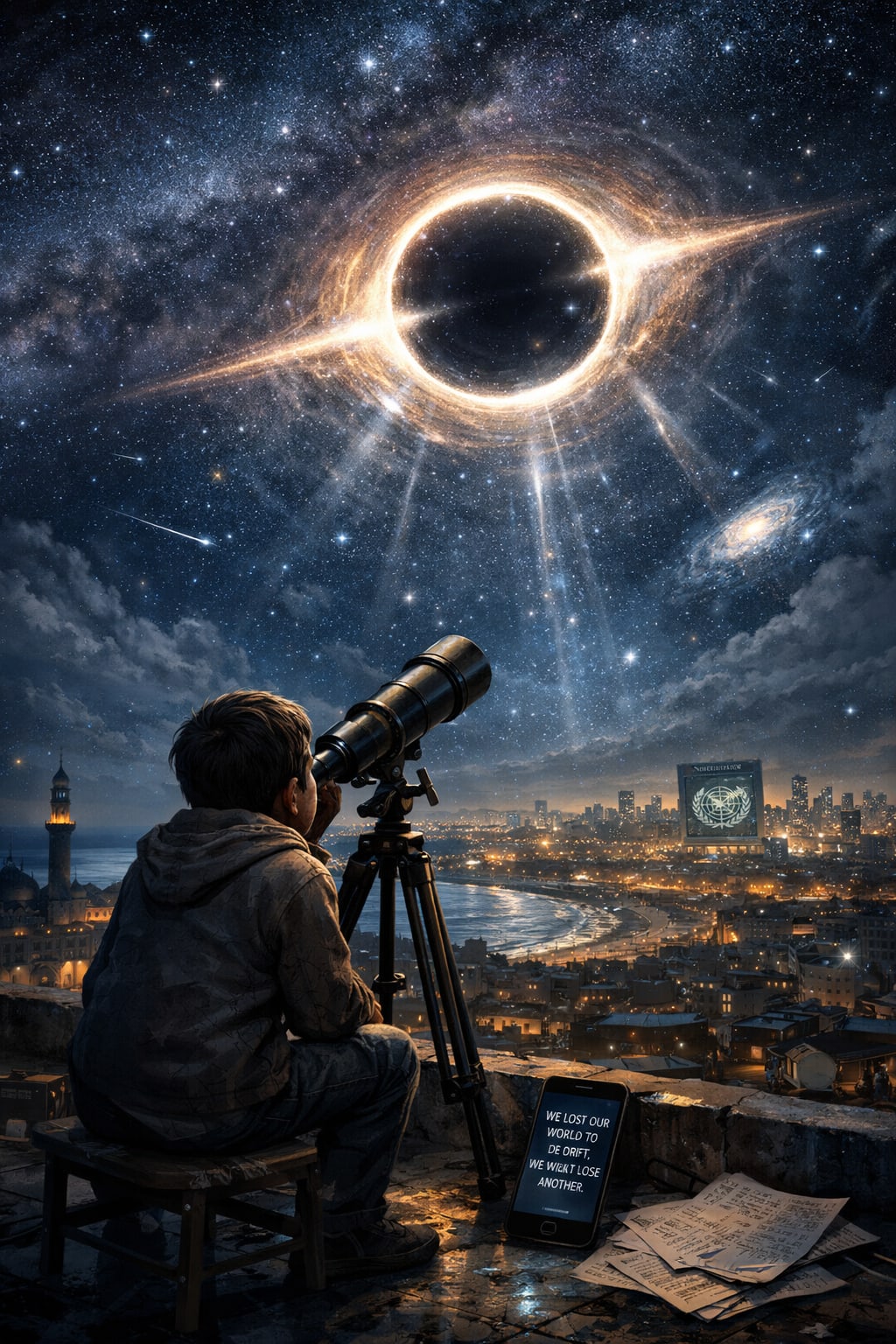
The night the sky changed, nobody noticed at first.
In the crowded streets of Karachi, traffic hummed and neon lights flickered against humid air. Street vendors shouted over the sound of buses. Teenagers laughed on rooftops. The Arabian Sea rolled in and out like it had for centuries.
Then gravity shifted.
Not violently. Not enough to send buildings tumbling. Just enough that a glass left on a table trembled. Just enough that a sleeping child stirred. Just enough that birds flying above Clifton Beach faltered mid-wingbeat before correcting themselves.
Across the world — in Tokyo, in New York City, in Cairo — the same microscopic pulse passed through the planet like a silent heartbeat.
Seismologists blamed tectonic drift. Physicists blamed solar interference. Politicians blamed each other.
But twelve-year-old Ayaan Malik blamed the sky.
Because he heard it.
Ayaan had always loved the stars. While others his age chased cricket balls through narrow alleys, he chased constellations with a cracked telescope his late mother had given him. She used to say, “The universe is a story still being written.”
That night, when gravity trembled, Ayaan’s telescope screamed.
Not audibly. Not like metal bending. But through the eyepiece, the stars blurred and rearranged themselves. Constellations dissolved. Orion’s belt tilted unnaturally. The North Star drifted a fraction west.
And then a new star appeared.
It wasn’t brighter than the rest. It wasn’t dramatic. It simply wasn’t supposed to be there.
Ayaan checked his astronomy app. No match.
He rubbed his eyes. Still there.
Then his phone buzzed.
Every phone in the world buzzed.
A single notification appeared on every screen, regardless of language, brand, or network provider:
“WE HAVE FOUND YOU.”
No sender. No signal origin. No code signature.
Within minutes, global panic erupted. News channels scrambled for explanations. The United Nations called an emergency assembly. Hackers tried tracing the signal and found something impossible:
The message did not come from Earth.
It came from the direction of the new star.
At the United Nations headquarters in New York City, leaders debated whether it was a hoax, an act of cyber warfare, or first contact.
Military satellites were redirected. Observatories locked onto the anomaly.
That was when scientists made the second discovery.
The new “star” wasn’t burning.
It was bending light around it.
Like an eye.
A gravitational lens, precisely positioned, artificially constructed, and impossibly vast.
Something had placed it there.
Something had aimed it at Earth.
Ayaan didn’t understand gravitational lensing yet. But he understood patterns. The new star pulsed in a rhythm — faint, steady intervals.
Like a heartbeat.
He recorded it.
When he converted the light fluctuations into audio frequencies, the sound made his chest tighten.
It wasn’t random.
It was structured.
Mathematical.
He uploaded the file before fear could stop him.
Within hours, physicists confirmed it: the pulse was prime numbers.
A universal language.
Humanity responded.
Radio telescopes around the world transmitted the same sequence back into space. Mathematicians crafted complex responses — constants, equations, the blueprint of hydrogen atoms.
The sky answered.
The pulse accelerated.
Then the gravity shift came again — stronger this time. Ocean tides surged unexpectedly. Planes reported turbulence in clear skies. GPS systems flickered.
A third message appeared.
“YOU ARE DRIFTING.”
That was when NASA released the truth.
Earth’s orbit had shifted by 0.0003 degrees.
Tiny. Harmless — for now.
But it wasn’t natural.
Something was nudging the planet.
Global fear transformed into existential dread. Were they warning us? Threatening us? Experimenting?
Religious leaders called it judgment. Tech billionaires called it opportunity. Militaries called it a target.
Ayaan called it lonely.
Because when he listened again to the pulses, slowing them down and isolating patterns, he heard something beneath the mathematics.
A tremor.
An irregularity.
Like hesitation.
He posted his theory online: “What if they’re not attacking? What if they’re stabilizing us?”
The idea sounded ridiculous.
Until astrophysicists confirmed a hidden variable in Earth’s trajectory.
The planet had been gradually destabilizing for decades — gravitational fluctuations from unseen dark matter density shifts near our solar system. The deviation should have been worse.
Something had corrected it.
The new star wasn’t pushing Earth away from the sun.
It was preventing Earth from drifting further.
The message wasn’t a threat.
It was a diagnosis.
On the fourth night, the pulses stopped.
The sky fell silent.
The artificial star dimmed.
Then one final message appeared:
“WE LOST OUR WORLD TO DRIFT. WE WILL NOT LOSE ANOTHER.”
No invasion came.
No ships arrived.
No beams of light descended.
Just silence.
But Earth’s orbit stabilized completely.
For the first time in modern astrophysical measurement, orbital fluctuation dropped to zero.
Perfect equilibrium.
Weeks passed.
Life resumed.
But something fundamental had changed.
Humanity was no longer alone — and no longer the most advanced intelligence watching the stars.
Ayaan returned to his rooftop in Karachi, telescope steady against the night breeze.
The artificial star remained, faint but present. A guardian lens suspended in cosmic darkness.
He wondered what their world had looked like. Oceans? Forests? Cities suspended under alien suns?
Had they panicked like we did? Debated like we did? Ignored warnings until it was too late?
He imagined a civilization watching their skies drift millimeter by millimeter — powerless to stop it.
And then choosing to save strangers instead.
The universe, his mother once said, was a story still being written.
Maybe this was its turning point.
Not a war of worlds.
Not a conquest.
But an inheritance.
Humanity had inherited a warning — and a responsibility.
We now knew planets could die quietly. Not by explosion. Not by collision.
But by drifting just slightly off course.
And maybe civilizations didn’t survive by dominating the stars.
Maybe they survived by steadying them.
As Ayaan adjusted his telescope, the artificial star pulsed once — softly.
Not mathematics this time.
Not a message.
Just a single, gentle flicker.
Like a goodbye.
Or perhaps —
About the Creator
Abubakar220
I am best Stories writer
Keep reading
More stories from Abubakar220 and writers in Unbalanced and other communities.
The Day the Stars Went Silent
It began without darkness. The stars still shone. On a clear Thursday night, children in deserts and cities pointed upward at familiar constellations. Satellites orbited peacefully. Aircraft crossed continents. The sky looked exactly as it had the night before.
By Abubakar2203 days ago in Earth
Super Bowl LX Recap: A Team Called Hawks
Sixty. The Super Bowl turned 60! Still amazes me that this was the sixtieth Super Bowl played in NFL history. It seems like yesterday that I watched Super Bowl XXVII, the first SB I ever watched. The QB who won Super Bowl XXVII has since called a few SBs, and will call next year's game, but that's another story. Super Bowl LX took place at Levi's Stadium in Santa Clara, California, the home stadium of the San Francisco 49ers. However, it was one of their division foes who represented the NFC, as the Seattle Seahawks faced off against the New England Patriots.
By Clyde E. Dawkins25 days ago in Unbalanced
Greeley-Jay Holds on for 4-3 Win Over Cortlandt
Scroll to end for photos On Thursday February 19, 5th seeded Greeley-Jay hosted the Cortlandt Rebels, and skating to a first period scoreless draw, wasn’t necessarily even up, according to Coach Alex Lichorat. “Their goalie played great,” he said. The Rebels got to know the feeling in the second period, though, but Greeley-Jay made much more of being put on the chase.
By Rich Monettiabout 5 hours ago in Unbalanced



Comments
There are no comments for this story
Be the first to respond and start the conversation.