
Basalt Crushing Challenges: How to Choose the Right Equipment for the Job
Basalt Crushing Challenges: How to Choose the Right Equipment for the Job

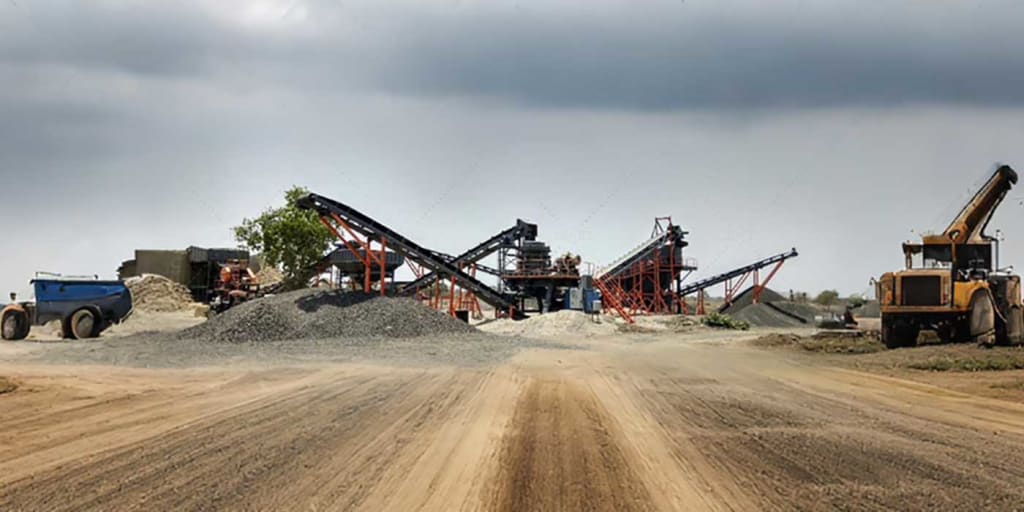
The processing of basalt, an extrusive igneous rock formed from rapidly cooled lava, presents a formidable set of challenges for aggregate producers. Its mineralogical composition, primarily plagioclase and pyroxene, confers exceptional compressive strength—often exceeding 300 MPa—and a high silica content that makes it notoriously abrasive. These intrinsic properties demand a deliberate, technically informed approach to equipment selection. An ill-suited basalt crusher will not only suffer catastrophic wear but will also fail to produce the requisite particle shape and gradation, compromising the final product's value in critical applications like high-strength concrete and asphalt. Success hinges on a systematic analysis that moves from material characterization through the crushing circuit, matching each machine's operational principle to the specific stage of size reduction and the desired product specification.
Material Characterization: Understanding the Basalt Adversary
Before any machine is selected, a comprehensive geotechnical analysis of the basalt deposit is non-negotiable. Simple visual inspection is insufficient. Laboratory testing must quantify the rock's Unconfined Compressive Strength (UCS) and its Los Angeles Abrasion (LAA) value. A high UCS indicates the need for crushers capable of generating immense fracture forces, while a high LAA value warns of accelerated wear on manganese steel liners and other components, directly influencing the economic viability of different crusher types. Furthermore, understanding the rock's fracture mechanics is crucial. Basalt can exhibit conchoidal fracture patterns, producing sharp, elongated slivers if crushed improperly. This necessitates equipment that promotes inter-particle crushing to encourage a more cubical product.
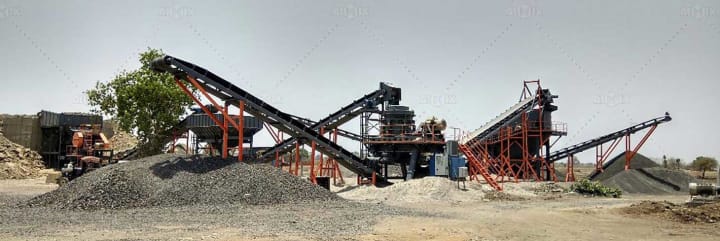
Equally critical is an analysis of the feedstock as it arrives at the primary crusher. The maximum feed size, or top-size, dictates the necessary dimensions of the crusher's feed opening. The gradation of the feed material—the distribution of particle sizes—impacts the crusher's efficiency and potential for packing or bridging within the chamber. Moisture content is a frequently underestimated variable. While basalt is typically low in inherent moisture, surface water from mining or weather can create fines that adhere to larger rocks and chamber walls, reducing capacity and increasing the risk of crusher stall. This characterization phase creates a definitive profile of the material adversary, establishing the non-negotiable performance criteria that the primary crushing equipment must overcome.
Primary Reduction: Matching Crusher Type to Feedstock and Product Goal
The primary crushing stage is responsible for the initial, coarse reduction of blasted basalt run-of-mine (ROM) material. The selection here is predominantly between two technologies: the jaw crusher and the gyratory crusher. Jaw crushers operate via compressive force between a fixed and a reciprocating jaw plate. They are the quintessential workhorse for hard, abrasive materials like basalt. Their selection is governed by the required feed opening size and the desired product's top size after this first break. Modern jaw crushers feature steep nip angles and aggressive crushing strokes specifically engineered for hard rock, efficiently reducing basalt boulders to a manageable 6- to 8-inch product. Their relative simplicity, ease of maintenance, and lower capital cost make them the default choice for many medium-capacity basalt operations.
For high-tonnage, high-capacity quarries where daily throughput is measured in thousands of tons, gyratory crushers offer a compelling advantage. Operating on a similar compression principle but with a gyrating mantle within a concave bowl, they provide a continuous crushing action. This results in higher capacity and a more consistent product gradation compared to the cyclical action of a jaw crusher mobile. Gyratories excel at handling slabby material—a common characteristic of basalt—and typically deliver a slightly more elongated product, which may be acceptable or even desirable for certain base course applications. The trade-off is significantly higher capital cost, greater installation complexity, and more specialized maintenance requirements. The choice between jaw and gyratory at the primary stage fundamentally shapes the entire downstream flow and the capital structure of the plant.
Secondary and Tertiary Processing: Shaping the Final Product
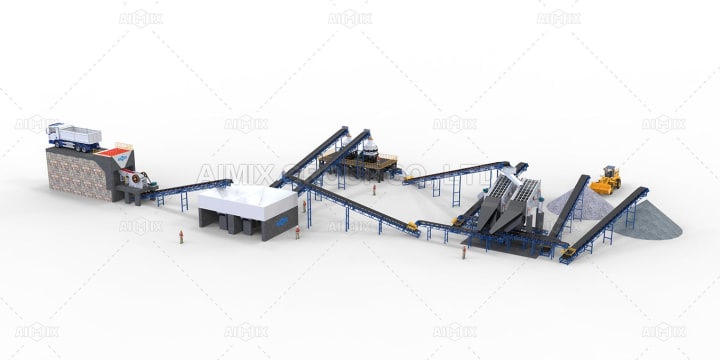
Following primary reduction, the material must be further refined to meet precise market specifications for shape, size, and cleanliness. This is the domain of secondary and tertiary crushers, where the goal shifts from brute-force reduction to controlled fragmentation for quality. The cone crusher is the undisputed cornerstone of this stage for basalt. Available in standard, short-head, and tertiary configurations, cone crushers utilize a gyrating mantle within a stationary concave to compress rock against itself. Modern cone crushers feature advanced chamber designs, variable throw, and automated settings systems that allow operators to fine-tune the balance between capacity, product shape, and liner wear. For producing high-quality, cubical aggregate for concrete and asphalt, a well-configured cone crusher circuit is essential. Its ability to maintain a consistent closed-side setting (CSS) despite liner wear is critical for product consistency.
For applications demanding superior particle shape—such as manufactured sand for high-performance concrete—Vertical Shaft Impactors (VSI) - sand making machines are employed, often in a tertiary or quaternary position. VSIs accelerate rock at high speed into an anvil or rock shelf, exploiting basalt's brittleness to induce a controlled "rock-on-rock" or "rock-on-anvil" fracture that creates highly cubical, well-fractured particles with optimal surface texture. While offering unparalleled shape, VSIs incur higher wear costs on consumable parts like anvils and rotor tips when processing highly abrasive basalt. An emerging technology for certain applications is the High-Pressure Grinding Roll (HPGR), which compresses a feed layer between two counter-rotating rolls. HPGRs are exceptionally energy-efficient and can produce a product with a high proportion of fines and microcracks, but they are a more specialized solution. The final selection in these stages is a meticulous optimization exercise, balancing the capital and operating costs of each machine against the premium price commanded by superior, in-spec aggregate products. The right equipment transforms a challenging basalt deposit from a geological obstacle into a high-value, market-dominant commodity.
About the Creator
consrtuctionmachines
AIMIX is a customer-center-oriented heavy equipment manufacturer and supplier, devoted to production, innovation, combination, one-stop solution, etc.
https://aimixgroup.com/
Keep reading
More stories from consrtuctionmachines and writers in Writers and other communities.
2026 Market Trends: Cement Mixer Pump in the Philippines
The Philippine construction sector is on a trajectory of sustained expansion, driven by the "Build, Better, More" infrastructure program, a robust residential market, and increasing private commercial development. Within this dynamic environment, the cement mixer pump—an integrated cement mixer pump machine combining a concrete mixer and a pumping unit—has moved from a niche specialty item to a mainstream productivity tool. As we look toward 2026, several distinct market trends are crystallizing that will shape how this equipment is specified, procured, and utilized across the archipelago. Understanding these trends is essential for contractors seeking to align their capital investments with the evolving demands of the Filipino construction landscape, ensuring they remain competitive, efficient, and responsive to project requirements.
By consrtuctionmachines5 days ago in Writers
If You Write A Book, Don’t Tell Anyone
There are days when I’m grateful Amazon doesn’t tell me specifically who has bought my book and who hasn’t. If they did, I would be heartbroken when I read the list and noticed all the important names in my life were not on my list of customers.
By Ellen Frances23 days ago in Writers
Best URL Shorteners
Long URLs filled with tracking codes and parameters can look messy and difficult to share. URL shorteners help transform these lengthy, cluttered links into shorter, cleaner versions that are easier to manage and share. Not only do they make URLs more user-friendly, but they also come with additional features like custom branding, tracking, and performance analytics.
By Backlinks Cart6 days ago in Writers




Comments