


This tiny episode, now recorded, becomes a testament to the way the mundane can be woven into the tapestry of a larger narrative, and I realize that the journal I am writing is itself a living document, constantly absorbing the present moment’s details.
Returning to the draft, I confront the paragraph I just completed, feeling a mixture of pride and unease. The sentences have a certain lyrical quality, yet I sense an undercurrent of excess—perhaps a tendency to linger too long on descriptive flourishes at the expense of momentum. I decide to read the passage aloud, allowing the cadence of my own voice to expose any clunky constructions. The words stumble over a particular phrase, prompting me to excise a redundant clause and replace a vague adjective with something more precise. This act of vocalizing my text serves as both a diagnostic tool and a therapeutic exercise, reminding me that the auditory dimension of language is as crucial as its visual representation.
With the revised section in place, I turn my attention to the emotional palette that underlies the entire writing process. I notice a subtle undercurrent of melancholy, as if each sentence is a quiet lament for the ideas that never fully materialize. I allow myself to dwell on that feeling, describing it in the journal not as a flaw but as a catalyst that fuels my perseverance. I write, “The ache of unfinished thoughts pushes me forward; it is both a reminder of my limitations and a beacon of my aspirations.” By naming the emotion, I transform it from an anonymous background hum into a character with agency in my narrative.
The afternoon sun begins to shift, casting longer shadows across the desk, and I feel my concentration waver as fatigue settles in. I confront this physiological signal head‑on, noting how my eyes grow heavier and my thoughts become fragmented. I decided to incorporate this bodily awareness into the journal, describing the sensation of my shoulders tightening and the rhythmic tapping of my foot as an unconscious metronome. By externalizing these physical cues, I create a bridge between the somatic experience of writing and the intellectual labor of composition, illustrating how the two are inseparably intertwined.
A sudden surge of inspiration erupts as I recall a childhood memory of scribbling stories in the margins of school textbooks. The recollection is vivid: the coarse paper, the smell of ink, the thrill of creating secret worlds under the watchful eye of a stern teacher. I weave this reminiscence into the current piece, drawing a parallel between that early, unfiltered enthusiasm and my present, more disciplined approach. The juxtaposition highlights a continuum—a thread that stretches from naïve imagination to mature self‑analysis—reinforcing the notion that the process of writing is a lifelong dialogue between past and present selves.
As evening descends, the room fills with a soft amber glow from a solitary desk lamp, and I find myself entering a state of flow that feels almost meditative. Words emerge with a fluidity that belies earlier hesitations, and I become aware of a rhythmic breathing pattern that seems to synchronize with the cadence of my sentences. I describe this phenomenon in the journal, noting the subtle interplay between the external light, the ambient silence, and the internal tempo of my thoughts. In this moment, the act of documenting the process becomes an act of experiencing it fully, where observation and creation merge into a single, seamless entity.
Finally, I close the notebook, feeling the weight of the day’s labor settle like a gentle pressure on my chest. I write a concluding reflection, acknowledging that the journal itself is a living artifact that records not only the content of my writing but also the intricate dance of attention, emotion, physiology, and environment that composes each line. I promise to return tomorrow, to revisit the passages, to prune what no longer serves and to nurture what has blossomed. In doing so, I reinforce the central insight that the process of writing is not a static task but an evolving, recursive journey—one that I am privileged to observe, dissect, and ultimately inhabit.
About the Creator
Forest Green
Hi. I am a writer with some years of experiences, although I am still working out the progress in my work. I make different types of stories that I hope many will enjoy. I also appreciate tips, and would like my stories should be noticed.
Keep reading
More stories from Forest Green and writers in Writers and other communities.
My Process
The protracted, almost ritualistic rhythm of my writing—hours spent wrestling with each sentence, revisiting paragraphs, and constantly rearranging ideas—has become a crucible for my thought, reshaping it in ways that are both subtle and profound: as I linger over a single metaphor, the mind is forced to unpack layers of meaning it would otherwise skim, prompting connections between seemingly unrelated concepts; the inevitable pauses between drafts act like mental respirations, allowing subconscious insights to surface and then be interrogated with fresh, analytical eyes; the iterative cycle of drafting, erasing, and refining compels me to articulate not only what I know, but why I know it, exposing hidden assumptions and inviting me to renegotiate them; consequently, the very act of writing becomes a form of sustained meditation, where each painstaking turn of phrase sharpens focus, expands the horizon of curiosity, and cultivates a disciplined patience that permeates every subsequent line of reasoning, ultimately turning the long process of writing into a powerful engine that drives deeper, more nuanced, and increasingly self‑aware thinking.
By Forest Greenabout 20 hours ago in Writers
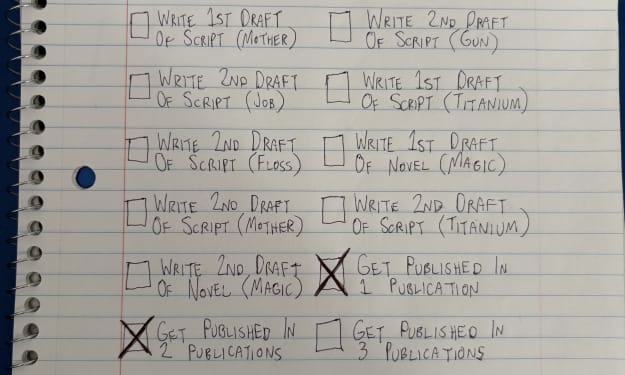
Early March 2026: 4 Goals Accomplished
It's early March and I've now accomplished my 4th writing goal for the year of 2026. Before diving into the behind-the-scenes of it... why not tell you up front what that accomplishment was? I was published in a 2nd publication for this year. Published in Helix Literary Magazine out of Central Connecticut State University. You can read it for free right now!
By Stephen Kramer Avitabile7 days ago in Writers
What is the Difference?
I just thought of this article from the idea of my previously published drabble of future writing projects. What is the difference between old-school typewriting and keyboarding. In a keyboarding class do they still make the students use correct posture, fingers on homerow, how to figure margins and such beginning skills of beginning typists? Do they have Timed writings for speed and accuracy? How many of us who had Typing in school remember when having these one-minute, three-minute or five-minute writings to make sure of proper finger placement, proper posture with feet flat on the floor and the teacher walking up and down the aisle making sure.
By Mark Graham5 days ago in Writers
Hottest in the Office
Dear Rafi, You’re very distracting to work around. For the first second I saw you the other day, I thought you were some type of executive. It took a moment to realize no, you were just the new guy, dressed up for the job he wants. Be still, my heart.
By Gabriel Shames2 days ago in Pride

Comments
There are no comments for this story
Be the first to respond and start the conversation.