
Reflexivity at the Edge of Exhaustion
Book Review

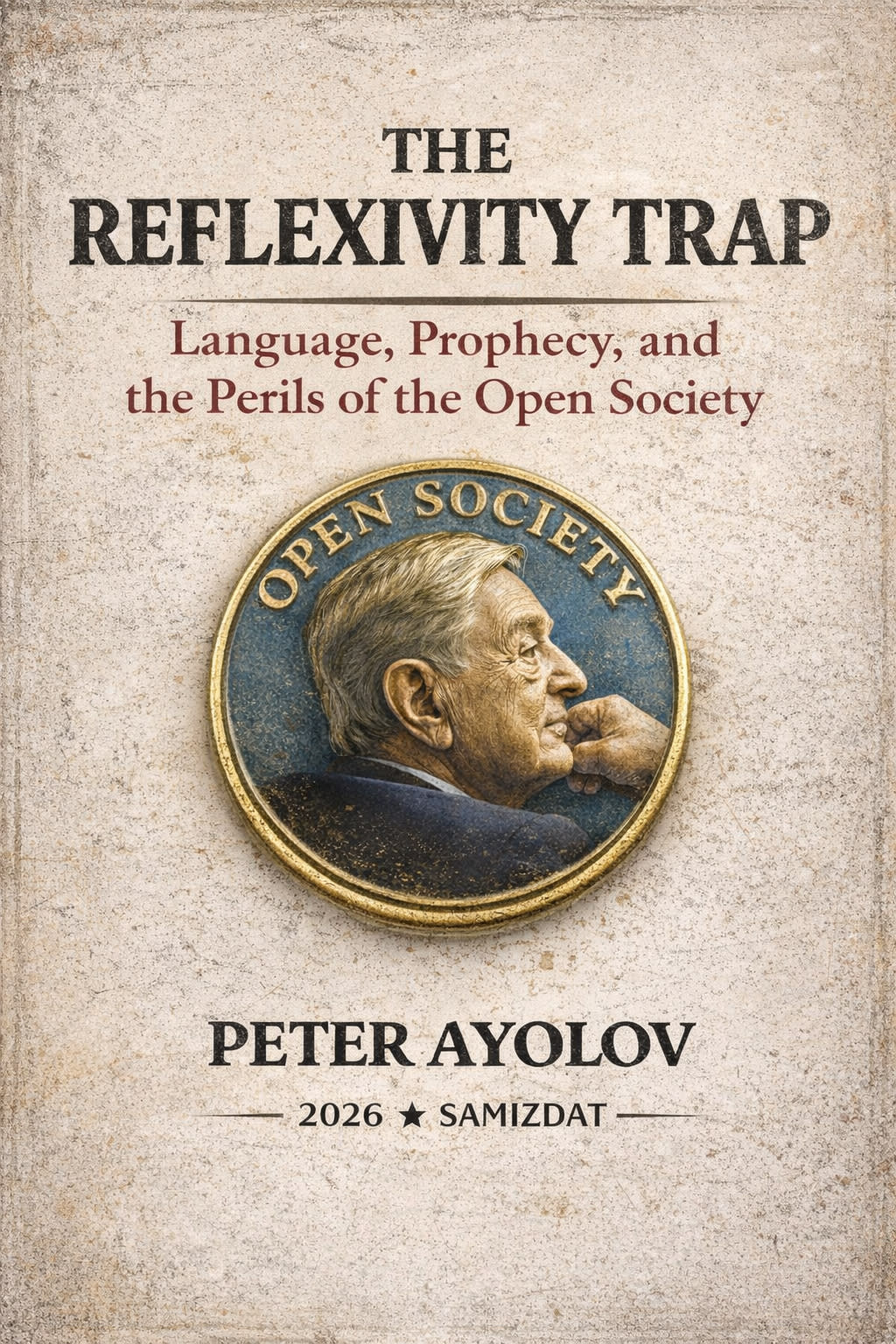
Book Review: Reflexivity at the Edge of Exhaustion
There are books that describe a condition, and there are books that diagnose a structure. The Reflexivity Trap: Language, Prophecy, and the Perils of the Open Society belongs to the latter category. It does not merely comment on the political turbulence of the present or the volatility of digital media. It proposes that a single mechanism — reflexivity — has shifted from an explanatory insight into a governing script, and that this shift marks a civilisational threshold. The result is a philosophical intervention into debates on openness, media, prophecy and power that is at once systematic and unsettling.
The central claim is deceptively simple: reflexivity, once understood as the feedback loop between belief and reality, has become operational. What W. I. Thomas framed in his theorem — that situations defined as real become real in their consequences — and what Robert K. Merton refined as the self-fulfilling prophecy, was initially an epistemic caution. Karl Popper extended this to the ‘Oedipus effect’, warning that predictions can alter the very course of events they seek to foresee. George Soros later applied reflexivity to financial markets, demonstrating how expectations can generate trends that then appear to confirm those expectations. Across these formulations, reflexivity described the fragility of social knowledge.
The book’s provocative thesis is that this fragility has been weaponised. Reflexivity no longer merely explains how predictions influence outcomes; it is deliberately mobilised to govern through anticipation. Markets price futures before they materialise. Political actors circulate forecasts designed to trigger emotional pre-alignment. Media ecosystems amplify narratives that generate the behaviour they later report as evidence. In this environment, prediction becomes performance, and performance becomes structure.
One of the book’s strongest contributions lies in its treatment of language. Rather than positioning language as a neutral medium that carries ideas, it is conceptualised as infrastructural. Words are not reflections of institutions; they configure them. A warning reorganises incentives. A promise mobilises capital. A moral accusation reorders alliances. The sentence circulates, and in circulating it returns as constraint. This emphasis on language as causal technology situates the argument within a broader tradition of speech-act theory and media analysis, yet pushes further by arguing that reflexive language now constitutes a regime.
The treatment of the open society is equally nuanced. Rather than rejecting openness outright, the book examines its boundary conditions. Openness historically promised correction: errors would be exposed, dogma dismantled, authority challenged. Reflexivity served freedom by revealing fallibility. But under conditions of media saturation and digital acceleration, openness multiplies anticipatory adjustments. Actors no longer respond to events; they respond to forecasts of responses. Hyper-coordination replaces spontaneity. The more transparent the system becomes, the more it is governed by pre-emptive alignment.
The book crystallises this in a memorable formulation: openness amplifies reflexivity; reflexivity erodes unpredictability; without unpredictability, meaning collapses. This chain is not presented as rhetorical flourish but as structural diagnosis. The argument is that novelty — the appearance of the genuinely new — requires contingency. If expectations circulate so rapidly and so universally that deviation becomes costly, history narrows into repetition. Control expands, but direction disappears.
The analysis of digital moral outrage is among the most compelling sections. Here the author argues that outrage has become the primary energy source of public life, a synthetic substitute for meaning and courage. Outrage simulates conflict without risk and morality without responsibility. It binds quickly and dissolves just as quickly, sustaining systems that thrive on engagement metrics rather than transformation. Anger is not suppressed; it is cultivated, circulated and monetised. What appears as political vitality becomes emotional labour performed within a reflexive loop.
This leads to one of the book’s most uncomfortable claims: sincerity has become structurally impossible. In a world where every utterance anticipates its reception, belief is naïve, open resistance is absorbed into spectacle, and loud disengagement becomes another role. The only viable strategy, the book suggests, is controlled pretence — not hypocrisy as moral failure, but as survival skill. This is framed not as cynicism but as reflexive sovereignty: the ability to perform necessary scripts without internalising them.
Whether one accepts this normative turn or not, it is intellectually daring. The figure of the ‘conscious pretender’ stands in stark contrast to both the believer and the rebel. It reflects a broader concern with how individuals can preserve dignity in systems that metabolise sincerity. Critics may see this as retreat, even quietism. Supporters may read it as realism in an age where visibility itself is captured by algorithmic incentives. Either way, it extends the analysis from institutional structures to existential posture.
The sections engaging with institutional reflexivity — particularly in finance and philanthropy — are analytically sharp. The discussion of reflexivity as operational doctrine highlights how beliefs can become engines of the very variables they claim to measure. Yet the book resists reducing this to conspiracy or moral indictment. It repeatedly insists that reflexivity guarantees feedback, not benign outcomes. Interventions designed to preserve openness are themselves interpreted and contested, generating new loops. The attempt to universalise fallibilism can be reframed as covert certainty, fuelling backlash.
Importantly, the work does not lapse into simplistic polemic. It recognises that openness without renewal decays, but renewal without limits can destabilise. The tension between error-correction and cohesion runs throughout. The final chapters introduce the notion of the ‘post-open society’ — a condition in which openness no longer binds but fragments. Instead of shared horizon, there is a territory filled with parallel scripts. The danger is not overt repression but exhaustion: a society permanently reacting yet unable to generate novelty.
One of the book’s virtues is its stylistic coherence. The prose is disciplined, philosophically dense but not obscure. Metaphors are sparing and controlled, though occasionally poetic turns — such as images of collecting rain without believing in the storm — mark a shift toward reflective tone. These moments may divide readers, but they underscore that the project is not purely analytical; it is also existential.
There are, however, areas where sceptical readers might press further. The claim that reflexivity cannot reflex itself without collapsing into loop is intriguing but could benefit from more explicit engagement with traditions that treat reflexivity as emancipatory. For example, certain strands of critical theory argue that heightened reflexivity enables deeper forms of critique rather than deadlock. The book anticipates this objection but does not fully explore counter-arguments. Similarly, the portrayal of digital outrage as almost uniformly synthetic risks overlooking instances where outrage catalysed tangible change.
Yet these criticisms do not undermine the core contribution. The book’s power lies in reframing contemporary turbulence not as moral decline or ideological excess but as structural saturation. When every forecast becomes performance and every narrative anticipates its effect, society risks becoming self-referential. Meaning depends on deviation. Without unpredictability, history becomes rehearsal.
The concluding emphasis on cohesion over pure openness is perhaps the most controversial move. The argument is not for closure or authoritarian consolidation, but for recognising that society requires bonds, memory and shared limits. After sincerity and after illusions, the future may depend less on infinite transparency and more on the reconstruction of solidarity. In this sense, the book gestures toward a post-reflexive equilibrium — one that preserves contingency without dissolving unity.
Ultimately, this is a work of diagnosis rather than programme. It does not offer technocratic solutions. It offers clarity about the mechanism. Reflexivity, once a warning about fallibility, has become a script that governs through anticipation. Open systems, saturated with predictive language, approach their own limits. The task is not to abolish reflexivity but to prevent it from sealing the loop.
For scholars of media, political theory, sociology and philosophy, the book provides a unifying framework that links financial volatility, digital outrage and institutional governance under a single conceptual lens. For general readers, it offers a sober account of why contemporary life feels simultaneously hyperactive and stagnant. The question it leaves open is whether unpredictability can be consciously preserved, or whether it will return only through crisis.
In the end, the book’s most enduring insight may be its insistence that progress requires more than openness. It requires the preservation of contingency within shared form. If reflexivity becomes total, novelty disappears. If openness dissolves cohesion, society becomes territory. The challenge is not to close the system, but to keep it alive.
About the Creator
Peter Ayolov
Peter Ayolov’s key contribution to media theory is the development of the "Propaganda 2.0" or the "manufacture of dissent" model, which he details in his 2024 book, The Economic Policy of Online Media: Manufacture of Dissent.
Keep reading
More stories from Peter Ayolov and writers in BookClub and other communities.
Empires of Writing: Civilisation as Scripted Infrastructure
Empires of Writing: Civilisation as Scripted Infrastructure "Civilisation depends less on stories than on ledgers. Empire begins when memory leaves the body. The map is the Empire." – Sacra Littera Alpha
By Peter Ayolovabout 20 hours ago in BookClub
Book Review: Atmosphere by Taylor Jenkins Reid
I flipped the book over in my hands in the centre of the small airport book shop. Although I had heard promising reviews of Atmosphere by Taylor Jenkins Reid, I hesitated. The synopsis didn’t compel me - I wasn’t much of a space girly. In high school it made me cringe when my peers would talk about the stars.
By sleepy drafts27 days ago in BookClub
The Perks of Being a Wallflower: The Heartbreaking Story That Changed How I See Life, Friendship, and Growing Up
When I first picked up The Perks of Being a Wallflower, I thought I was just reading a coming-of-age story. A few diary entries, teenage angst, friendship drama. Something I could breeze through in an afternoon. But what I discovered was far deeper, far more painful, and far more beautiful than I expected.
By Lukáš Hrdličkaa day ago in BookClub




Comments
There are no comments for this story
Be the first to respond and start the conversation.