
Oil at War: The Strait of Hormuz Crisis and the Rising Iran–Israel–US Conflict
How a narrow waterway in the Persian Gulf could trigger a global energy shock and reshape the balance of power in the Middle East

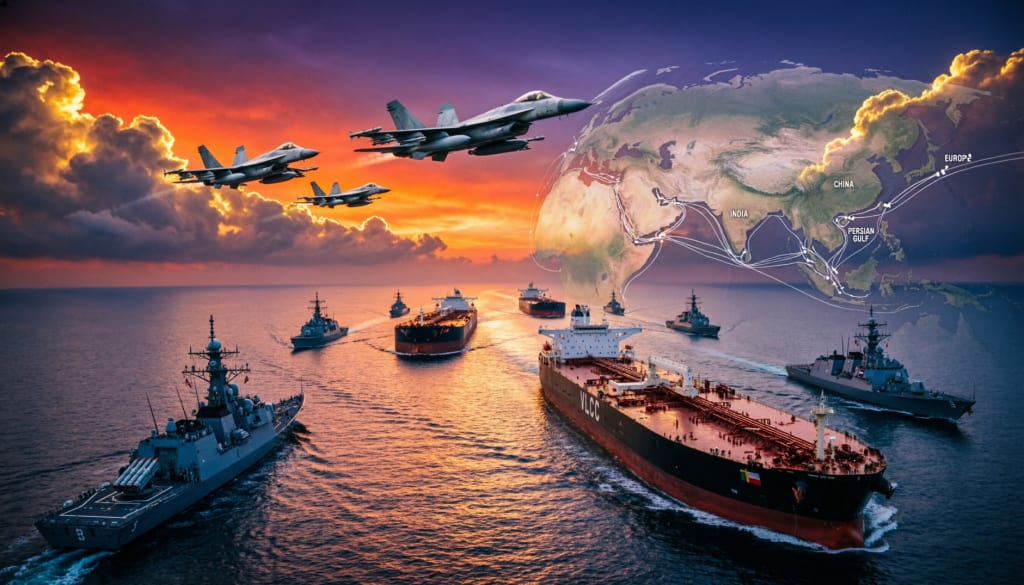
Oil at War: The Strait of Hormuz Crisis and the Rising Iran–Israel–US Conflict
The Middle East has once again become the center of global attention as tensions between Iran, Israel, and the United States intensify. At the heart of this crisis lies one of the world’s most strategic waterways: the Strait of Hormuz. This narrow maritime corridor carries a huge portion of the world’s oil supply, and any disruption here has the power to shake the global economy.
Over the past weeks, military clashes between Iran and the allied forces of Israel and the United States have escalated sharply. Airstrikes, missile attacks, and naval threats have turned the region into a potential flashpoint for a broader conflict. Reports indicate that U.S. and Israeli strikes targeted Iranian military infrastructure, while Iran responded with missile and drone attacks against regional targets and maritime routes.
The crisis is not just about military confrontation—it is also about control of energy. The Strait of Hormuz connects the Persian Gulf with the Gulf of Oman and the Arabian Sea. It serves as the primary export route for oil from Gulf producers such as Saudi Arabia, Iraq, Kuwait, Qatar, and the United Arab Emirates. Approximately 20 million barrels of oil pass through this strait every day, representing roughly 20 percent of global oil consumption.
Because of this, the strait is widely considered the most important energy chokepoint in the world.
In recent developments, Iranian authorities have warned that vessels linked to the United States, Israel, or their allies could be targeted if they pass through the strait. Several commercial ships have already been damaged during the crisis, raising fears among shipping companies and insurers. The result has been a sharp reduction in tanker traffic and rising insurance costs for vessels entering the region.
At the same time, global oil markets have reacted immediately. Prices surged as traders worried about potential supply disruptions. Even the threat of a partial closure of the Strait of Hormuz can send energy prices soaring because there are few alternative routes for transporting Gulf oil to international markets.
For the United States and its allies, keeping the strait open is considered a strategic priority. Washington has reportedly called for an international naval coalition to secure the shipping route and ensure the free flow of oil through the waterway.
From Iran’s perspective, however, control of the Strait of Hormuz represents a powerful strategic tool. By threatening to block or disrupt traffic, Tehran can exert pressure on its adversaries and demonstrate its regional influence. This leverage becomes particularly significant during periods of military confrontation.
Another key factor in the current crisis is the attack on Iran’s Kharg Island, one of the country’s most important oil export terminals. The island handles a large share of Iranian crude exports and is a crucial part of the country’s energy infrastructure. Strikes on such strategic sites highlight how deeply the conflict is tied to the global oil economy.
The geopolitical stakes are enormous. If the conflict escalates further, it could affect not only the Middle East but also economies around the world. Countries in Asia—including China, Japan, and India—depend heavily on oil shipped through the Strait of Hormuz. A prolonged disruption could lead to higher energy prices, supply shortages, and economic instability.
Beyond economics, the situation also raises fears of a wider regional war. The Middle East already faces multiple tensions involving proxy groups, regional rivalries, and nuclear concerns. A direct confrontation between Iran and the U.S.–Israel alliance could draw in additional actors and destabilize the region even further.
For now, global leaders are urging de-escalation while preparing for the worst. Naval patrols are increasing, diplomatic pressure is mounting, and energy markets remain on high alert.
The Strait of Hormuz may appear small on the map, but its influence reaches every corner of the world. In an era when energy security and geopolitical power are deeply connected, this narrow passage of water has become one of the most dangerous flashpoints on the planet.
Whether diplomacy can calm the crisis—or whether the conflict will widen into a larger war—remains uncertain. What is clear is that the fate of this strategic waterway could shape the global political and economic landscape for years to come.
About the Creator
Wings of Time
I'm Wings of Time—a storyteller from Swat, Pakistan. I write immersive, researched tales of war, aviation, and history that bring the past roaring back to life
Keep reading
More stories from Wings of Time and writers in Criminal and other communities.
The Middle East at a Crossroads
The Middle East at a Crossroads The Middle East has once again become the center of global attention as tensions rise between several powerful countries and regional actors. Conflicts, political rivalries, and military movements have created an atmosphere of uncertainty that many analysts believe could reshape global politics in the coming years. Although wars and crises have occurred in this region for decades, the current situation feels more fragile and dangerous because multiple global powers are indirectly involved.
By Wings of Time 12 days ago in Criminal
Push To Prevent Catapults Being Bought By Children
MP’s have been warned to put new legislation in place that will help to close a loophole in the law which allows people including children to legally buy weapons which is capable of killing wildlife. The alert was issued during a briefing in parliament which set out growing evidence that catapults were being misused against animals and to damage other people’s private property. The Naturewatch Foundation who hosted the session expanded on their message that at the moment there is a completely unregulated system where people of any age can buy weapons and there are no meaningful controls on sale or power.
By Ashish Prabhu7 days ago in Criminal



Comments
There are no comments for this story
Be the first to respond and start the conversation.