
Civilization Is A Disease
by George Bernard Freud*

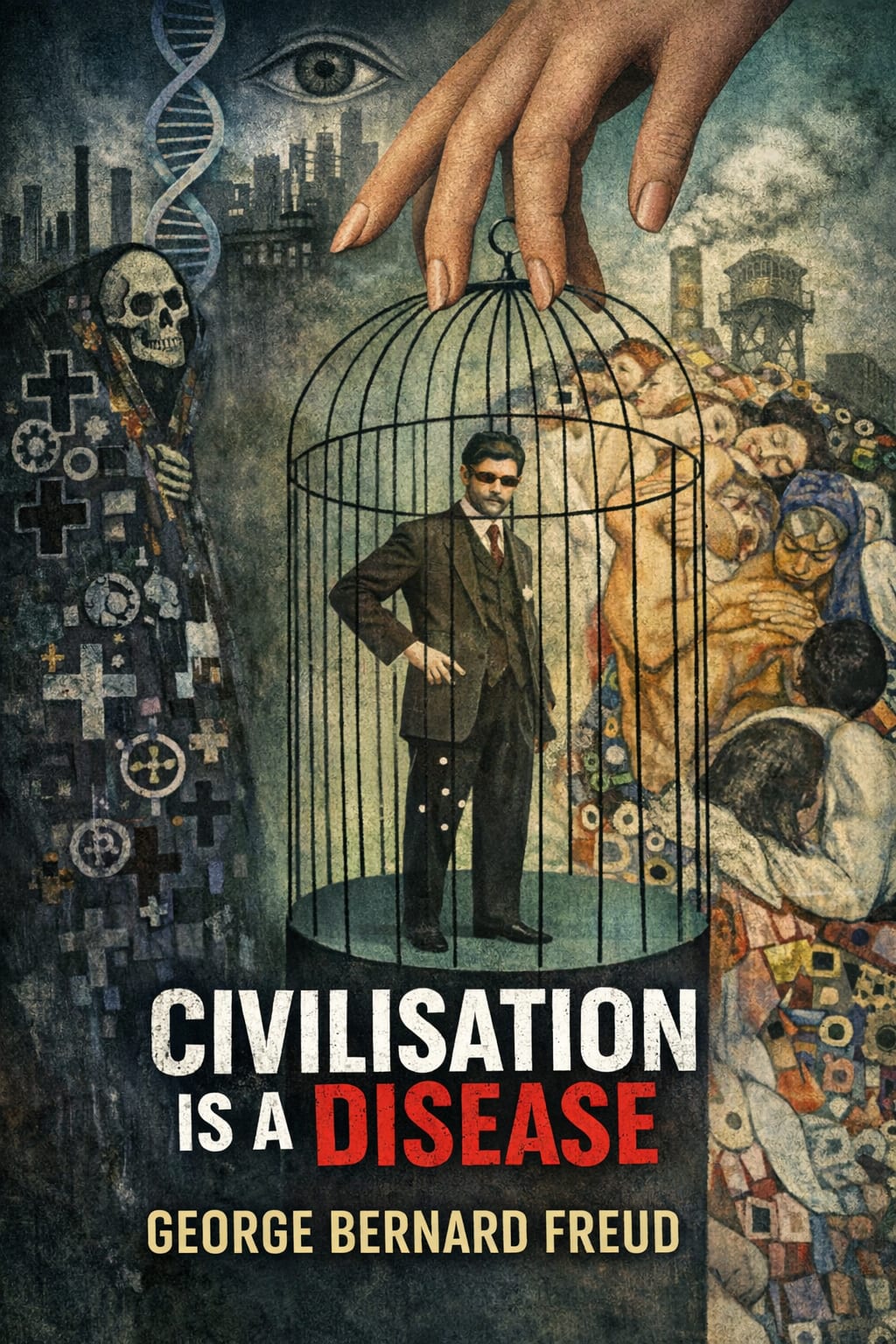
Civilization Is A Disease
‘Civilization is a disease produced by the practice of building societies with rotten material.’ George Bernard Shaw placed that line in ‘Maxims for Revolutionists’, appended to Man and Superman, and the sentence still shocks because it does not merely criticise modernity; it pathologises it. Shaw, a leading Fabian and public intellectual, belonged to a reformist socialist milieu that believed society could be engineered gradually and rationally from above. Yet that same rationalist confidence often shaded into something darker: population management, elite planning, and the fantasy that humanity itself could be improved by sorting, disciplining, breeding, excluding, and sometimes eliminating the ‘unfit’. Shaw’s line can therefore be read not only as a critique of civilization, but as an unwitting confession about one of civilization’s recurring diseases: the educated elite’s urge to redesign humanity. ([online-literature.com][1])
That is why the history of modern civilization cannot be told as a simple story of progress. The steam engine, the school system, the welfare state, the modern city, the scientific laboratory, the university, the newspaper, and the planned society all promise uplift. But once elites begin to see populations as material to be arranged, measured, and improved, civilization acquires a clinical vocabulary. People become stock, burden, efficiency problem, surplus, degenerate strain, dangerous race, feeble-minded class, or disposable underclass. In that atmosphere, cruelty no longer presents itself as cruelty. It arrives as administration. Murder comes dressed as hygiene. Exclusion appears as science. Genocide appears as policy. This is the decisive paradox: civilization claims to tame barbarism, yet its most organised barbarisms are often produced by the very classes that regard themselves as the summit of reason. ([OUP Academic][2])
Shaw matters here because he stands at a revealing crossroads. Britannica identifies him as a key Fabian figure, and scholarship on British socialism has long shown how eugenic thinking circulated among sections of the early twentieth-century left as well as the right. One academic study notes plainly that Shaw supported eugenics, while another records his notorious 1910 remark that eugenic politics could end in ‘an extensive use of the lethal chamber’. At the same time, recent scholarship warns against flattening Shaw into a simple proto-Nazi caricature: he did not map neatly onto later exterminationist regimes, and part of his rhetoric traded in provocation and paradox. But that qualification does not remove the stain. It makes it more revealing. The cultured radical, the witty reformer, the humane critic of capitalism could still flirt with the logic that some lives are socially unjustifiable. That is civilization as disease: moral corruption at the top speaking in the language of improvement. ([OpenEdition Journals][3])
What makes this disease possible is the old elite fantasy that society is a machine and human beings are raw material. Fabian gradualism, technocratic planning, eugenic selection, racial hierarchy, and population control all share one temptation: they relocate moral authority from ordinary human dignity to managerial intelligence. Once that move is made, the poor become a breeding problem, the colonised become a civilizational lag, the disabled become a cost, and the dissenter becomes a pathology. The language shifts, the century changes, the official justifications evolve, but the structure remains. The elite claims the right to classify life from above. It no longer asks what justice requires; it asks what efficiency demands. It no longer asks how to live with flawed fellow humans; it asks how to optimise the species. ([OUP Academic][2])
Yet this managerial arrogance rests on a deeper anthropological contradiction. For all its claims to transcend nature, civilization never escapes the animal substrate beneath it. Konrad Lorenz argued in On Aggression that fighting and warlike behaviour in human beings have an inborn basis, even if social conditions can redirect or ritualise them. Freud, from a different angle, also insisted that civilization does not abolish instinct; it represses, redirects, and internalises it. Both thinkers, however differently, force a humiliating recognition: human beings are not angels wearing suits, but animals whose drives do not vanish when they enter parliament, the academy, or the planning commission. The polished elite is not post-animal. It is animality with theories. ([Encyclopedia Britannica][4])
Cormac McCarthy’s ‘The Kekulé Problem’ sharpens this humiliation. In that essay he suggests that the unconscious mind is far older than language and still works through image, symbol, and metaphor rather than clear verbal propositions. He even speculates that language behaved like a ‘parasitic invasion’ of the brain, colonising regions not already occupied. The famous dream of August Kekulé — the snake seizing its own tail — becomes the emblem of a mind that solves problems in pre-verbal pictures and only later permits consciousness to translate the result into words. If McCarthy is even partly right, then civilization’s self-image as a verbal, rational order sits on top of a much older, darker, non-verbal organism. The official speech of progress may be thin ice over archaic water. ([nautil.us][5])
This helps explain why civilization so often says one thing and desires another. Its constitutions praise equality while its elites sort populations into desirable and undesirable groups. Its churches preach neighbour-love while its bureaucracies calculate expendability. Its universities speak of humanity while generating hierarchies of intelligence, race, fitness, and worth. The unconscious animal does not disappear; it becomes institutional. Aggression is laundered through expertise. Domination is sublimated into management. Predation becomes policy language. A civilisation may therefore be most dangerous not when it is openly savage, but when it is technically humane and rhetorically enlightened. ([Encyclopedia Britannica][6])
Freud’s 1908 essay ‘Civilized’ Sexual Morality and Modern Nervous Illness is crucial here because it shows civilization first as repression. There he argues that modern sexual codes impose excessive renunciation and thereby help generate neurosis. By 1930, in Civilization and Its Discontents, the argument widens: civilization exists by binding people together, but it achieves this through the repression and redirection of instinct. Freud’s notion of sublimation is central. Primitive or sexual energies are not simply extinguished; they are rerouted into work, art, knowledge, and communal order. Civilization becomes possible because instinct is denied immediate gratification and transformed into higher activity. But the price is permanent discontent, guilt, and psychic strain. ([sexualityandthemodernistnovel.files.wordpress.com][7])
Freud’s insight becomes more disturbing when applied politically. If civilization depends on repression and sublimation, then its loftiest achievements may contain a hidden residue of denied aggression and denied desire. The cultured person is not the opposite of the violent person. He may be violence redirected, aestheticised, bureaucratised, moralised. The state planner, the racial theorist, the eugenic reformer, the imperial pedagogue, the sterilisation advocate, the demographer of ‘surplus’ populations — all may imagine themselves as acting from reason, compassion, necessity, or science. But psychoanalytically one might say that civilization has converted brute force into system, and instinct into doctrine. The beast is still there. It has merely learned administration. ([Encyclopedia Britannica][8])
This is why a critical reading of Freud remains indispensable. Join this reading not to canonise him, but to use him. His concepts of repression and sublimation still help explain why modern civilization produces both refinement and misery, both orchestras and camps, both rights language and racial hygiene. He understood that social order is purchased through instinctual renunciation. He also understood that the bill is never fully paid. The repressed returns — as anxiety, guilt, moral panic, and aggression. Civilization therefore carries its own pathology inside itself. It does not merely protect humans from nature; it reorganises nature into institutions. ([Encyclopedia Britannica][8])
Once this is seen, the comforting myth that the main danger comes from the ‘stupid masses’ begins to collapse. The old contemptuous image of the lower orders as breeding, eating, lusting animals is itself one of civilization’s favourite lies. History shows that the most elaborate theories of elimination did not come from the simple man struggling to survive. They came from salons, laboratories, ministries, editorial boards, universities, and think tanks. Eugenics was not invented by the hungry crowd. Racism was not systematised by the illiterate peasant. Theories of depopulation, selective breeding, civilizational hierarchy, and socially useful death were formulated by educated elites who believed they had moved beyond animality. In reality they had only perfected predation by giving it abstract language and institutional method. ([OUP Academic][2])
The final lesson is brutal. The enemy of man is not merely the ordinary animal human who eats, breeds, fears, envies, and survives. That creature is dangerous, but familiar. More dangerous is the transfigured animal at the top of civilization: the educated elite who calls himself rational, superior, evolutionary, progressive, or post-human, and then builds doctrines that justify the sacrifice of millions. These are civilization’s symptoms at its point of moral decay. Every civilisation, sooner or later, breeds a class that wants to classify, cull, sterilise, torture, deport, or reduce some population in the name of health, order, destiny, or improvement. That is why civilization can indeed become a disease. Its terminal phase arrives when intelligence detaches itself from conscience, when theory arms cruelty, and when the elite begins to speak of human beings as rotten material. The enemy of people is me. ([online-literature.com][1])
[1]: https://www.online-literature.com/george_bernard_shaw/4211/?utm_source=chatgpt.com "Maxims for Revolutionists by George Bernard Shaw"
[2]: https://academic.oup.com/histres/article/90/250/764-787/5603562?utm_source=chatgpt.com "Eugenics, socialists and the labour movement in Britain, 1865 ..."
[3]: https://journals.openedition.org/politics/367?utm_source=chatgpt.com "George Bernard Shaw toward Nazism?"
[4]: https://www.britannica.com/topic/On-Aggression?utm_source=chatgpt.com "On Aggression | work by Lorenz"
[5]: https://nautil.us/the-kekul-problem-236574?utm_source=chatgpt.com "The Kekulé Problem"
[6]: https://www.britannica.com/biography/Sigmund-Freud/Toward-a-general-theory?utm_source=chatgpt.com "Sigmund Freud - Psychoanalysis, Psychology, Theory"
[7]: https://sexualityandthemodernistnovel.files.wordpress.com/2017/02/freud_sexualmorality.pdf?utm_source=chatgpt.com "'Civilized' Sexual Morality and Modern Nervous Illness"
[8]: https://www.britannica.com/topic/Civilization-and-Its-Discontents?utm_source=chatgpt.com "Civilization and Its Discontents | work by Freud"
About the Creator
Peter Ayolov
Peter Ayolov’s key contribution to media theory is the development of the "Propaganda 2.0" or the "manufacture of dissent" model, which he details in his 2024 book, The Economic Policy of Online Media: Manufacture of Dissent.
Keep reading
More stories from Peter Ayolov and writers in Critique and other communities.
“Distorted Communication”
“Distorted Communication” In his 1991 book The Structural Transformation of the Public Sphere: An Inquiry into a Category of Bourgeois Society, Jürgen Habermas presents the Enlightenment as a time for change—a pivotal moment when humanity began transitioning from self-imposed immaturity to a state of maturity. In this mature state, individuals must use their reason in public discourse. Habermas envisioned a society where every person becomes a public intellectual, communicating ideas openly to the world. Today, this vision is partially realized through online media, where anyone can publish their thoughts globally. However, the rise of this communication medium has also fostered a climate of dissent, with the collision of countless perspectives creating tension rather than unity. The transformation of global communication into an international open-access platform is a defining event of the 21st century, symbolizing humanity's step toward intellectual maturity. Yet, this journey is hindered by the planned obsolescence of communication, a kind of intellectual adolescence that prevents full independence and fosters the "manufacture of dissent."
By Peter Ayolovabout 14 hours ago in Critique
Cassie and Johnny
I’m the kind of dame you notice. I’m no femme fatale, but you can’t ignore me, at least not until I warn you about what’s coming, then everybody ignores me. Hell, they usually blame me afterwards and give Johnny all the credit for saving the day, but my Johnny couldn’t save a seat at the movies without my help. Sure, he’s brawny, but brainy? Not so much. Like that time I asked him to spot me five bucks, and he said he didn’t see it anywhere on me, and believe you me, he looked but good.
By Harper Lewis18 days ago in Critique



Comments
There are no comments for this story
Be the first to respond and start the conversation.