
Piergiorgio Corallo in blue
The photographic series “Nel blu dipinto di blu” at the National Museum of Contemporary Art of Bucarest

Photography often reveals more by removing elements than by adding them.
In the photographic series Nel blu dipinto di blu this idea becomes the central visual strategy. The images are built around a simple but striking rule: almost everything appears in black and white, while a single blue element remains visible inside the scene.
From March 9 to March 20, 2026 a selection of photographs from the series will be presented in the Europe section of the National Museum of Contemporary Art of Romania, Bucarest.
At first glance the photographs appear minimal. Surfaces, shadows and textures dominate the compositions. The absence of color gives the images a quiet, almost suspended atmosphere. But inside each scene a blue detail appears. Sometimes it is subtle, sometimes it becomes the focal point of the photograph.
This approach connects the project to a long tradition in photography where color is not simply descriptive but structural.
Artists such as Saul Leiter demonstrated how a fragment of color could guide the viewer’s perception of an image. Leiter often used reflections, windows and partial views where color appeared almost accidentally, transforming the atmosphere of the photograph. Ernst Haas explored a similar direction, showing how color could operate as a compositional force rather than a decorative feature.
Nel blu dipinto di blu continues this exploration but pushes it toward a quieter and more minimal direction.
One photograph shows a blue electric guitar resting on an empty stage. The floor, cables and background remain monochrome, almost fading into darkness. Without performers or audience the instrument appears suspended between action and silence. The blue surface of the guitar becomes the visual center of the photograph, while everything else retreats into shadow.
The image suggests the moment before or after music happens.
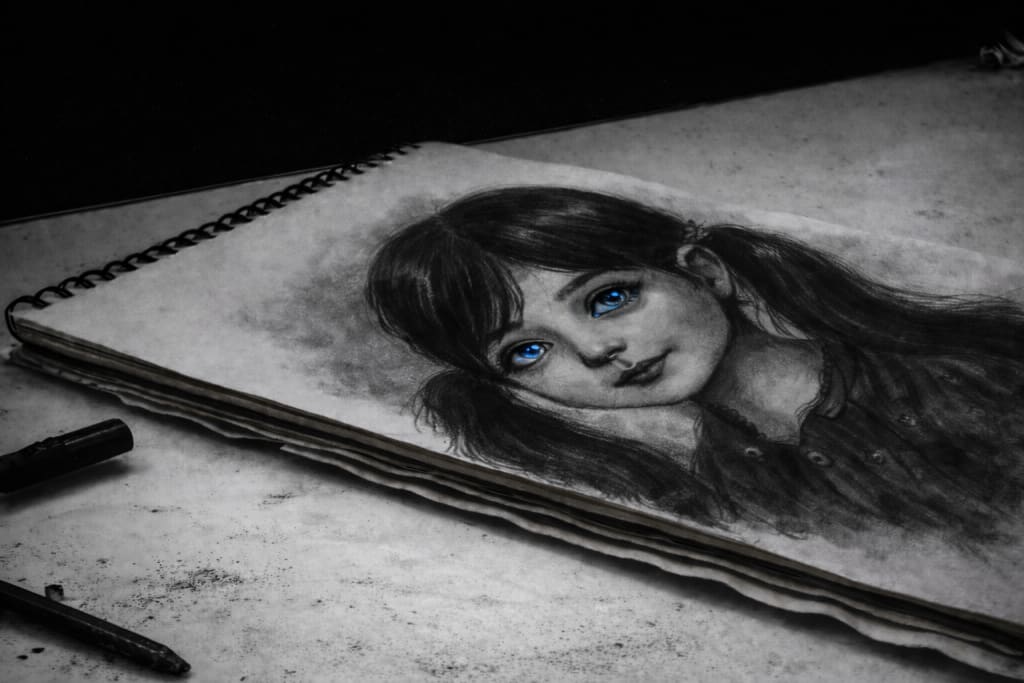
Another photograph moves toward a more intimate environment. A sketchbook lies open on a table, revealing a pencil drawing of a young girl. The drawing itself remains monochrome, except for the eyes. A small blue detail transforms the entire image.
Here the color does not belong to the photographed object but to the imagined character within the drawing. The photograph therefore captures two levels of reality at once: the physical object on the table and the symbolic presence inside the drawing.
The result is subtle but powerful.
A third image focuses on a blue pencil placed between two contrasting surfaces, one dark and one light. The composition becomes almost geometric. The pencil acts like a dividing line across the image, separating two visual spaces.
This type of visual reduction recalls the conceptual clarity found in the work of Spanish photographer Chema Madoz, whose images transform everyday objects into quiet visual statements.
In Nel blu dipinto di blu the objects remain recognizable, but their role inside the composition changes. They become visual anchors that organize the viewer’s attention.
Other photographs in the series explore environments related to everyday creative work.
A desk appears partially illuminated. A laptop, a pen and a coffee cup are placed on the surface. The scene could belong to a writer, a designer or a musician working late at night. Once again the blue detail is limited to a single object: the cup.
The image does not depict action but atmosphere. The objects suggest presence without showing the person who used them.
Another photograph introduces a vintage rotary telephone placed on a table. The metallic structure and circular form of the device create a sculptural quality. The black and white treatment emphasizes the texture of the material, while the blue buttons in the center bring a small but precise visual interruption.
The object feels both familiar and distant, belonging to another time.
Across the series the blue element never dominates the scene. Instead it acts as a signal.
Black and white creates the structure of the image. Blue introduces variation.
The photographs do not form a narrative sequence. Instead they behave like a constellation of moments connected by the same visual rule. Each image proposes a small shift in perception, asking the viewer to reconsider the balance between object, space and color.
This quiet approach distinguishes the project from more spectacular uses of color in contemporary photography.
Here color is reduced to its minimum presence.
The result is a form of visual attention where the smallest detail becomes the center of the image.
In this sense Nel blu dipinto di blu can be seen as a meditation on how little is needed to transform a photograph.
Sometimes a single color is enough.
The exhibition will be open from March 9 to March 20, 2026 in the Europe section of the National Museum of Contemporary Art of Romania, in Bucarest.
Admission is free.
Daniel Whitaker, Photomania, Milano, 2026
About the Creator
The Global Verge
Independent culture & music press reporting from Europe and Latin America.
Keep reading
More stories from The Global Verge and writers in Critique and other communities.
The Geography Has Shifted: How Emerging Artists Are Building Audiences Before Becoming Visible at Home
For decades, artistic recognition followed geography. Musicians developed locally, gained national attention, and only afterward reached international listeners. Success had a visible progression. Scenes existed. Gatekeepers validated careers. Cultural movement felt structured.
By The Global Verge19 days ago in Journal
Cassie and Johnny
I’m the kind of dame you notice. I’m no femme fatale, but you can’t ignore me, at least not until I warn you about what’s coming, then everybody ignores me. Hell, they usually blame me afterwards and give Johnny all the credit for saving the day, but my Johnny couldn’t save a seat at the movies without my help. Sure, he’s brawny, but brainy? Not so much. Like that time I asked him to spot me five bucks, and he said he didn’t see it anywhere on me, and believe you me, he looked but good.
By Harper Lewis19 days ago in Critique
The Friendship Recession: Why Adults Are Struggling To Build Close Relationships
This is a universal phenomenon that is affecting both individual and collective psyches. Humans thrive on companionship. The pandemic is solely to blame, however that particular far from auspicious time is not really to blame. The no-friends-trend-turned-friendship-recession, bringing forth the loneliness epidemic was a thing before 2020.
By Justine Crowleyabout 11 hours ago in Psyche


Comments