
A Dozen Hidden Giants: Scientists Discover Multiple Black Holes at the Heart of Our Galaxy
New research reveals that the center of the Milky Way may contain far more black holes than previously believed, reshaping our understanding of galactic evolution.

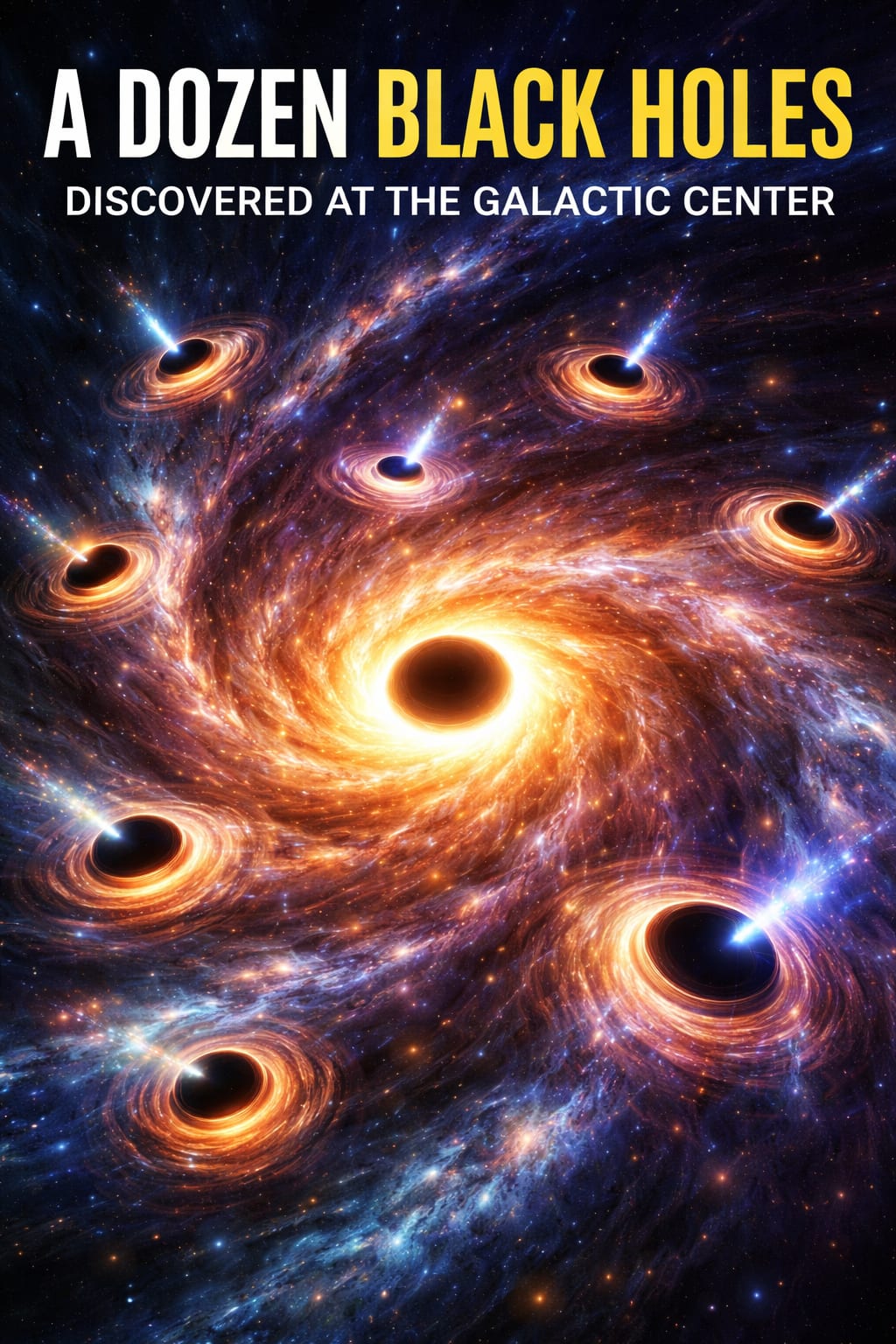
In one of the most fascinating discoveries in modern astronomy, scientists have identified about a dozen previously hidden black holes near the center of our galaxy, the Milky Way. This remarkable finding provides new insight into the mysterious and chaotic region surrounding the galaxy’s core and may help astronomers better understand how galaxies evolve over billions of years.
At the heart of the Milky Way lies a supermassive black hole known as Sagittarius A*. With a mass about four million times greater than that of the Sun, Sagittarius A* dominates the gravitational environment of the galactic center. For decades, scientists suspected that many smaller black holes could also exist nearby, but detecting them has proven extremely difficult.
Black holes themselves cannot be seen directly because their gravity is so powerful that not even light can escape them. Instead, astronomers detect them by observing their effects on nearby stars or clouds of gas. When a black hole pulls matter toward itself, the material heats up to extremely high temperatures and emits X-rays that can be detected by space telescopes.
Using data from the powerful Chandra X-ray Observatory, astronomers were able to identify a cluster of X-ray sources near the galactic center that strongly suggest the presence of multiple stellar-mass black holes. These black holes are believed to have formed when massive stars collapsed after explosive deaths known as supernovae.
Researchers estimate that the dozen black holes detected are only a small fraction of the total population that may exist in this region. In fact, theoretical models predict that thousands of stellar-mass black holes could be concentrated within just a few light-years of Sagittarius A*. Over millions of years, gravitational forces would naturally cause these dense objects to migrate toward the galactic center.
The discovery supports long-standing theories about the dynamics of galactic cores. According to astrophysicists, heavy objects such as neutron stars and black holes gradually sink toward the center of galaxies through a process known as mass segregation. This means that the region around Sagittarius A* could be far more crowded and energetic than previously imagined.
Detecting these black holes required years of careful observation and analysis. Scientists searched for binary systems where a black hole pulls material from a nearby star. As the star’s gas spirals toward the black hole, it forms an extremely hot disk that shines brightly in X-ray wavelengths. By identifying these signals, astronomers were able to distinguish black holes from other cosmic objects.
The discovery also has important implications for the future study of gravitational waves. When two black holes orbit each other and eventually merge, they produce ripples in spacetime known as gravitational waves. These waves were first directly detected in 2015 by the LIGO Scientific Collaboration, confirming a key prediction of Albert Einstein’s theory of general relativity.
If thousands of black holes truly exist near the center of the Milky Way, then the likelihood of black hole mergers in that region could be much higher than previously thought. Future gravitational-wave observatories may detect signals originating from our galaxy’s core, offering scientists a new way to study these extreme objects.
Another intriguing aspect of this discovery is how it may influence our understanding of star formation near galactic centers. The environment close to Sagittarius A* is extremely harsh, with intense radiation, strong gravitational forces, and turbulent clouds of gas and dust. Yet stars continue to form there, suggesting that the presence of numerous black holes may play a role in shaping stellar evolution in this region.
Astronomers hope that next-generation observatories, including more sensitive X-ray telescopes and advanced infrared instruments, will allow them to detect even more hidden black holes in the Milky Way. Each new discovery helps researchers build a clearer picture of the complex ecosystem that exists at the center of galaxies.
Ultimately, the finding of a dozen black holes near the Milky Way’s core is just the beginning. It provides strong evidence that the galactic center is packed with invisible remnants of massive stars—cosmic ghosts that continue to influence their surroundings long after their original stars have vanished.
As scientists continue exploring the depths of our galaxy, the crowded and mysterious region surrounding Sagittarius A* may reveal even more secrets about the nature of gravity, the life cycle of stars, and the powerful forces that shape the universe itself. 🌌🕳️✨
About the Creator
Irshad Abbasi
Ali ibn Abi Talib (RA) said 📚
“Knowledge is better than wealth, because knowledge protects you, while you have to protect wealth.
Keep reading
More stories from Irshad Abbasi and writers in Earth and other communities.
The Zo ne of Silence: America’s Enigmatic Corner Where Laws and Logic Vanish
Deep within the rugged, breathtaking wilderness of Yellowstone National Park lies a geographical oddity so unsettling that it sounds like the plot of a legal thriller. Known to scholars and conspiracy theorists alike as the **"Zone of Death,"** this 50-mile stretch of land represents a terrifying glitch in the American judicial system—a place where, theoretically, a person could commit a major crime and walk away a free man.
By Irshad Abbasi 3 days ago in Earth
It’s too warm': Greenland’s fishermen are under threat from climate change
Greenland’s traditional fishing communities are facing an uncertain future as the Arctic warms faster than any other region on Earth, dramatically reshaping the landscapes and livelihoods of the semiautonomous Danish territory. Local fishermen, whose lives have long been tied to sea ice and predictable seasonal patterns, are now confronting unpredictable weather, shifting fish populations, and economic pressures that threaten both their culture and the local economy. A Changing Arctic Reality In the small coastal town of Ilulissat, veteran fisherman Helgi Áargil described how climate change has upended his routines. Where once he relied on stable sea ice and consistent fishing grounds, he now finds warmer waters, rainier conditions, and fish moving to deeper, cooler waters. Last year his boat became trapped in ice that calved from a nearby glacier; this year, instead of strengthening ice, it has been unusually wet — making conditions less predictable and incomes more volatile. Fishing accounts for up to 95 percent of Greenland’s exports, with key markets including China, the United States, Japan and Europe. This heavy economic reliance amplifies the impact of climate effects on fish patterns and harvests. Disappearing Ice, Changing Practices Traditional ice fishing — once conducted on sea ice more than a metre thick — has declined sharply. Older generations recall times when they could easily drill holes in stable ice to fish for cod, halibut, shrimp and snow crab. Today, sea ice is retreating earlier and forming later, forcing many fishermen to rely on boats even in the coldest months. While boats allow access to broader waters, they come with higher fuel costs and greater exposure to the elements, challenging sustainability. Karl Sandgreen, head of the Icefjord Center in Ilulissat, noted that ice thick enough to support traditional fishing began disappearing roughly three decades ago. The shift has not only changed how fishers operate but also increased competition and pressure on stocks closer to shore. Ecological and Economic Pressures Warmer conditions are also affecting fish behavior. Many species are moving deeper or into new areas as they seek cooler waters, complicating efforts to maintain stable catches. A warming ocean can temporarily boost plankton growth — potentially increasing some fish stocks — but it also alters ecosystems in unpredictable ways. Experts warn that fish may not behave as they once did, complicating traditional fishing forecasts and practices. The head of Royal Greenland, the territory’s largest employer, has expressed concern about a future with significantly diminished sea ice, which could push more traditional fishers toward larger, commercial fishing operations. However, this transition is not without risks. Increased fishing pressure near shorelines already shows early signs of overfishing; halibut are getting smaller, a classic indicator of stock stress noted by experts. Cultural Identity at Risk Fishing in Greenland is more than an economic activity; it is a cultural bedrock. In towns and villages across the island, harbours where daily catches are unloaded and sold remain central to community life. Many Greenlanders associate fishing with identity and tradition, and climate change is directly threatening these cultural ties as environmental conditions change faster than adaptation measures can keep pace. “You can have too much ice to sail and yet too little to qualify for safe ice fishing,” noted Toke Binzer, describing the paradoxical challenges fishermen now face. The unpredictability makes planning difficult and income erratic — one trip might bring significant earnings, while the next yields little or nothing. Limited Alternatives and Future Paths Beyond fishing, economic alternatives in Greenland remain limited. Tourism is growing but not at a pace that could offset losses in the fishing sector. With a total population barely over 50,000, opportunities outside harvesting marine resources are comparatively sparse. As dog sledding and other ice‑based traditions also diminish due to changing conditions, entire ways of life are under threat. Efforts to support traditional fishers include loans for boats and business assistance, but long‑term resilience will likely require broader strategies. These could involve sustainable fishing quotas, diversification into aquaculture, and investments in climate adaptation infrastructure. Yet many local observers emphasize that meaningful change must also address the root causes of warming — a challenge far beyond Greenland’s shores. A Climate Warning Sign Greenland’s fishermen are becoming a human indicator of rapid Arctic change. The region is warming faster than the global average, reshaping ecosystems and economies alike. As these communities adapt or struggle, their challenges shed light on the broader global consequences of climate change — illustrating how environmental shifts ripple through cultures, industries and livelihoods thousands of kilometres from major industrial centres.
By Fiaz Ahmed 5 days ago in Earth



Comments
There are no comments for this story
Be the first to respond and start the conversation.