
Major Scientific Milestones of 2017
From revolutionary space discoveries to breakthroughs in genetics and artificial intelligence, 2017 proved to be a remarkable year for global science.

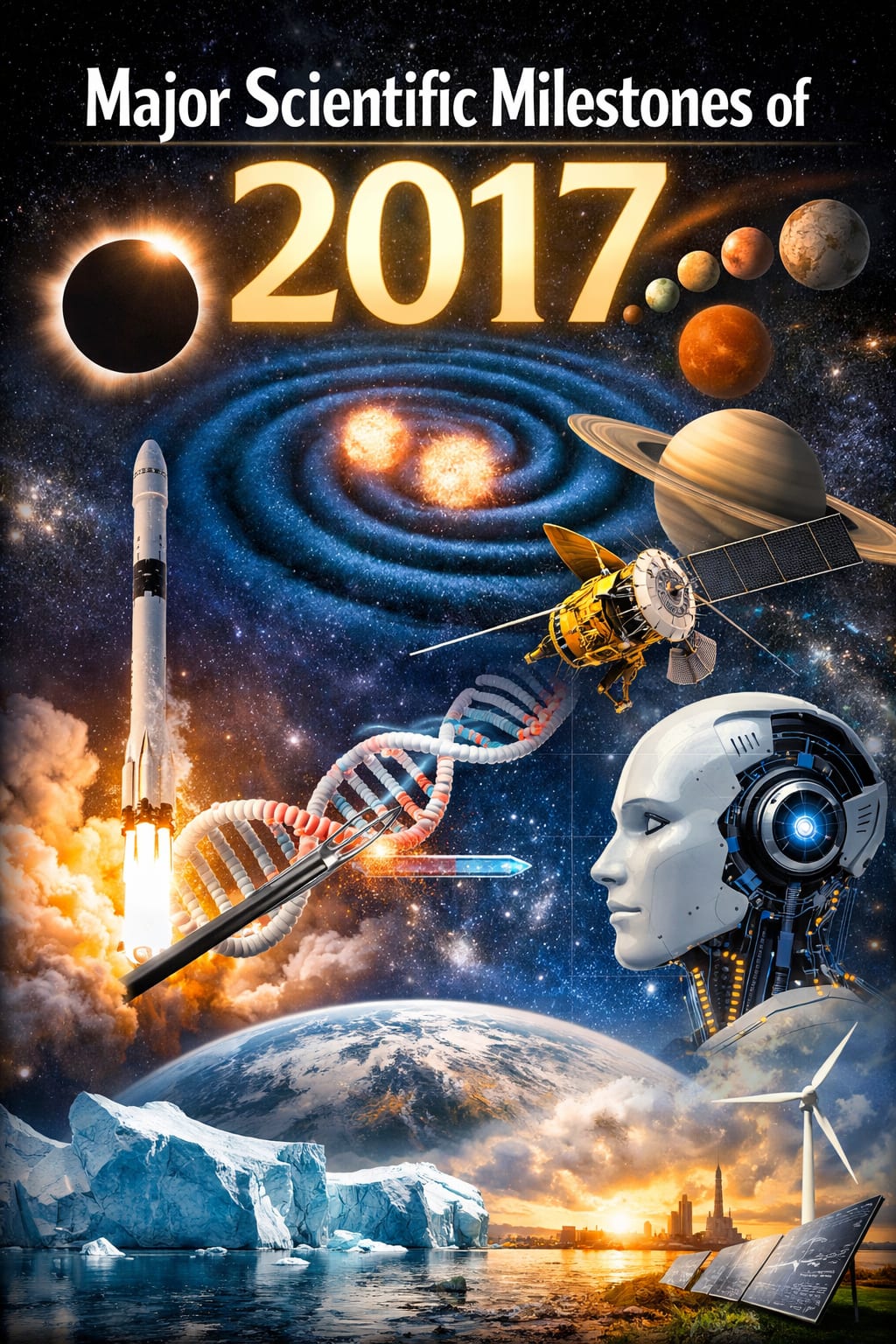
The year 2017 was an extraordinary period for scientific progress. Researchers across the world achieved remarkable breakthroughs in space exploration, medicine, technology, and environmental science. These discoveries not only expanded human knowledge but also opened new possibilities for the future. From observing gravitational waves to advances in gene editing and artificial intelligence, 2017 demonstrated the powerful role science plays in shaping modern society.
One of the most significant scientific achievements of 2017 was the confirmation of gravitational waves resulting from the collision of neutron stars. Scientists working with the LIGO Scientific Collaboration and the Virgo Collaboration detected these ripples in space-time, providing further proof of the predictions made by Albert Einstein in his theory of relativity more than a century earlier. This discovery was particularly important because it allowed astronomers to observe cosmic events through both gravitational waves and electromagnetic signals for the first time, marking the beginning of a new era in astronomy known as “multi-messenger astronomy.”
Another remarkable event in 2017 was the historic solar eclipse that captured global attention. The Solar Eclipse of August 21, 2017 was widely observed across the United States and parts of the Atlantic and Pacific Oceans. Millions of people witnessed the rare celestial event, while scientists used the opportunity to study the Sun’s corona and improve understanding of solar activity. The eclipse also sparked widespread public interest in astronomy and science education.
Space exploration also saw significant progress in 2017. SpaceX made headlines with the successful reuse of rocket boosters, an achievement that marked a major step toward reducing the cost of space travel. The company launched several missions using previously flown rockets, demonstrating that reusable spacecraft could become a practical and economical approach for future space exploration. This innovation could potentially enable more frequent missions to the Moon, Mars, and beyond.
Meanwhile, scientists discovered several potentially habitable planets outside our solar system. A major breakthrough came earlier in the year when astronomers studying the TRAPPIST-1 planetary system identified multiple Earth-sized planets orbiting the small star. Some of these planets were located in the star’s habitable zone, where liquid water might exist. The discovery increased hopes that life could exist elsewhere in the universe and intensified the search for extraterrestrial environments capable of supporting life.
In the field of medicine and biotechnology, 2017 was equally groundbreaking. The gene-editing technology CRISPR-Cas9 continued to revolutionize genetic research. Scientists successfully used the technique to correct genetic mutations in human embryos during laboratory experiments, offering hope for the treatment of inherited diseases in the future. Although the research raised ethical questions, it also demonstrated the enormous potential of gene editing for medicine and biotechnology.
Artificial intelligence also experienced rapid growth during 2017. Technology companies such as Google and IBM continued developing advanced AI systems capable of performing complex tasks. Machine learning technologies improved in areas such as speech recognition, medical diagnosis, and data analysis. AI systems became increasingly integrated into everyday technologies, from smartphones to healthcare tools, transforming industries and influencing how people interact with digital systems.
Another important milestone occurred in planetary science. The spacecraft Cassini–Huygens completed its historic mission to Saturn after more than thirteen years of exploration. In September 2017, the spacecraft performed a dramatic “Grand Finale” by plunging into Saturn’s atmosphere. During its mission, Cassini sent back invaluable data about Saturn, its rings, and its moons, particularly Enceladus and Titan, which are considered potential locations for microbial life. The mission greatly expanded humanity’s understanding of the outer solar system.
Environmental science also remained a major focus in 2017. Scientists continued to raise concerns about climate change, documenting rising global temperatures, melting ice sheets, and increasing sea levels. International organizations such as the United Nations emphasized the need for stronger global cooperation to address environmental challenges. Researchers also worked on developing renewable energy technologies and sustainable solutions to reduce carbon emissions.
In conclusion, 2017 was a year filled with remarkable scientific discoveries and technological advancements. From observing gravitational waves and discovering new planets to improving gene editing and artificial intelligence, scientists made progress in many different fields. These achievements not only deepened our understanding of the universe but also highlighted the importance of continued investment in scientific research. As humanity moves forward, the breakthroughs of 2017 will remain an important foundation for future innovation and discovery.
About the Creator
Irshad Abbasi
Ali ibn Abi Talib (RA) said 📚
“Knowledge is better than wealth, because knowledge protects you, while you have to protect wealth.
Keep reading
More stories from Irshad Abbasi and writers in Earth and other communities.
Hotter Than Many Stars: Astronomers Discover an Ultra-Hot Exoplanet
Astronomers have discovered an extraordinary new exoplanet that is hotter than many stars, offering a rare glimpse into some of the most extreme conditions in the universe. The planet, located hundreds of light-years away from Earth, has stunned scientists with surface temperatures so intense that they rival those found on small stars. The discovery is providing new insights into how planets form, evolve, and survive in hostile cosmic environments.
By Irshad Abbasi about 22 hours ago in Earth
The Universe That Dreams Us
For centuries, humanity believed the universe was expanding. Galaxies drifting farther apart. Space stretching endlessly like an invisible fabric. The theory had been supported by decades of observations, especially from the famous Hubble Space Telescope, which showed distant galaxies moving away from Earth in every direction.
By Abubakar220about 23 hours ago in Earth
From ad men to mad men
It's after 2am in the morning when a local police patrol vehicle in Northern New Jersey spots a figure costumed as Quasimodo, The Hunchback of Notre Dame, proceeding southbound on the sidewalk along Lydecker Street. Though the hunchback’s costume stuffing offers added insulation, it's January, and friggin’ freezing. Carefully, the officers slow down, gently question the subject, and offer him a ride home.
By David W. Maury4 days ago in Humor



Comments
There are no comments for this story
Be the first to respond and start the conversation.