Climate
“It Has Ventilation Systems, Food Storage, Nurseries, Toilets and Highways” – 11 Animals That Build Villages, Towns and Even Cities. AI-Generated.
When we think of cities, we picture skyscrapers, highways, sewage systems, and carefully designed neighborhoods. Yet long before humans mastered architecture and infrastructure, animals were already building complex settlements complete with ventilation systems, food storage facilities, nurseries, waste management areas, and transportation routes.
By Ayesha Lashari26 days ago in Earth
China Has Planted So Many Trees Around the Taklamakan Desert That It’s Turned This ‘Biological Void’ Into a Carbon Sink. AI-Generated.
For generations, the Taklamakan Desert in northwestern China was considered one of the most lifeless places on Earth. Stretching across more than 330,000 square kilometers, this vast sea of sand earned the nickname “biological void” because almost nothing could survive its blistering heat, shifting dunes, and extreme lack of rainfall.
By Sajida Sikandar26 days ago in Earth
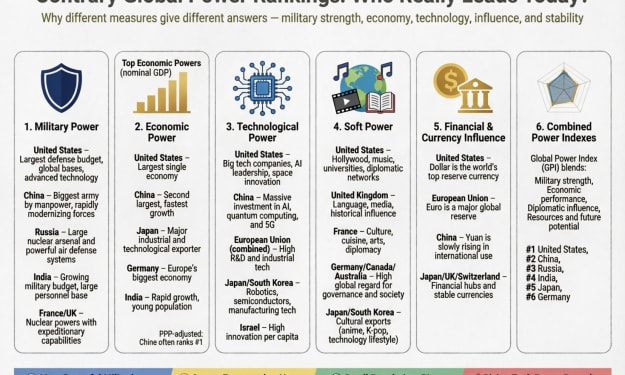
Contrary Global Power Rankings: Who Really Leads Today?
Contrary Global Power Rankings: Who Really Leads Today? When we talk about the “most powerful countries in the world,” many people immediately think of military strength or economic size. But real global power is complex and multidimensional. A country may have the largest economy, while another may have the strongest army, and yet another may wield outsized cultural influence. Different ranking systems lead to different leaders — and sometimes surprising results.
By Wings of Time 27 days ago in Earth
Cypro Banker Adversaries: How Cyber Threats Are Challenging Banks and Financial Systems. AI-Generated.
In the digital age, the banking sector has become a prime target for cyber adversaries — groups and individuals seeking to exploit vulnerabilities for financial gain, espionage, or disruption. Cypriot banks, despite their reputation as a stable financial hub, are not immune to these threats. The term “Cypro banker adversaries” captures the growing spectrum of cyber attacks, ranging from ransomware and malware campaigns to complex state-linked operations targeting banks in Cyprus and beyond.
By Ayesha Lashari27 days ago in Earth
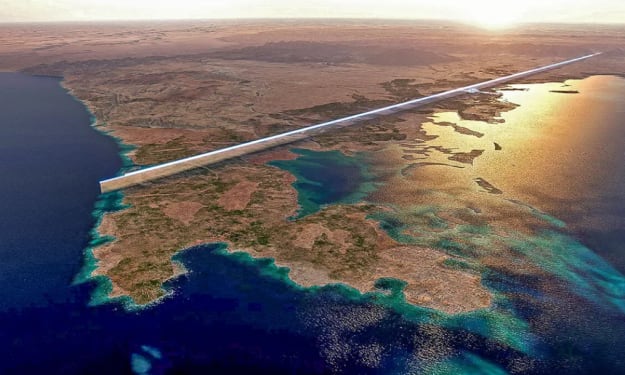
Prosperity Without Relief: Why Many Saudis Feel Squeezed Amid an Economic Boom. AI-Generated.
Saudi Arabia is frequently portrayed as a nation in the midst of a historic economic transformation. Mega-projects rise from the desert, foreign investment conferences draw global CEOs, non-oil revenues are expanding, and the Kingdom’s Vision 2030 reform agenda is regularly praised as bold and ambitious. On paper, the economy appears dynamic and forward-looking.
By Ayesha Lashari27 days ago in Earth
Americans Are Losing Hope: What the Latest Gallup Poll Reveals About the Depth of National Gloom. AI-Generated.
For generations, optimism has been a defining feature of the American identity. The belief that tomorrow will be better than today has powered economic growth, social movements, and personal ambition. But a new Gallup poll suggests that this long-standing sense of hope may be fading — and fading fast. The latest data paints a sobering picture: fewer Americans believe their future will be better than their present. The numbers reveal not just temporary frustration, but a deeper and more widespread sense of uncertainty about where the country — and their own lives — are headed. Let’s take a closer look at what the poll shows and why it matters. Optimism at a Near Record Low Gallup’s survey asks Americans to rate their current lives and where they expect to be five years from now on a scale of 0 to 10. Those who rate their future at 8 or above are considered optimistic about what lies ahead. In 2025, only about 59% of Americans rated their future lives this positively — the lowest level recorded in nearly two decades of tracking. That marks a significant drop compared to earlier years when optimism was considerably stronger. Even more striking is the number of Americans classified as “thriving” — those who rate both their present life positively and expect a strong future. Fewer than half of Americans now meet that standard. In simple terms: many Americans don’t feel confident that the next five years will bring improvement. Future Expectations Are Falling Faster Than Present Satisfaction One of the most revealing aspects of the poll is this: Americans’ satisfaction with their current lives has declined somewhat over time — but expectations for the future have fallen nearly twice as sharply. This suggests that people aren’t only reacting to immediate struggles like inflation, housing costs, or political tension. Instead, they’re losing confidence in long-term progress. It’s one thing to feel frustrated about today. It’s another to believe tomorrow won’t be better. That shift in mindset signals something deeper than economic anxiety. It reflects a broader uncertainty about opportunity, stability, and national direction. Political Divides Deepen the Gloom Political affiliation plays a major role in how Americans view the future. Historically, supporters of the party in power tend to feel more optimistic, while supporters of the opposition feel less hopeful. That pattern continues — but the most recent drop among Democrats following the 2024 election has been particularly sharp. At the same time, Republicans’ optimism has risen slightly with their party holding power, but not enough to offset the overall national decline. In fact, even many Republicans report less optimism compared to previous years. The result? A country where hope is fractured along partisan lines — and where national unity around a shared positive future seems increasingly distant. Economic Anxiety Remains a Key Driver Although unemployment rates and certain economic indicators appear stable on paper, many Americans continue to feel financial pressure. Housing affordability, rising insurance costs, healthcare expenses, and lingering concerns about inflation weigh heavily on households. Even when wages increase, they often struggle to keep pace with living costs. This disconnect between official economic data and everyday experience may be fueling skepticism. When people don’t feel tangible improvement in their daily lives, they are less likely to believe broader economic success stories. Consumer confidence matters because it influences spending, investment, and long-term planning. If Americans feel uncertain, they may delay major decisions — buying homes, starting businesses, or expanding families. Over time, that hesitation can ripple through the broader economy. Younger Americans Are Especially Concerned Younger adults, particularly those under 35, are among the most worried about politics and governance. Many feel burdened by student debt, high housing prices, and an increasingly polarized political climate. For a generation raised during financial crises, a global pandemic, and intense political division, optimism may not come as naturally as it once did for earlier generations. When young people — the group typically most hopeful about the future — begin expressing deep skepticism, it signals a potentially long-term cultural shift. Why Public Optimism Matters It’s easy to dismiss survey data as just numbers. But collective optimism plays a powerful role in shaping national outcomes. Hope influences: Economic behavior – People invest, spend, and innovate when they believe in future growth. Civic engagement – Optimistic citizens are more likely to vote, volunteer, and participate in community life. Mental health – A positive outlook is closely tied to emotional well-being and resilience. Social stability – Societies with higher trust and shared optimism tend to experience less unrest. When optimism declines broadly, the effects can extend far beyond individual moods. Is This Temporary — or Structural? The key question is whether this drop represents a short-term reaction to political and economic cycles, or a deeper structural shift. America has faced moments of pessimism before — during recessions, wars, and periods of social upheaval. In many cases, optimism eventually rebounded. But today’s challenges feel layered: economic pressure, political polarization, institutional distrust, global instability, and rapid technological change all combine to create uncertainty. Unlike previous downturns driven by a single crisis, today’s gloom appears multifaceted. What Could Restore Confidence? Rebuilding optimism likely requires more than improved economic statistics. Americans may need to see tangible progress in areas that affect daily life: Affordable housing and healthcare Stable prices and wages that keep up with costs Reduced political dysfunction Greater institutional trust Clear long-term national direction Leadership, transparency, and practical solutions matter. When people see systems working effectively, confidence tends to rise. A Turning Point for the American Mood The latest Gallup poll doesn’t suggest Americans have given up entirely. A majority still believe in a positive future — but that majority is shrinking. The data reveals something significant: the American belief in steady progress is no longer a given. Whether this period becomes a temporary dip or a lasting transformation depends on how leaders, institutions, and communities respond. Optimism has long been one of America’s greatest strengths. The challenge now is whether it can be renewed in an era defined by uncertainty. If history offers any lesson, it’s this: public mood can change — but it rarely changes on its own.
By Ayesha Lashari27 days ago in Earth