
The Fiery Circle: Understanding the Pacific Ring of Fire
Why 90% of the World’s Earthquakes Strike a Single Horseshoe-Shaped Zone

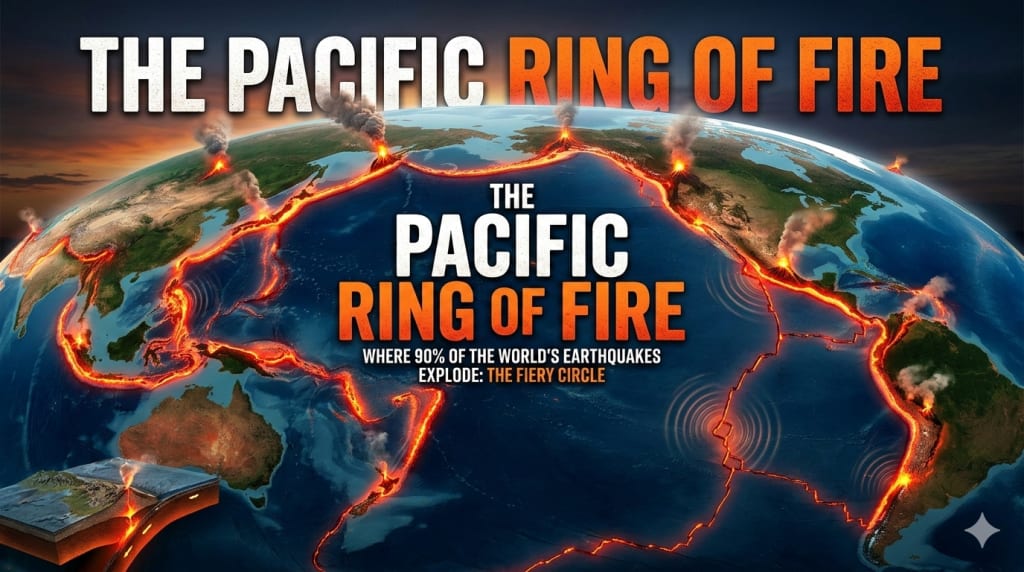
The **Pacific Ring of Fire** is not a literal ring of flames, but it is undoubtedly the most geologically volatile region on Earth. Stretching approximately 40,000 kilometers (25,000 miles) in a massive horseshoe shape, it traces the coasts of the Pacific Ocean—from the southern tip of South America, up along the coast of North America, across the Bering Strait, down through Japan, and into Southeast Asia and New Zealand.
While it covers only a fraction of the Earth's surface, it is home to **75% of the world’s active volcanoes** and is responsible for a staggering **90% of the world's earthquakes**. To understand why this area is so restless, we have to look beneath the surface at the relentless movement of tectonic plates.
---
### The Engine Room: Plate Tectonics
The Earth’s outer shell, the lithosphere, is broken into giant "jigsaw pieces" called tectonic plates. These plates are constantly moving, fueled by heat from the Earth's core. The Ring of Fire is essentially the border where the **Pacific Plate** meets several other major and minor plates (such as the Nazca, Philippine, and North American plates).
Most of the drama happens at **subduction zones**. This occurs when an oceanic plate (which is dense and heavy) collides with a continental plate (which is lighter). Instead of a head-on crash where both stop, the heavier oceanic plate is forced downward into the Earth’s mantle.
### Why the Earthquakes Never Stop
The reason 90% of earthquakes occur here boils down to **friction and pressure**:
1. **Stick and Slip:** As the oceanic plate slides under the continental plate, they don’t glide smoothly. They are made of rough rock and get "stuck."
2. **Energy Accumulation:** Even though the plates are stuck, they continue to push against each other. This builds up massive amounts of elastic potential energy over decades or centuries.
3. **The Snap:** Eventually, the stress exceeds the strength of the rocks. The plates suddenly "slip" or break. That instantaneous release of built-up energy sends shockwaves through the ground—this is what we feel as an earthquake.
Because the Ring of Fire is almost entirely comprised of these active plate boundaries, the "snapping" happens somewhere along the line almost constantly.
---
### The Birth of Volcanoes
The same process that causes earthquakes also creates the "Fire" in the ring. As the subducting plate sinks deeper into the mantle, the high temperatures and pressure cause the plate to release water and other volatiles. This lowers the melting point of the surrounding rock, creating **magma**.
This molten rock is lighter than the solid rock around it, so it rises toward the surface. When it breaks through the crust, it creates the explosive, cone-shaped volcanoes characteristic of regions like Indonesia, Japan, and the American Northwest (Cascades).
### Impact on Humanity
The Ring of Fire is home to some of the world's most densely populated regions. Cities like Tokyo, Manila, Los Angeles, and Santiago sit directly on or near these fault lines.
* **Tsunamis:** Because many of these earthquakes occur underwater at subduction zones, the sudden displacement of the seafloor can push massive amounts of water upward, triggering devastating tsunamis.
* **Geothermal Energy:** On the bright side, the intense heat beneath the surface provides these regions with incredible potential for geothermal energy. Countries like Iceland (not in the ring, but volcanic) and the Philippines utilize this "inner fire" to generate clean electricity.
---
### Conclusion
The Pacific Ring of Fire is a vivid reminder that the Earth is a living, breathing planet. The high frequency of earthquakes in this zone isn't a coincidence; it is the natural consequence of the Pacific Plate being recycled into the Earth's interior. While this movement causes immense destruction, it is also the very process that creates new land and shapes the geography of our world.
**Would you like me to create a detailed list of the most significant earthquakes that have occurred along the Ring of Fire in the last century?**
About the Creator
Irshad Abbasi
Ali ibn Abi Talib (RA) said 📚
“Knowledge is better than wealth, because knowledge protects you, while you have to protect wealth.
Keep reading
More stories from Irshad Abbasi and writers in Earth and other communities.
Mount Sinai, the World’s Oldest Monastery, and the Prophet’s Letter: Faith, History, and a Controversial Development Plan
At a sacred site revered by Muslims, Christians, and Jews alike, an ambitious modernization project has stirred debate after reports of graves being relocated—raising questions about heritage, memory, and the cost of progress.
By Irshad Abbasi a day ago in Earth
War:
War: The Art of Never Growing Up There is something deeply strange about war. It isn’t strange in the sense that it surprises us, we have normalized it far too effectively for that. Rather, it is strange in the way something feels instinctively "wrong" even after thousands of years of repetition. It feels like an evolutionary glitch, a behavior that doesn’t quite belong to the world we claim to be building.
By Rick Anguloa day ago in Earth



Comments
There are no comments for this story
Be the first to respond and start the conversation.