
The World’s Largest Natural Pressure Cooker
Deep beneath the surface of Yellowstone National Park lies a massive volcanic system whose heat, gases, and pressure have earned it the nickname “the world’s largest natural pressure cooker.”

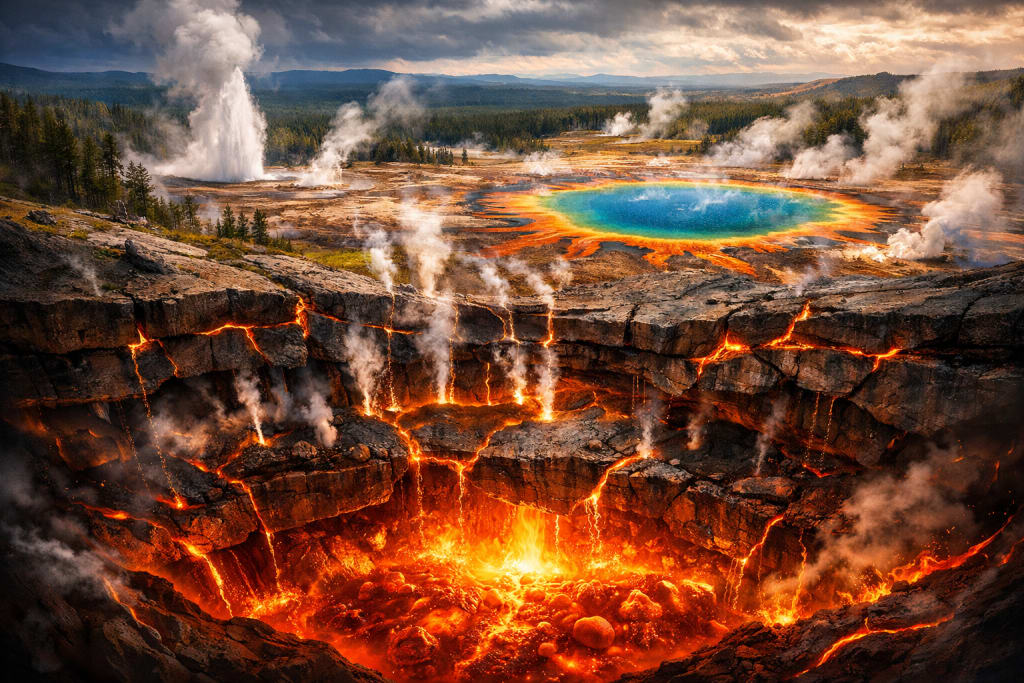
Hidden beneath the beautiful landscapes of Yellowstone National Park lies one of the most powerful geological systems on Earth. Famous for its geysers, hot springs, and colorful thermal pools, Yellowstone is not just a national park—it is the surface expression of a gigantic volcanic system known as the Yellowstone Caldera. Because of the immense heat, pressure, and gases trapped beneath the ground, scientists often describe this system as the world’s largest natural pressure cooker.
A pressure cooker works by trapping steam and heat in a sealed container, increasing pressure until the contents inside cook faster. In a similar way, Yellowstone’s underground system traps heat, water, and volcanic gases deep within the Earth’s crust. The result is an enormous natural system where pressure builds continuously beneath the surface.
The Yellowstone volcanic system sits on top of a powerful underground heat source known as the Yellowstone hotspot. This hotspot is a column of extremely hot rock rising from deep within the Earth’s mantle. As this heat moves upward, it melts surrounding rocks and creates magma chambers beneath the surface.
Scientists believe that beneath Yellowstone there are two massive magma reservoirs. These chambers contain partially molten rock, gases, and superheated water. The combination of these elements creates an environment where pressure can build up over time. Above these magma chambers lies a thick layer of rock acting like the lid of a giant pressure cooker.
Water plays a major role in this system. Rain and snowmelt seep through cracks in the ground and travel deep underground where they encounter hot rocks heated by magma. The water then becomes superheated—often hotter than boiling point—but remains trapped under pressure. When the pressure becomes too high, the water and steam escape through geysers, hot springs, or small hydrothermal explosions.
One of the most famous examples of this pressure-release system is Old Faithful. This geyser erupts regularly as underground pressure builds and then suddenly releases steam and hot water high into the air. While Old Faithful appears predictable and harmless, it is actually a small part of the vast and complex hydrothermal network beneath the park.
The Yellowstone Caldera itself was formed by three enormous volcanic eruptions in the past. These eruptions occurred approximately 2.1 million, 1.3 million, and 640,000 years ago. Each eruption was powerful enough to release thousands of times more material than typical volcanic eruptions. When the magma chambers emptied during these eruptions, the ground above collapsed, creating the massive caldera that exists today.
Because Yellowstone still contains active magma beneath the surface, scientists closely monitor the area for signs of changes in pressure. Instruments measure earthquakes, ground deformation, and gas emissions. Small earthquakes occur frequently in the region as rocks shift and pressure changes underground. These tremors are usually harmless and are considered a normal part of the system releasing stress.
Despite popular fears, experts from organizations such as the United States Geological Survey emphasize that a massive eruption at Yellowstone is extremely unlikely in the near future. In fact, the hydrothermal features—geysers, hot springs, and steam vents—actually help release pressure gradually. In a sense, they act like safety valves in the world’s largest natural pressure cooker.
Today, Yellowstone remains one of the most studied volcanic systems on Earth. Scientists use satellites, seismographs, and chemical sensors to better understand how this giant underground system works. Their research helps improve our understanding of volcanic activity, geothermal energy, and Earth’s inner processes.
While the idea of a gigantic pressure cooker beneath the ground may sound alarming, it also highlights the dynamic nature of our planet. Yellowstone reminds us that the Earth is constantly evolving beneath our feet, powered by heat and energy from deep inside the planet.
For visitors, the park offers breathtaking scenery—steaming geysers, colorful pools, and vast wilderness. But beneath this beauty lies a powerful geological engine quietly building and releasing pressure, making Yellowstone truly the world’s largest natural pressure cooker.
About the Creator
Irshad Abbasi
Ali ibn Abi Talib (RA) said 📚
“Knowledge is better than wealth, because knowledge protects you, while you have to protect wealth.
Keep reading
More stories from Irshad Abbasi and writers in Earth and other communities.
The Search for Earth’s Missing Billion Years
Earth’s history stretches back about 4.5 billion years, recorded in the rocks, minerals, and fossils that form the planet’s geological archive. Yet within this immense timeline lies a puzzling mystery often referred to by scientists as the “missing billion years.” During this period, an enormous span of time appears strangely quiet in the geological record, raising important questions about what exactly happened on Earth during that era.
By Irshad Abbasi 2 days ago in Earth
Harmful Effects of the Environment
The environment is the natural world around us. It includes air, water, land, plants, animals, and all living and non-living things that support life on Earth. A healthy environment is very important for the survival and well-being of humans, animals, and plants. However, in recent years, the environment has been facing serious harm due to human activities. Pollution, deforestation, and climate change are some of the major environmental problems that are affecting the world today. These harmful effects are not only damaging nature but also creating serious challenges for human life.
By aadam khan2 days ago in Earth


Comments
There are no comments for this story
Be the first to respond and start the conversation.