
A Memory I’ll Hold On to Forever
It was just a small note - but it meant everything.

The hallway outside the classroom was unusually quiet that morning.
Most of the students had already arrived. Their voices floated through the door; laughter, small conversations, the rustling sound of chairs being moved across the floor.
But just outside the classroom door stood Ema, quietly.
She held her mother’s hand tightly, her small fingers wrapped around it as if letting go would pull her into something she wasn’t ready to face.
“I don’t want to go,” she whispered.
Her voice was barely audible.
Her mother leaned down gently.
“Come on, Ema,” she said softly. “Sensei is waiting.”
I stepped outside the classroom and greeted them.
“Good morning, Ema.”
Normally she would smile.
Normally she would say hello.
But that morning she just shook her head again, her eyes fixed on the floor.
“I don’t want to go.”
Children carry emotions in ways adults often forget how to read.
Sometimes it appears as silence.
Sometimes as stubbornness.
Sometimes as a quiet refusal to move forward.
Ema looked tired.
This didn't look exactly like the kind of tiredness that comes from a late bedtime or too much play. This was something different, a heaviness that seemed to sit quietly behind her eyes.
Her mother tried again.
“It will be fun,” she said. “Just one hour.”
We promised games.
Songs.
Activities with her classmates.
Still, Ema held on tighter.
The hallway remained still as the moment stretched longer than anyone expected.
Finally her mother looked up at me with an apologetic smile.
“I’m sorry,” she said softly, bowing slightly.
I shook my head.
“It’s okay.”
Some days, the most important lesson is simply allowing space.
They turned and slowly walked down the hallway together.
And just like that, Ema’s seat in the classroom remained empty that day.
A week passed.
In teaching, time moves quickly. Lessons continue, new topics begin, students laugh, learn, and move through their routines.
But small moments linger in a teacher’s mind.
I found myself wondering what had weighed so heavily on Ema that morning.
Children rarely explain these things.
Their worlds are large, but their words are still small.
The following week, Ema returned.
When she entered the school, she walked slowly toward the classroom.
She looked shy, but there was something different in her expression.
Determination.
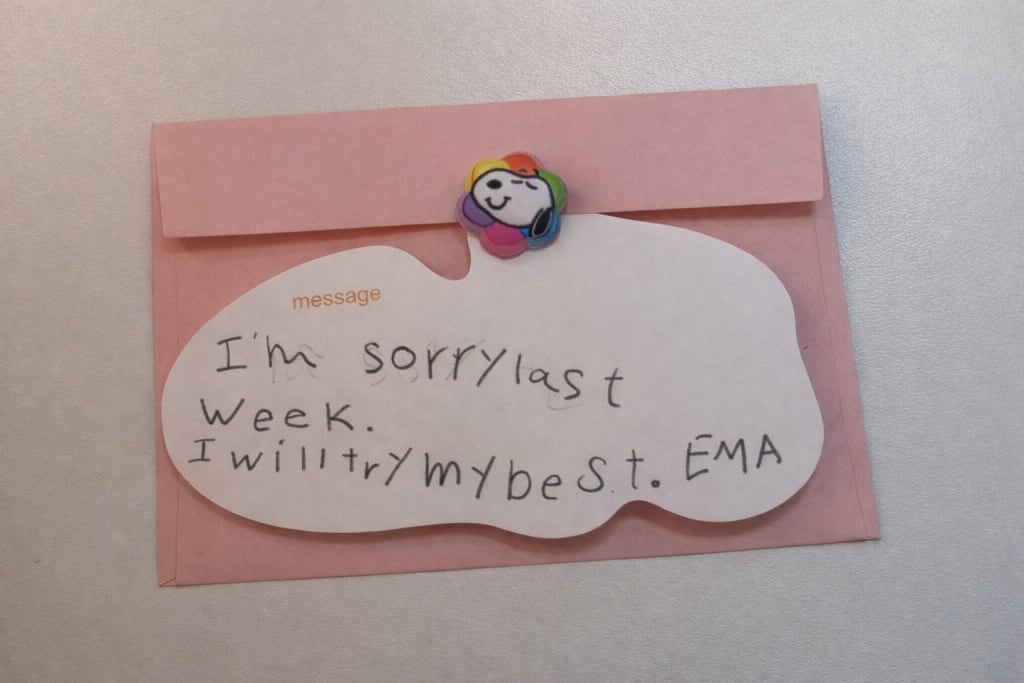
In her hands she held a small pink envelope.
She approached me quietly.
“Sensei…”
Her voice was soft again, but this time she looked up.
“This is for you.”
I opened the envelope carefully.
Inside was a small piece of paper cut into the shape of a cloud.
The letters were uneven and slightly crooked — the kind of handwriting that shows careful effort.
The note read:
“I’m sorry last week.
I will try my best.
— Ema”
For a moment, the hallway seemed to pause.
Teachers receive many papers.
Worksheets.
Assignments.
Homework.
But some pieces of paper carry something different.
Something honest.
Something deeply human.
I looked at Ema.
She watched my face closely, as if waiting for permission to breathe again.
I smiled.
“Thank you, Ema.”
Immediately her shoulders relaxed.
The tension that had been sitting quietly around her seemed to dissolve.
People often believe teaching is about delivering lessons.
Grammar, vocabulary and correct answers written neatly on a whiteboard.
But the longer you teach, the more you understand something different.
Teaching is not only about knowledge.
It is about patience.
It is about trust.
It is about creating a place where a child can disappear for a moment — and still feel safe enough to return.
Children feel emotions just as deeply as adults do.
The only difference is that they are still learning the language to explain them.
Sometimes those emotions appear as resistance.
Sometimes as silence.
And sometimes they appear in the form of a small handwritten note.
That day in class, Ema laughed with the other students.
She raised her hand during activities.
She answered questions with a quiet confidence.
It was as if the heavy cloud from the previous week had finally moved away.
Children have an incredible ability to begin again.
To fall down.
To stand back up.
To try once more.
Later that afternoon, when the classroom had emptied and the building grew quiet again, I looked at the note one more time.
“I’m sorry last week. I will try my best.”
There is something powerful about those words when they come from a child.
It's not perfection or an achievement.
It's just the courage to try again.
I decided to keep the note.
Teachers collect many things over the years; textbooks, lesson plans, worksheets, schedules. I have collected so many so far.
But the things that remain with us the longest are often the smallest.
A drawing.
A thank-you card.
A note written with effort.
Years from now, I may forget the lesson we taught that day.
But I will remember Ema’s note FOREVER because sometimes, the moments that stay with us forever are not the ones we planned.
They are the quiet human moments we never expected.
And, those are the memories we hold on to.
****
*Sensei is the Japanese word for teacher
****
(I'm an English teacher living in Japan. I would like to share more about my experiences as I navigate daily life and culture in Japan. If you give me a 'hi' it would be a greenlight to continue sharing my experiences in this new country I now call home)
Thank you!
About the Creator
Lori A. A.
Writer, Teacher exploring identity, human behavior, and life between cultures.
Keep reading
More stories from Lori A. A. and writers in Education and other communities.
The Overlooked Consequences of Weak Healthcare Program Planning
Healthcare programs are created to expand access to care, improve patient outcomes, and strengthen public health systems. Governments, hospitals, nonprofits, and health organizations invest significant resources into developing programs that address disease prevention, treatment, and community wellness. When these initiatives are carefully planned and strategically executed, they can transform healthcare delivery and improve the quality of life for entire populations.
By Evyatar Nitzany3 days ago in Education
10 Best AI Agent Development Companies Transforming Business Operations
Imagine having a smart assistant that can handle complex tasks, make decisions, and learn independently. That's what AI agents do for businesses today. These are not just chatbots. They are advanced software programs designed to perform specific tasks intelligently and on their own. From automating IT support to improving software development, AI agents are becoming essential tools for companies looking to increase efficiency and drive innovation.
By Jamika Wilkersonabout 3 hours ago in Education



Comments
There are no comments for this story
Be the first to respond and start the conversation.