
Why the Sun Rotates Faster at the Equator: The Surprising Physics of Solar Rotation
Why does the Sun rotate faster at the equator than at the poles? Discover the fascinating science behind solar differential rotation and how it affects the Sun’s magnetic activity.

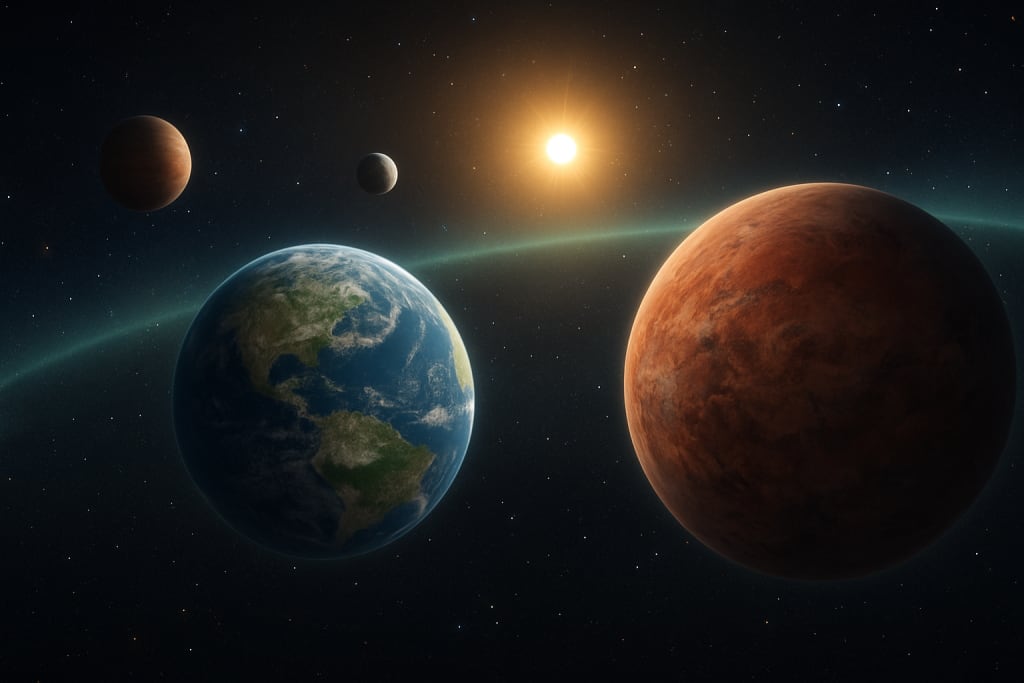
If you watch the Sun through powerful telescopes over several days, you might notice something unusual. Dark patches known as sunspots slowly drift across the surface of the Sun as the star rotates. At first, this movement seems similar to the rotation of Earth or other planets.
But astronomers discovered something surprising when they studied the Sun carefully: the Sun does not rotate as a solid body.
Instead, different parts of the Sun rotate at different speeds. The equator spins faster than the polar regions. This phenomenon is known as differential rotation, and it is one of the most fascinating aspects of solar physics.
Understanding why the Sun rotates differently at the equator helps scientists explain many important solar phenomena, including sunspots, solar flares, and the powerful magnetic storms that sometimes affect Earth.
________________________________________
How the Sun Rotates
The Sun does rotate, but not in the same way as a solid planet.
Earth, for example, rotates as a rigid body. Every location on the planet takes roughly 24 hours to complete one full rotation.
The Sun behaves differently because it is not solid. It is a massive ball of extremely hot plasma composed mostly of hydrogen and helium.
This plasma behaves like a fluid rather than a solid structure.
Because of this fluid nature, different regions of the Sun can move independently of each other.
________________________________________
Rotation Speed at Different Latitudes
Astronomers have measured how fast different parts of the Sun rotate by tracking sunspots and other features on its surface.
Their observations revealed clear differences:
• The solar equator completes one rotation in about 25 days.
• Mid-latitude regions rotate in about 27 days.
• Near the solar poles, rotation takes roughly 34 to 35 days.
This means the equator rotates significantly faster than the poles.
This uneven rotation is what scientists call solar differential rotation.
________________________________________
Why the Sun Does Not Rotate Like a Solid Object
The main reason for differential rotation is the Sun’s internal structure.
Unlike Earth, which has a solid crust and mantle, the Sun is made almost entirely of plasma, an extremely hot state of matter in which atoms are stripped of their electrons.
In plasma, particles move freely and are strongly influenced by magnetic fields and convection currents.
Because the Sun behaves like a fluid, its layers are not locked together in rigid motion.
Instead, different regions can move at different speeds depending on their location and internal dynamics.
________________________________________
The Role of Convection in Solar Rotation
One of the key processes responsible for differential rotation is convection.
Inside the outer layers of the Sun, hot plasma rises toward the surface while cooler plasma sinks back down. This circulation process is similar to the movement of boiling water in a pot.
These convection currents transport energy outward from the Sun’s interior.
However, they also influence the motion of plasma across the Sun’s surface.
Because the Sun is rotating at the same time that convection occurs, these rising and sinking flows become twisted and stretched.
This interaction creates complex motion patterns that contribute to faster rotation at the equator.
________________________________________
Angular Momentum and Solar Rotation
Another important factor is the conservation of angular momentum.
When a rotating fluid body like the Sun evolves, angular momentum must be redistributed throughout the star.
In many rotating systems, material near the equator tends to move faster because it travels a larger circular path during rotation.
Over time, this effect can lead to faster rotation at lower latitudes compared to higher latitudes.
In the Sun, this process works together with convection and magnetic forces to create the differential rotation pattern we observe.
________________________________________
The Sun’s Internal Layers and Rotation
The Sun has several internal layers, each playing a role in how the star rotates.
The Core
At the center of the Sun lies the core, where nuclear fusion occurs. This region produces the energy that powers the Sun.
The Radiative Zone
Above the core is the radiative zone, where energy moves outward primarily through radiation.
The Convective Zone
The outer portion of the Sun is known as the convective zone. In this region, hot plasma rises and cool plasma sinks in large convection cells.
The convective zone is where differential rotation is most strongly observed.
The complex flow patterns in this region cause different latitudes to rotate at different speeds.
________________________________________
The Tachocline: A Key Region of Solar Dynamics
Between the radiative zone and the convective zone lies a thin transition layer called the tachocline.
This region is extremely important in solar physics.
The tachocline separates the relatively stable rotation of the radiative zone from the turbulent motion of the convective zone.
Scientists believe this boundary plays a crucial role in generating the Sun’s magnetic field.
The interaction between rotation and magnetic fields in the tachocline helps drive the solar magnetic cycle.
________________________________________
Differential Rotation and the Solar Magnetic Field
One of the most important consequences of differential rotation is the creation of the Sun’s magnetic field.
Because the equator rotates faster than the poles, magnetic field lines become twisted and stretched over time.
This twisting process gradually strengthens the magnetic field and can eventually produce intense solar activity.
When magnetic fields become highly tangled, they can suddenly snap and reconnect.
This process releases enormous amounts of energy in events such as:
• Solar flares
• Coronal mass ejections
• Sunspots
These solar storms can sometimes affect Earth by disrupting satellites, communication systems, and power grids.
________________________________________
How Astronomers Discovered Differential Rotation
The discovery of solar differential rotation dates back several centuries.
Early astronomers such as Galileo Galilei observed sunspots moving across the Sun’s surface. By tracking these spots over time, they realized the Sun was rotating.
Later observations with more advanced telescopes revealed that sunspots at different latitudes moved at different speeds.
Modern spacecraft, including solar observatories and satellites, have confirmed these findings with incredible precision.
Using techniques such as helioseismology, scientists can now study the internal motion of the Sun by observing waves that travel through its interior.
________________________________________
Why Differential Rotation Matters
Understanding solar rotation is crucial for several areas of astrophysics.
Predicting Solar Activity
Differential rotation plays a major role in the solar magnetic cycle, which affects solar storms and space weather.
Protecting Space Technology
Solar storms influenced by magnetic activity can damage satellites, GPS systems, and power infrastructure.
Understanding Other Stars
The Sun serves as a model for studying how other stars rotate and generate magnetic fields.
Many stars across the universe also exhibit differential rotation, though the patterns may differ depending on their size and structure.
________________________________________
The Sun as a Laboratory for Stellar Physics
Because the Sun is the closest star to Earth, it provides an ideal laboratory for studying stellar behavior.
Astronomers can observe its surface, atmosphere, and internal processes in extraordinary detail.
Research into solar rotation continues to reveal new insights into the dynamics of stars and the complex interactions between plasma, gravity, and magnetic fields.
________________________________________
Conclusion
The Sun’s rotation is far more complex than that of a solid planet. Instead of spinning as a single rigid body, the Sun rotates at different speeds depending on latitude.
The equator completes a rotation in about 25 days, while the poles take more than a month.
This phenomenon, known as differential rotation, occurs because the Sun is made of fluid plasma rather than solid rock.
Convection currents, angular momentum, and magnetic forces all contribute to this unique behavior.
Differential rotation also plays a critical role in shaping the Sun’s magnetic field and driving powerful solar activity.
By studying how the Sun rotates, scientists gain valuable insights into the behavior of stars throughout the universe and the dynamic processes that power our solar system.
The next time you see the Sun shining in the sky, remember that beneath its calm appearance lies a complex and constantly moving star, spinning in ways that continue to fascinate astronomers around the world.
About the Creator
Keep reading
More stories from shahkar jalal and writers in Education and other communities.
How Long the Sun Has Left: The Future Life and Death of Our Star Explained
Every day, the Sun rises and sets with remarkable consistency. It has illuminated Earth for billions of years, sustaining life and shaping the environment of our planet. Because the Sun appears stable and unchanging, it is easy to imagine that it will shine forever.
By shahkar jalalabout 5 hours ago in Education


Comments
There are no comments for this story
Be the first to respond and start the conversation.