
How Long the Sun Has Left: The Future Life and Death of Our Star Explained
How long will the Sun continue to shine? Discover the remaining lifespan of the Sun, its future evolution, and what will eventually happen to our solar system.

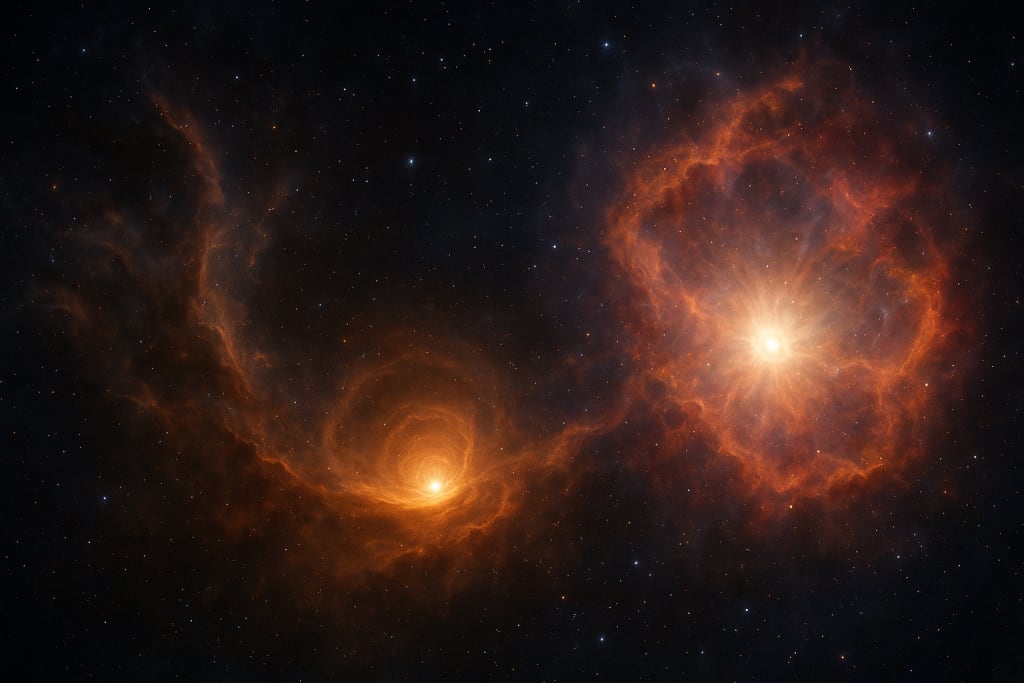
Every day, the Sun rises and sets with remarkable consistency. It has illuminated Earth for billions of years, sustaining life and shaping the environment of our planet. Because the Sun appears stable and unchanging, it is easy to imagine that it will shine forever.
But like every star in the universe, the Sun has a finite lifespan.
Deep within its core, a powerful nuclear engine is slowly consuming its fuel. For billions of years, hydrogen atoms have been fusing together to produce the energy that lights our solar system. Yet this fuel supply is not endless. One day, far in the future, the Sun will run out of hydrogen and begin a dramatic transformation that will reshape the entire solar system.
So how long does the Sun have left? And what will happen when its life eventually reaches its final stages?
To answer these questions, astronomers study stellar evolution—the process that determines how stars form, change, and eventually die.
________________________________________
The Birth of the Sun
The Sun formed about 4.6 billion years ago from a giant cloud of gas and dust known as a nebula. This cloud collapsed under its own gravity, forming a dense central region that eventually became our star.
As the material condensed, pressure and temperature in the center increased dramatically. Eventually, the core became hot enough for nuclear fusion to begin.
This moment marked the birth of the Sun as a true star.
From that point forward, the Sun began converting hydrogen into helium in its core, releasing enormous amounts of energy that radiate outward as sunlight.
________________________________________
The Sun’s Current Stage: A Main Sequence Star
Today, the Sun is in the main sequence phase of its life cycle. This stage is the longest and most stable period in a star’s life.
During the main sequence phase, nuclear fusion in the core continuously converts hydrogen into helium. This process releases energy that balances the inward pull of gravity.
Astronomers call this balance hydrostatic equilibrium.
As long as this balance exists, the Sun remains stable and continues shining steadily.
Most stars spend about 90 percent of their lives in this stage, making it the longest period in stellar evolution.
________________________________________
How Long the Sun Will Continue Shining
Scientists estimate that the Sun will remain in the main sequence stage for about 10 billion years in total.
Since the Sun is currently about 4.6 billion years old, it has roughly 5 billion years left before significant changes begin.
This means the Sun is currently about halfway through its life.
For the foreseeable future—hundreds of millions and even billions of years—the Sun will continue shining and providing the energy that supports life on Earth.
________________________________________
What Happens as the Sun Ages
Although the Sun will remain stable for billions of years, it is slowly changing even now.
As hydrogen in the core is converted into helium, the core gradually becomes denser. This causes the temperature and pressure inside the core to increase slightly.
Because of this process, the Sun is slowly becoming brighter and hotter over time.
Scientists estimate that the Sun is about 30 percent brighter today than when it first formed.
This gradual increase in brightness will continue over billions of years.
________________________________________
The Future of Earth
Long before the Sun reaches the end of its life, the increasing brightness will begin affecting Earth.
In roughly 1 to 2 billion years, the Sun will become bright enough to trigger major climate changes on our planet.
Higher temperatures could cause Earth's oceans to gradually evaporate. Water vapor would accumulate in the atmosphere, intensifying the greenhouse effect.
Eventually, Earth could become too hot to support life as we know it.
This transformation would occur long before the Sun runs out of fuel.
________________________________________
The End of the Main Sequence
In about 5 billion years, the Sun’s core will have exhausted most of its hydrogen fuel.
Without hydrogen fusion to support it, the core will begin to collapse under gravity.
As the core contracts, it will heat up dramatically. This increase in temperature will ignite hydrogen fusion in a shell surrounding the core.
The energy produced by this shell fusion will push the outer layers of the Sun outward.
At this point, the Sun will begin expanding into a red giant star.
________________________________________
The Red Giant Phase
When the Sun becomes a red giant, it will grow enormously—possibly expanding hundreds of times its current size.
Mercury and Venus will almost certainly be swallowed by the expanding Sun.
The fate of Earth is uncertain. Some models suggest Earth may also be engulfed, while others suggest it may survive but become a scorched, lifeless world.
During this phase, the Sun’s surface temperature will decrease slightly, giving the star a reddish appearance.
Despite the cooler surface, the total energy output of the Sun will increase dramatically because of its enormous size.
________________________________________
Helium Fusion and Later Stages
Eventually, the Sun’s core will become hot enough to begin helium fusion.
During this stage, helium atoms will fuse into heavier elements such as carbon and oxygen.
This phase will last for a shorter period compared to the main sequence stage.
Once helium fuel is exhausted, the Sun will not have enough mass to fuse heavier elements.
At that point, the Sun will enter its final stages.
________________________________________
The Formation of a Planetary Nebula
As the Sun nears the end of its life, it will begin shedding its outer layers into space.
These layers will form a glowing cloud of gas known as a planetary nebula.
Planetary nebulae are some of the most beautiful objects in the universe, often forming colorful and intricate shapes.
Although they appear spectacular, this phase marks the final transformation of the star.
________________________________________
The Sun’s Final Remnant: A White Dwarf
After the outer layers drift away, the remaining core of the Sun will become a white dwarf.
A white dwarf is an extremely dense stellar remnant about the size of Earth but containing nearly half the mass of the Sun.
It will no longer produce energy through nuclear fusion.
Instead, it will slowly cool and fade over billions of years.
Eventually, after trillions of years, it will become a cold, dark object known as a black dwarf.
However, the universe is not yet old enough for any black dwarfs to exist.
________________________________________
Why Scientists Can Predict the Sun’s Future
Astronomers are able to estimate the Sun’s future because they observe millions of stars at different stages of their life cycles.
By studying these stars and applying the laws of physics, scientists can reconstruct how stars evolve over time.
Computer simulations of stellar evolution also match what astronomers observe in the universe.
This combination of observation and physics gives scientists high confidence in predictions about the Sun’s future.
________________________________________
Why Understanding the Sun’s Lifespan Matters
Studying the Sun’s lifespan helps scientists understand several key aspects of the universe.
Stellar Evolution
The Sun serves as a model for understanding how medium-sized stars evolve.
Planetary Habitability
Learning how stars change over time helps scientists determine whether planets around other stars might support life.
The Future of the Solar System
Understanding the Sun’s future reveals what will eventually happen to the planets, moons, and other objects in our solar system.
________________________________________
Conclusion
The Sun has been shining for about 4.6 billion years, powering Earth’s climate and supporting life across the planet. Yet even this enormous star has a limited lifespan.
Scientists estimate that the Sun has about 5 billion years left before it exhausts its hydrogen fuel and begins transforming into a red giant.
During its final stages, the Sun will expand dramatically, reshape the solar system, and eventually leave behind a dense white dwarf surrounded by a glowing planetary nebula.
Although this transformation lies far in the distant future, it reminds us that stars—like everything in the universe—are constantly evolving.
For now, the Sun remains a stable and life-giving star, continuing to shine as the heart of our solar system for billions of years to come.
About the Creator
Keep reading
More stories from shahkar jalal and writers in Education and other communities.
Why the Sun Will Become a Red Giant: The Future of Our Solar System Explained
Every morning, the Sun rises as it has for billions of years, bathing Earth in light and warmth. To us, it feels permanent and unchanging. Yet in the vast timeline of the universe, the Sun is only halfway through its life.
By shahkar jalalabout 18 hours ago in Education
Problem-Solving Skills for Better Decision Making
Making good choices is a skill. Some people think strong decisions come from luck or natural talent. In truth, they come from practice and clear thinking. This is where powerful problem-solving skills for better decision-making play an important role.
By Andrew Lake2 days ago in Education


Comments
There are no comments for this story
Be the first to respond and start the conversation.