
The Library of Possible Prefaces
Where the Beginning Should Have Been
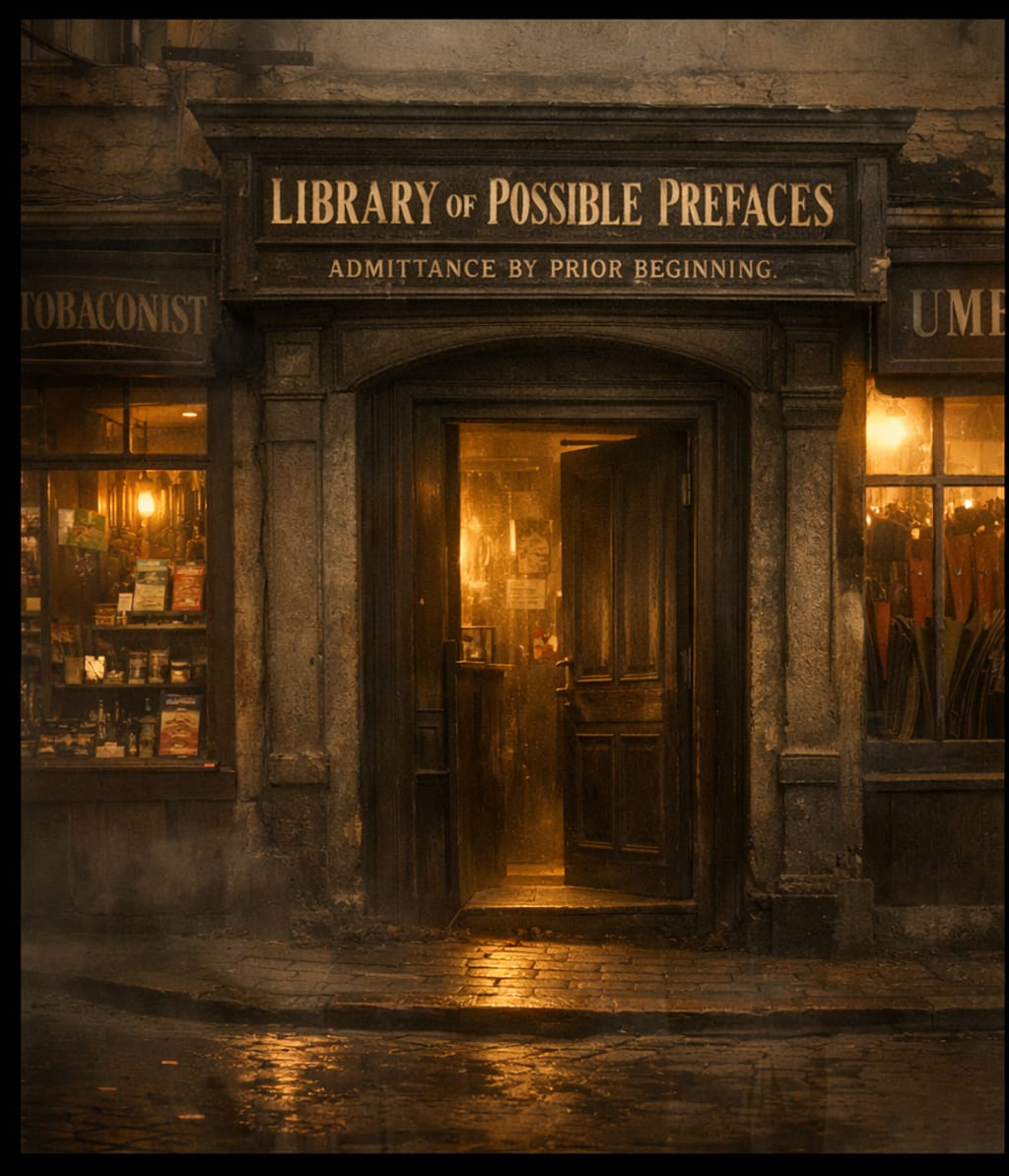
If you have come this far, you have already made a mistake. The library does not let you know you are there. It appears between a tobacconist and a shop that sells umbrellas, in a city whose name I will not give you, because the name of a city is the end of a city, and this city has not yet decided what it is.
The sign above the door reads: LIBRARY OF POSSIBLE PREFACES — Admittance by Prior Beginning.
Margaret Thomas stood beneath this sign on a morning in October and understood neither word of the last condition, which is perhaps why the door opened for her.
The archivist was a small man who moved between the shelves with the efficiency of someone who has spent decades in conversation with papers. He did not look up when she entered. He was reading, or appearing to read, or performing the memory of reading. It was difficult to say which.
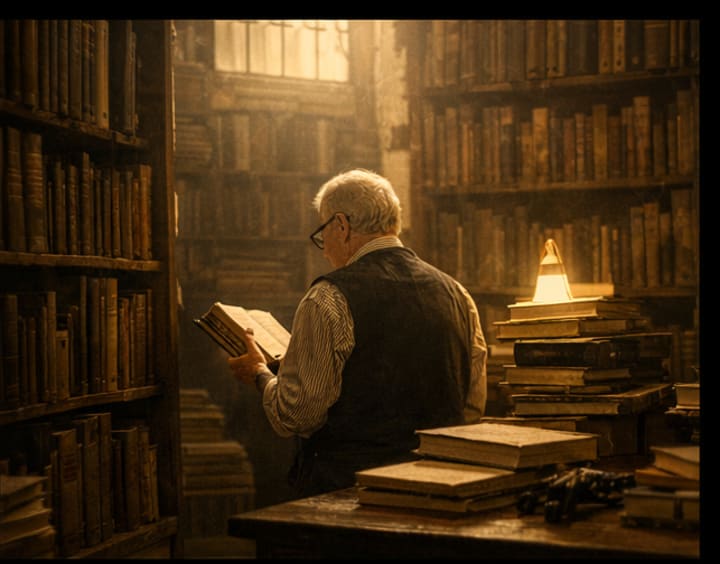
"You are the cataloguer," he said.
"I applied for the position," Margaret said, which is not the same thing.
He closed his book and she noticed it had no back half, only a front cover and perhaps forty pages before the remainder was white and he looked at her over his spectacles.
"The collection," he said, "consists of four thousand, three hundred and twelve volumes. Each contains a first chapter. Some contain only a first paragraph. One contains only a first sentence, though that sentence is, I think you will agree when you read it, sufficient." He paused. "The rest of each volume is blank."
"The authors never finished them?"
"The authors finished precisely what they intended. The first chapter is the whole. What comes after?" He gestured at the shelves, at the high windows through which afternoon light fell in long bars across the spines "what comes after is not their concern. It is perhaps yours."
He handed her a notebook, a pencil, and a small card that read: Do not attempt to write in the blank pages. The blank pages are not empty.
She began, as one must, at the beginning.
The first volume she pulled from the shelf had a blue cloth cover and no title. Inside, in handwriting that slanted gently rightward as though leaning toward something just out of frame.
The morning my mother left for the last time, she paused at the door and said something I could not hear, and I have been moving toward that sentence ever since.
Below this, blank pages. Forty of them. Margaret held the book and felt, with some surprise, that she was not holding an unfinished thing. She was holding a thing that had been completed by its own incompletion, the way a door left ajar is not a broken door but a different kind of door entirely.
She wrote in her notebook: Author unknown. First line only. The forty blank pages feel, somehow, like an answer.
She moved to the second volume.
There is a city I have never visited, and everything I know about love I learned there.
Third volume: My brother and I made a bet, the summer we were young, about which of us would become the person we were afraid of becoming. We never settled it. We are still waiting.
She began to understand the architecture of the collection. Each first chapter was not the opening of a story but the opening of an opening. A door that revealed, when you looked through it, not a room but another door, slightly smaller, and through that door another, and so on until the doors became too small to see, too small to pass through, but not too small to feel the air moving between them, the faint current of all the stories that had almost been.
By the second week she had catalogued four hundred and eleven volumes and begun to notice something she did not immediately report to the archivist.
The world outside the library was changing.
Or rather, the world outside the library was revealing what it had always been.
The tobacconist next door, when she stopped for matches, looked up from his counter with the expression of a man who has been introduced many times but never proceeded past introduction. "Good morning," he said, warmly, with great sincerity. And then, nothing. Not silence exactly. More the expectant pause of a sentence awaiting its second clause, which does not come, which has perhaps never come, which perhaps cannot come because the second clause would require a commitment the first clause has been carefully avoiding.
She walked home through streets that were, she now saw, preliminary. The buildings were real enough and she could touch the stone, feel the cold of it in October. But they had the quality of buildings in the first chapter of a novel about buildings, buildings that exist to establish mood and era, that will be referred to later with nostalgia, that have not yet become themselves.
A woman passed her on the corner, and their eyes met, and Margaret had the vertiginous sensation that they were both characters who had been introduced but not yet given their scenes, that they were waiting in the white space between chapters for the author to return and decide what happened next.
She did not sleep well that night. She lay in bed and looked at the ceiling and thought, what would the second sentence of my life be?
She had been born. That was the first sentence. Everything after was presumably the story. But she could not find the story's seam, the place where it had departed from preamble and entered event. She could find only more preamble, each day the opening of the day before, her whole life an elaborate and beautiful throat-clearing before the speech that was perpetually, courteously, about to begin.
The volume she kept returning to was on the third shelf of a row marked not alphabetically but by something she came to think of as proximity to the thing unsayable. The volumes at the near end were almost-ordinary first chapters: a woman inheriting a house, a man on a train, the usual furniture of beginnings. The volumes at the far end were first chapters that read like transmissions from a location she couldn't identify, which communicated not through meaning but through the feeling of meaning, the shape of meaning, the shadow that meaning casts on the wall when it passes.
The volume she kept returning to was near the far end. Its cover was the color of old water. No author, no title. Inside:
I set out to write the story of my life and found that my life had already been written, not by me. It was not finished, and by an author whose name I cannot read because it is written in a script that only exists in the moment of reading it and vanishes the instant you look directly at the page.
Here is what I know. The story is long. It contains, in its later chapters, scenes of great beauty and at least one scene I will not be able to read without setting the book down and walking away for a while. The protagonist, I recognize her, I think, from the early descriptions is still in the first chapter. She has been in the first chapter for some time. She has the feeling, reading ahead, that the first chapter is where she is most fully herself. Uncertain, reaching, not yet simplified by event.
The second chapter begins; she picked up a pen.
Below this, the pages were blank.
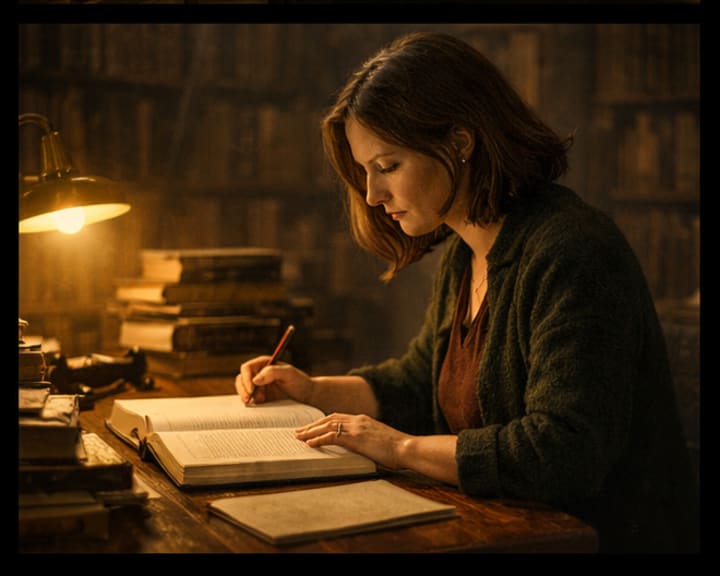
On the thirty-first day, Margaret found the ledger.
It was on a reading table at the rear of the library, in a room she was certain had not existed the day before, though the dust on the floor suggested it had been there for years. The room was small. On the table, the ledger, open, and beside it a pen with a black cap.
At the top of the open page, written in the archivist's careful hand the Names of Those Who Have Catalogued This Collection.
The page was blank. She could see, if she tilted it toward the window light, the faint impressions of names that had been pressed into the paper and then it was not erased, but unwritten. Returned. As though the paper had accepted the ink for a moment and then thought better of it, had decided it was not yet time, had sent the names back to wherever names go when they are not yet permanent.
She uncapped the pen. The nib was fine, and a small bead of ink formed at its tip, that was dark but ready to use.
She thought of the first volume, the mother at the door, the sentence that could not be heard. She thought of the tobacconist saying good morning and pausing at the edge of whatever came next. She thought of her own life and the long, considered preface of it, the opening that kept opening, the beginning that had been, she now understood, not a failure to begin but a particular and undervalued form of being. The form that has not yet foreclosed, that holds all its possible second sentences still inside it, unreleased, alive in the way that only the unwritten is alive.
She put the pen to the page.
The ink touched the paper. It formed the first letter of her first name, and she could see it, perfectly made, definite, and then the paper seemed to breathe, a barely perceptible rise and fall, and the ink was gone.
Not smeared. Gone.
She put the pen to the paper again. Again, the ink formed its letter. Again, after a moment, gone.
She set the pen down and looked at the page, which held her name's ghost. The impression without the substance, the shape of what had almost been recorded.
From the other room she heard the archivist moving between shelves, the silent percussion of a man at home among beginnings.
She picked up her notebook and her own notebook, the one she had brought on the first day and opened it to a fresh page. At the top she wrote, Day Thirty-One. Below this she wrote the title of the library, and the number of volumes catalogued, and then she paused, her pencil above the paper, and felt the strange quality of that pause. I was not hesitation, not doubt, but the suspended moment before the committed stroke, the moment that contains, still, all the directions the stroke could go, the moment that is in some ways the best moment, the most complete, the one worth preserving if you could only find a way to stop time inside it.
She did not stop time inside it.
But she held it for a moment longer.
Outside the window, the city went about its unfinished business. The buildings standing in their preliminary way, people greeting each other at the threshold of conversations that would approach but never quite reach their subject, the whole apparatus of daily life arranged like a very long and very beautiful first chapter, waiting with great patience for someone to decide what happened next, or to decide that the waiting itself was the story, or to set the book down and walk away, or to read on, or to sit very still in the certain kind of light of a library that existed between a tobacconist and an umbrella shop, on a street in a city that had not yet decided what it was, holding a pencil above a page, on the edge of a sentence that had not yet been written, which meant it was still, for this last held moment, anything.
About the Creator
Tim Carmichael
Tim is an Appalachian poet and cookbook author. He writes about rural life, family, and the places he grew up around. His poetry and essays have appeared in Beautiful and Brutal Things, his latest book.
Keep reading
More stories from Tim Carmichael and writers in Fiction and other communities.
Medusa's Nest That Never Sleeps
Medusa felt Kestrel wake before she did, a slow tightening near her left temple, the turn of a narrow head testing the dark. She had given that one the kestrel’s name for its hunting patience, for the way it surveyed the middle distance as though the cave wall might suddenly take flight. The tongue began its work at once, sampling the cavern’s stale breath and bringing back its report. Cold stone, mouse droppings tucked behind the eastern wall, the mineral trace of yesterday’s rain.
By Tim Carmichaela day ago in Fiction
Flower Bloom 369
FLOWER Bloom 2/25/26 Wednesday By Mariann Carroll Karen had been with Tony for 7 years. Tony started acting strangely after her surgery. He would mow the lawn in the rain and be on his cellphone. He started pushing Karen away. Tony came clean about seeing someone. Karen moved out two months later. Karen moved in with a friend. She felt betrayed.
By Mariann Carroll5 days ago in Fiction
Menthe
Did I deserve it? The punishment? Perhaps. But the reputation? Absolutely not. It’s too neat, too pat. Show me a storyteller who glides easily over an important part of the story, and I’ll show you a person who didn’t bother to investigate any further than their tiny mind can fathom.
By Meredith Harmonabout 5 hours ago in Fiction
Tatt~Master
— Assembly Line Tatt Machine ~ Impressions to Impress — As I begin to understand more about the Tattoo Phenomenon. I've written silly, yet verbatim, dating site anecdotes in 'Frazzled.' So let me ask you: Would you be More attracted to someone slathered with tattoos, or Less?
By Jay Kantor2 days ago in Humor




Comments (2)
This reminded me of Joseph Grand in Camus’s The Plague, endlessly rewriting the opening line of his manuscript.
I’ve been in such a strange space that I’m behind on reading your excellent work. Hoping to get into a different space tomorrow and catch up, reveling in my weirdness today. 💖