
Aircraft Lighting Market: Why the Lights on Your Plane Matter More Than You Think
From wingtip strobes to cabin mood lighting, aircraft lighting is a sophisticated, safety-critical industry quietly undergoing a major technological transformation.

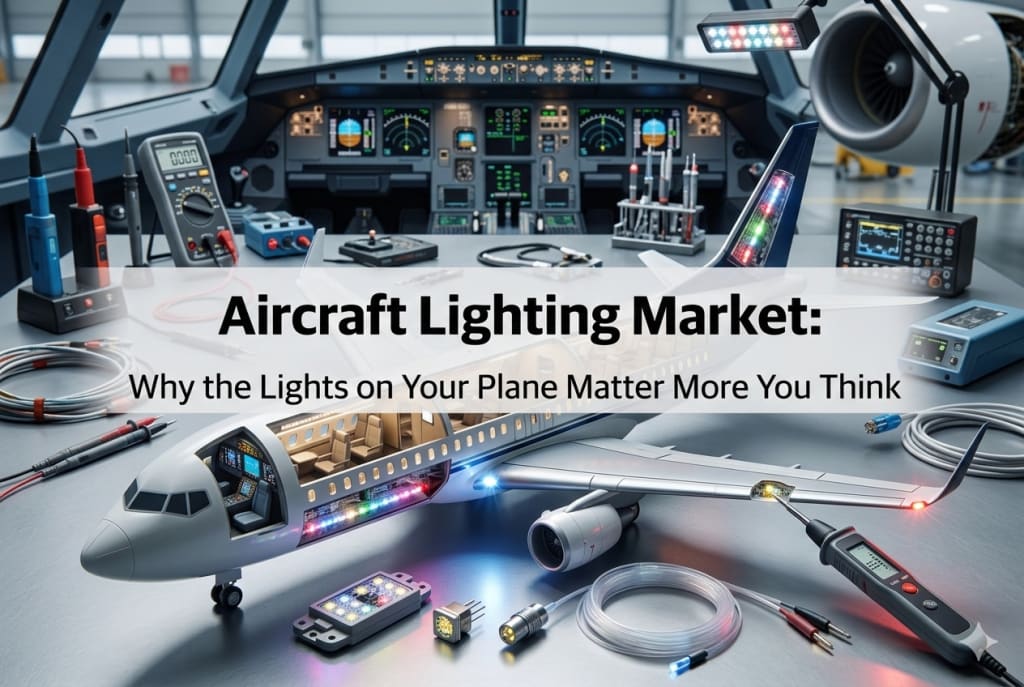
Next time you board a flight, take a moment before you settle into your seat to look around. The soft glow overhead as you shuffle down the aisle. The reading light above your headrest. The subtle blue wash that fills the cabin during a red-eye as most passengers drift off to sleep. And if you've ever watched a plane approach through the dark from the ground, you've seen those rhythmic strobes and steady navigation lights that make aircraft visible across miles of sky.
None of this is accidental. Every light on an aircraft — inside and out — has been engineered to serve a specific purpose, meet rigorous safety standards, and increasingly, to do all of that while consuming as little power and requiring as little maintenance as possible. Behind it all is a specialized industry that most travelers never think about but that plays a quietly essential role in aviation safety and passenger experience.
More Than Ambiance — A Safety-Critical System
Aircraft lighting divides broadly into two worlds: exterior and interior. Each carries its own technical requirements, regulatory frameworks, and design challenges.
Exterior lighting is fundamentally about safety and navigation. Anti-collision lights — the strobing beacons that flash red or white — make aircraft visible to other pilots and air traffic controllers in all weather conditions and at significant distances. Navigation lights, positioned on wingtips and the tail, use color conventions (red on the left, green on the right, white at the rear) that pilots worldwide recognize instantly to determine an aircraft's orientation and direction of travel. Landing lights flood the runway with intense illumination during approach and touchdown. Logo lights wash the tail with branding. Each type is precisely regulated by aviation authorities like the FAA and EASA, with strict requirements for brightness, visibility angles, and reliability.
Interior lighting serves a different but equally important set of functions. Emergency lighting — the floor-level path markers and exit signs that illuminate automatically if cabin power fails — is a matter of life and death. Reading lights, overhead panels, lavatory lighting, and galley lighting contribute to crew efficiency and passenger comfort. And increasingly, cabin mood lighting has emerged as a sophisticated tool that airlines use to shape the passenger experience in ways that go far beyond simple illumination.
The LED Revolution in the Sky
For most of aviation history, aircraft lighting relied on incandescent and fluorescent bulb technologies — functional but far from ideal. They burned out frequently, required regular replacement, consumed significant electrical power, and offered limited flexibility in terms of color and intensity.
The shift to LED technology has been transformational. LEDs last dramatically longer than traditional bulbs — tens of thousands of hours compared to hundreds — which translates directly into reduced maintenance costs and fewer unscheduled delays caused by lighting failures. They consume a fraction of the power, a meaningful advantage on aircraft where every pound of fuel saved matters. And they offer something their predecessors never could: full-spectrum color control.
That last capability has opened the door to what airlines now call "human-centric" or "circadian" lighting systems. The science behind these systems is grounded in chronobiology — the study of how light affects human biological rhythms. By gradually shifting cabin light from cool blue-white tones to warm amber hues during long-haul overnight flights, and then brightening back toward daylight spectrums as the destination approaches, airlines can actively help passengers manage jet lag and arrive feeling more rested.
Several major carriers have invested heavily in these systems, recognizing that passenger wellbeing has become a genuine competitive differentiator in premium travel. What began as a comfort feature has evolved into a science-backed wellness tool embedded in the aircraft itself.
Market Drivers and the Road Ahead
The global aircraft lighting market is expanding steadily, driven by several converging forces. Commercial aviation continues its long-term growth trajectory, with aircraft fleets expanding across Asia, the Middle East, and other emerging markets. Each new aircraft represents a fresh lighting system installation. Meanwhile, the massive global fleet of existing aircraft is progressively being retrofitted with LED systems, creating a substantial and ongoing aftermarket opportunity.
Military aviation represents another significant demand segment, with defense forces worldwide investing in advanced lighting systems for fighter jets, transport aircraft, helicopters, and unmanned aerial vehicles. The requirements in military applications are even more demanding — extreme durability, stealth compatibility, and performance across brutal environmental conditions.
Sustainability pressures are also shaping the market. As aviation faces intense scrutiny over its environmental footprint, manufacturers are under growing pressure to reduce aircraft weight and power consumption wherever possible. Lighting systems, while not the largest contributor to either metric, represent a tangible area where incremental improvements compound meaningfully across large fleets.
A Small Detail With a Large Impact
It's easy to overlook lighting when thinking about what makes modern aviation work. The engines, the avionics, the aerodynamics — these command most of the attention. But lighting is woven into nearly every dimension of the flying experience, from the safety of nighttime operations to the comfort of a twelve-hour transoceanic crossing.
The aircraft lighting market may operate quietly in the background. But it illuminates something important about how aviation innovation works — one carefully engineered detail at a time.
As LED technology matures and human-centric design principles take hold across the industry, the aircraft lighting market stands at an genuinely exciting moment of technological and commercial evolution.
About the Creator
Keep reading
More stories from Frank Morgan and writers in Futurism and other communities.
The Lobster Market: From Ocean Floor to Fine Dining — and Everything In Between
There's something almost paradoxical about lobster. It's a bottom-dwelling crustacean that scavenges the ocean floor, yet it commands some of the highest prices on restaurant menus around the world. It was once so abundant along the northeastern American coast that it was fed to prisoners and indentured servants — considered too common to be worthy of respectable tables. Today, a single lobster dinner can cost more than a week's groceries.
By Frank Morgana day ago in Futurism
Best Email Marketing Strategies for 2026: The Inbox Guide
In the digital landscape of 2026, we are living through the "Great Algorithm Fatigue." Social media platforms have become unpredictable, and AI-powered search engines often summarize website content so effectively that users never actually click through to the source.
By Digistir360about 5 hours ago in Futurism
Cassie and Johnny
I’m the kind of dame you notice. I’m no femme fatale, but you can’t ignore me, at least not until I warn you about what’s coming, then everybody ignores me. Hell, they usually blame me afterwards and give Johnny all the credit for saving the day, but my Johnny couldn’t save a seat at the movies without my help. Sure, he’s brawny, but brainy? Not so much. Like that time I asked him to spot me five bucks, and he said he didn’t see it anywhere on me, and believe you me, he looked but good.
By Harper Lewis5 days ago in Critique




Comments
There are no comments for this story
Be the first to respond and start the conversation.