
The Dynamics of the Interstellar Medium and Galactic Magnetism
Space

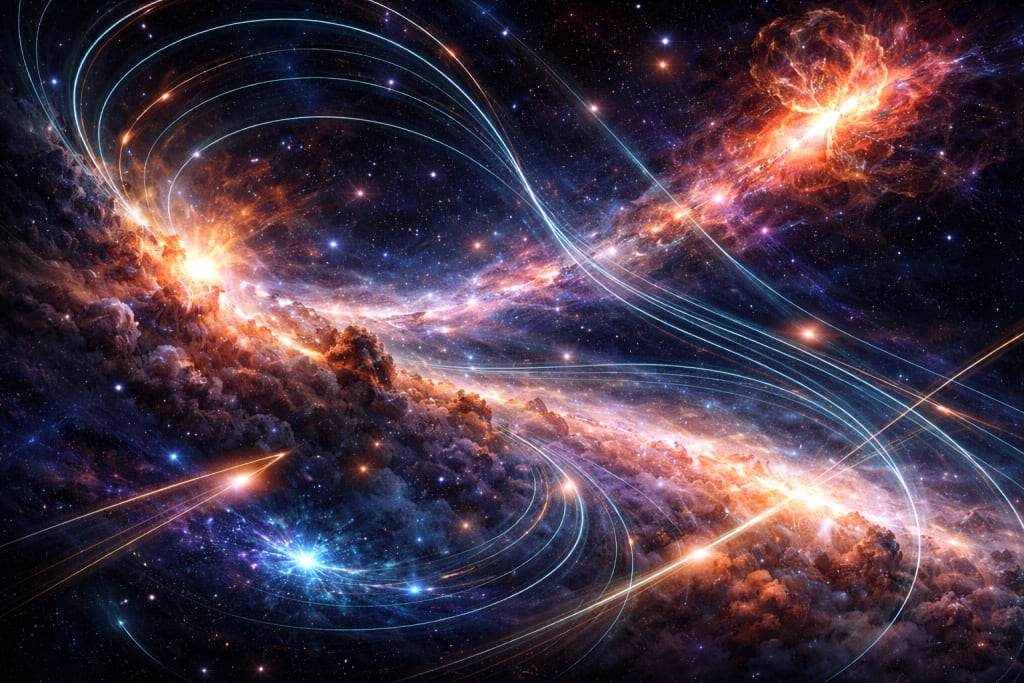
At first glance, the space between stars appears empty — a silent vacuum separating luminous islands of light. In reality, this vast region is filled with a complex, restless environment known as the interstellar medium (ISM). Far from being inert, it is a dynamic system of gas, plasma, dust, radiation, turbulence, and magnetic fields. Within galaxies such as the Milky Way, the interstellar medium functions as both the raw material and the regulating mechanism for star formation, cosmic ray transport, and large-scale galactic structure.
What Fills the “Empty” Space
The interstellar medium is composed of approximately 99% gas and 1% dust by mass. The gas exists in multiple thermodynamic phases, each characterized by distinct temperature and density regimes:
- Cold neutral medium (~100 K), often found in dense clouds.
- Warm neutral and ionized medium (~8,000 K), more diffuse and widespread.
- Hot ionized plasma (up to several million K), typically produced by supernova explosions.
These phases coexist in a state of dynamic equilibrium. Shock waves from exploding stars compress gas in one region while stellar radiation heats and ionizes matter in another. Over time, material cycles between phases, driven by energetic feedback processes. Yet temperature and density alone do not determine the structure of the ISM. Magnetic fields are equally fundamental.
Magnetic Fields: Weak but Influential
Galactic magnetic fields are extremely weak compared to those encountered on Earth — typically only a few microgauss. However, in the low-density plasma of interstellar space, even such faint fields exert significant dynamical influence.
Charged particles spiral along magnetic field lines rather than moving freely in straight paths. This constrains plasma motion, redistributes energy, and introduces anisotropy into gas dynamics. In regions where gravity attempts to compress molecular clouds, magnetic pressure can partially counteract collapse, delaying or regulating star formation.
Observations of polarized starlight and radio synchrotron emission reveal that the large-scale magnetic field in the Milky Way roughly follows the spiral arms. However, on smaller scales, turbulence distorts and tangles field lines, creating a complex, filamentary geometry.
Turbulence: Structured Chaos
The interstellar medium is not static; it is highly turbulent. In fact, it is best described using magnetohydrodynamics (MHD), the physics of electrically conducting fluids interacting with magnetic fields.
The main drivers of turbulence include:
- Supernova explosions
- Stellar winds from massive stars
- Differential galactic rotation
When a massive star ends its life in a supernova, it releases an expanding shock wave traveling thousands of kilometers per second. This shock compresses surrounding gas, amplifies magnetic fields through compression and stretching, and injects energy into the ISM. The injected energy cascades from large scales (tens of parsecs) down to smaller scales, forming a turbulent spectrum.
In a highly conductive plasma such as the ISM, magnetic field lines are effectively “frozen” into the gas — a principle known as flux freezing. This means that as gas flows and twists, magnetic field lines are carried along, stretched, folded, and sometimes intensified. The interplay between turbulent motion and magnetic tension creates a dynamic feedback loop that shapes the structure of interstellar clouds.
Magnetic Regulation of Star Formation
One of the central questions in modern astrophysics concerns the role of magnetic fields in star formation. Gravity pulls gas inward, attempting to collapse dense molecular clouds into protostars. However, turbulence and magnetic pressure resist this collapse.
If the magnetic field within a cloud is sufficiently strong relative to gravity, the cloud can remain stable for millions of years. Conversely, if turbulence dissipates or magnetic support weakens — through processes such as ambipolar diffusion — gravitational collapse may proceed.
High-resolution observations from the James Webb Space Telescope have revealed intricate filamentary structures within star-forming regions. These filaments frequently align with local magnetic fields, suggesting that magnetism helps guide the accumulation of matter. Rather than random collapse, star formation often proceeds along magnetically organized pathways.
For example, in dense star-forming clouds, gas tends to flow preferentially along field lines, feeding growing protostars. The geometry of the magnetic field can therefore influence the orientation of protoplanetary disks and even the angular momentum of forming stars.
Cosmic Rays and Magnetic Confinement
Magnetic fields also regulate the motion of cosmic rays — highly energetic charged particles accelerated in environments such as supernova remnants. Instead of traveling in straight lines across the galaxy, cosmic rays undergo repeated scattering off magnetic irregularities.
This scattering dramatically increases their residence time within the galaxy. In effect, the galactic magnetic field acts as a confining structure, forming a diffuse magnetic halo around the disk. Cosmic rays contribute to the pressure balance of the ISM, heat interstellar gas, and influence ionization chemistry inside molecular clouds. Thus, magnetism indirectly affects both thermodynamics and chemical evolution.
The Galactic Dynamo
A natural question arises: how do galaxies sustain magnetic fields over billions of years?
The answer lies in the galactic dynamo mechanism. Differential rotation — the fact that different parts of a galaxy rotate at different angular velocities — stretches and amplifies magnetic field lines. Combined with turbulent motions in the interstellar plasma, this process converts kinetic energy into magnetic energy.
Even if early galaxies began with extremely weak seed magnetic fields, dynamo action could amplify them to present-day strengths over cosmological timescales. This self-sustaining process ensures that magnetism remains a persistent structural component of galaxies.
The Hidden Architecture of the Galaxy
The interstellar medium is not a passive backdrop for stars. It is an active, self-regulating system shaped by the interplay of gravity, radiation, turbulence, cosmic rays, and magnetic fields. While starlight is visible, the magnetic scaffolding that organizes matter remains largely invisible.
Yet without magnetism, the ISM would fragment differently, star formation rates would shift, and the transport of high-energy particles would change dramatically. Galactic structure itself would evolve along altered pathways.
In that sense, magnetic fields represent an unseen architecture — a subtle but decisive influence on the evolution of galaxies like the Milky Way. To understand how stars form, how energy circulates, and how galaxies persist over billions of years, we must account for this invisible but fundamental force shaping the cosmos.
About the Creator
Keep reading
More stories from Holianyk Ihor and writers in Futurism and other communities.
Euclid and the Precision Era of Dark Cosmology
In 2023, the European Space Agency launched Euclid with a sharply defined objective: to map the geometry of the Universe and determine, with unprecedented precision, how dark matter and dark energy shape cosmic evolution. Rather than focusing on individual spectacular objects, Euclid operates as a large-scale cartographer. Its mission is statistical and structural. It surveys billions of galaxies across a third of the sky to reconstruct a three-dimensional map of the cosmic web stretching over 10 billion years of cosmic history.
By Holianyk Ihor6 days ago in Futurism
Australia Smoothies Market: Health & Wellness Trends, Retail Expansion & Product Innovation
According to IMARC Group, the Australia smoothies market reached USD 504.6 Million in 2025 and is projected to grow to USD 749.1 Million by 2034, exhibiting a compound annual growth rate (CAGR) of 4.26% during 2026–2034. The market’s expansion reflects increasing consumer focus on health, nutrition, and convenience across Australia. Rising demand for nutrient-rich beverages, growing availability of ready-to-drink (RTD) options, and the proliferation of smoothie bars in urban centers are collectively strengthening Australia smoothies market share. As consumers prioritize balanced diets and functional ingredients, smoothies are becoming a mainstream component of daily nutrition.
By Shrestha Roy4 days ago in Futurism
Conversational AI Market: AI Ethics & Data Privacy, Trust Building & Market Forecast
According to IMARC Group's latest research publication, global conversational AI market size reached USD 13.6 Billion in 2024. Looking forward, IMARC Group expects the market to reach USD 151.6 Billion by 2033, exhibiting a growth rate (CAGR) of 29.16% during 2025-2033.
By sujeet. imarcgroup5 days ago in Futurism
Pearl
1980 something. we all hung out at Pearl and you and i were nothing special, or so i thought. i mean we all danced, drenched in our own sweat, our own saline solution of fear, too many beers, shots, laughter, tears, fucks in the bathroom and i don't know when we began to be afraid. do you?
By ROCK aka Andrea Polla (Simmons)5 days ago in Fiction



Comments
There are no comments for this story
Be the first to respond and start the conversation.