how to
How to create science fiction and technology projects in a simplistic, easy manner.
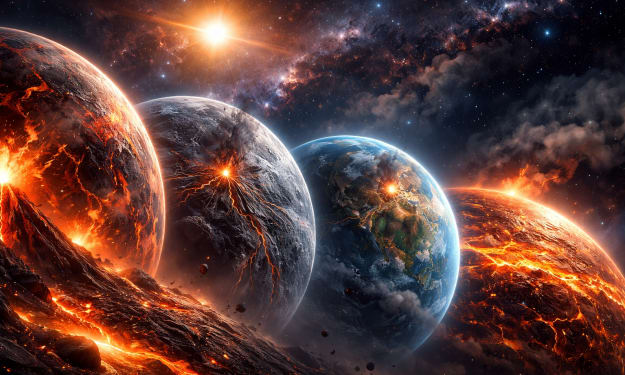
The Cosmic Influence of the Sun on the Inner Planets and Climate
At the center of our planetary system lies Sun, a G-type main-sequence star that governs the physical and climatic evolution of the inner planets: Mercury, Venus, Earth, and Mars. Although these worlds share a common origin and relatively close orbital distances, their climates differ dramatically. The explanation lies in how each planet interacts with solar radiation, solar wind, and long-term stellar evolution.
By Holianyk Ihorabout 16 hours ago in Futurism
The Dynamics of the Interstellar Medium and Galactic Magnetism
At first glance, the space between stars appears empty — a silent vacuum separating luminous islands of light. In reality, this vast region is filled with a complex, restless environment known as the interstellar medium (ISM). Far from being inert, it is a dynamic system of gas, plasma, dust, radiation, turbulence, and magnetic fields. Within galaxies such as the Milky Way, the interstellar medium functions as both the raw material and the regulating mechanism for star formation, cosmic ray transport, and large-scale galactic structure.
By Holianyk Ihorabout 16 hours ago in Futurism
Why Consumer Electronics Continue to Shape Digital Lifestyles in the United Kingdom?
Consumer electronics have become deeply integrated into daily life across the United Kingdom. From smartphones and laptops to smart televisions and wearable devices, technology is influencing how people communicate, work, and entertain themselves.
By deepanshu Thakur5 days ago in Futurism
Euclid and the Precision Era of Dark Cosmology
In 2023, the European Space Agency launched Euclid with a sharply defined objective: to map the geometry of the Universe and determine, with unprecedented precision, how dark matter and dark energy shape cosmic evolution. Rather than focusing on individual spectacular objects, Euclid operates as a large-scale cartographer. Its mission is statistical and structural. It surveys billions of galaxies across a third of the sky to reconstruct a three-dimensional map of the cosmic web stretching over 10 billion years of cosmic history.
By Holianyk Ihor7 days ago in Futurism
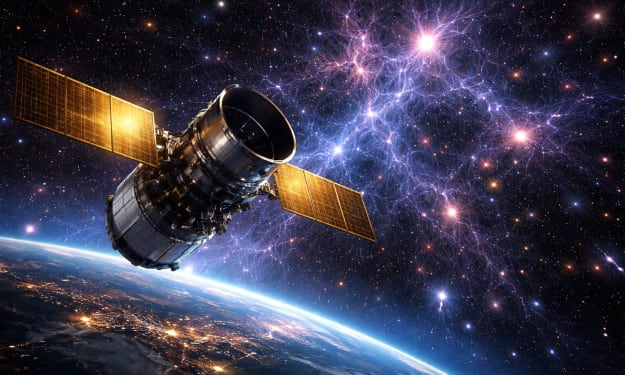
Launch and Scientific Impact of NASA’s Nancy Grace Roman Space Telescope (2026)
In 2026, NASA is preparing to launch one of the most ambitious space observatories of the decade: the Nancy Grace Roman Space Telescope. Designed to survey the universe at an unprecedented scale in near-infrared light, Roman is expected to reshape modern astrophysics by combining high resolution with an extraordinarily wide field of view. If the Hubble Space Telescope revealed the fine details of the cosmos, Roman will provide the panoramic context.
By Holianyk Ihor7 days ago in Futurism
Space Discoveries Powered by Machine Learning
Over the past decade, machine learning has evolved from a useful analytical tool into a central engine of discovery in astronomy. Modern observatories no longer produce manageable datasets measured in gigabytes—they generate petabytes of images, spectra, and time-series signals. Human analysis alone is no longer sufficient. In many areas of space research, algorithms now act as the first line of discovery.
By Holianyk Ihor7 days ago in Futurism
Exoplanets with Signs of Active Geology: Worlds That Refuse to Stay Still
For decades, exoplanets were little more than data points—subtle dips in starlight, faint radial velocity shifts, abstract entries in astronomical catalogs. Today, they are increasingly understood as dynamic worlds with atmospheres, climates, and in some cases, signs of active geology. For planetary science and astrobiology, that distinction is critical. A geologically active planet is not static. It has internal heat, material circulation, and potentially long-term environmental stability.
By Holianyk Ihor7 days ago in Futurism
The Silent Search Revolution: Why Your Website Might Be Getting Fewer Clicks. AI-Generated.
We’ve all been there. You have a quick question - maybe you’re checking a flight status or looking for a fast recipe - and you find the answer instantly at the very top of the Google search page. You don’t click a single link. You just get the info and go.
By Digistir36012 days ago in Futurism
How Fast Have Humans Really Accelerated Objects — and How Much Does Time Slow Down at Those Speeds?
Humanity has not yet built a starship that cruises at a significant fraction of the speed of light. However, we have accelerated certain objects to velocities so extreme that time itself measurably slows down. The answer to the question “What is the fastest object humans have ever accelerated?” depends on what we mean by “object.” For spacecraft, the numbers are impressive but not relativistic. For subatomic particles, the story becomes profoundly different.
By Holianyk Ihor14 days ago in Futurism
10 Mind-Blowing Space Stories School Never Told You
For many of us (especially if you grew up watching Star Trek), space truly feels like the final frontier. Sure, school taught us about planets, gravity, and maybe a little about rockets. But what we got was just a glimpse of the safe, simplified version.
By Areeba Umair15 days ago in Futurism
Why Most E-Commerce Stores Fail Before Reaching Scale in 2026 and How to Avoid It . AI-Generated.
The e-commerce industry is on a rapid growth path in 2026. Companies are putting a lot of their money into online platforms to tap global customers and increase sales. But the truth is, even with this upside, many e-commerce shops are going down before they become self-sufficient. Usually, the reason for failure is not the lack of good products or market demand but the result of having poor backend technical infrastructure and dysfunctional system design.
By Navghan Modhavadiya 17 days ago in Futurism
AI as a Reflective Surface
Much of the confusion surrounding artificial intelligence comes from treating it as an agent rather than a surface. When people speak about AI “doing the thinking,” “creating the ideas,” or “speaking for someone,” they are often projecting agency onto a system that does not possess intention, belief, or understanding. This projection obscures what is actually happening in many real-world uses. In those cases, AI is not acting as a source of meaning, but as a surface that reflects, redirects, and reshapes what is already present.
By Peter Thwing - Host of the FST Podcast19 days ago in Futurism