
The Cosmic Influence of the Sun on the Inner Planets and Climate
Space

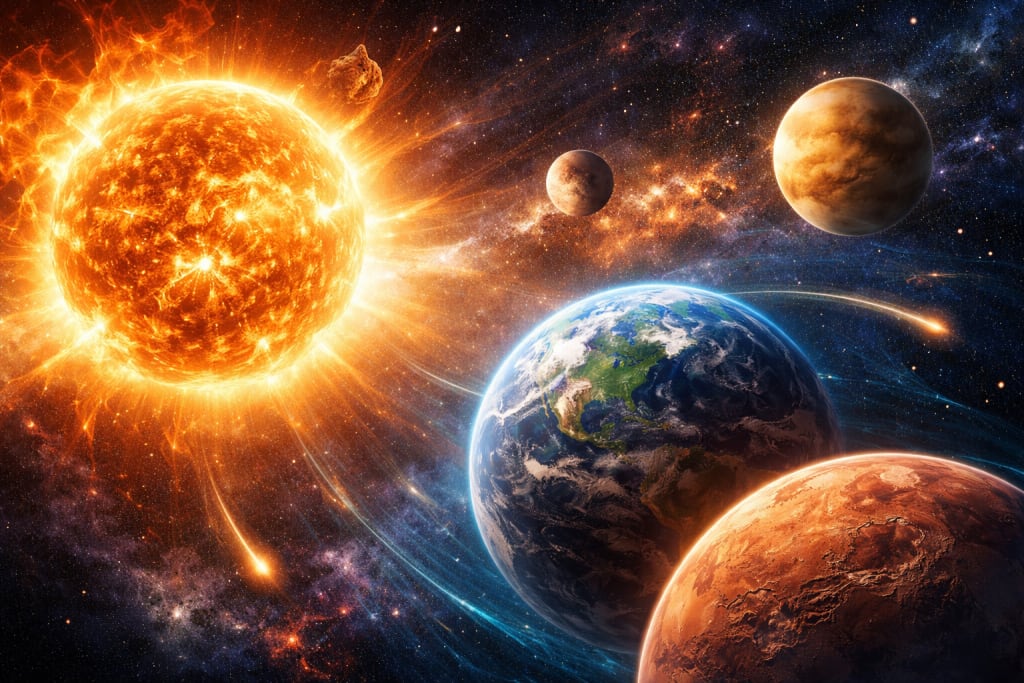
At the center of our planetary system lies Sun, a G-type main-sequence star that governs the physical and climatic evolution of the inner planets: Mercury, Venus, Earth, and Mars. Although these worlds share a common origin and relatively close orbital distances, their climates differ dramatically. The explanation lies in how each planet interacts with solar radiation, solar wind, and long-term stellar evolution.
Solar Radiation: The Primary Climate Driver
The most immediate form of solar influence is electromagnetic radiation. The intensity of sunlight decreases with distance according to the inverse-square law. Mercury, orbiting closest to the Sun, receives nearly seven times more solar energy per unit area than Earth. With virtually no substantial atmosphere to distribute or retain heat, Mercury experiences extreme temperature swings: daytime surface temperatures soar above 430°C (806°F), while nighttime temperatures plunge below –170°C (–274°F). The Sun’s energy arrives unfiltered and escapes just as quickly.
Venus receives roughly twice the solar energy that Earth does. Yet distance alone does not explain its infernal climate. Venus is enveloped in a dense carbon dioxide atmosphere with thick clouds of sulfuric acid. This composition drives a runaway greenhouse effect. Solar radiation penetrates the upper atmosphere, warms the surface, and becomes trapped by greenhouse gases. The result is a surface temperature exceeding 460°C (860°F), hot enough to melt lead. In effect, solar energy becomes thermally imprisoned.
Earth represents a delicate equilibrium. Solar radiation is partially reflected by clouds, ice, and oceans—a measure known as albedo—while the rest is absorbed and redistributed by atmospheric circulation and ocean currents. Greenhouse gases such as carbon dioxide and water vapor retain enough heat to keep the global average temperature around 15°C (59°F). A slight change in solar output, even by fractions of a percent, can influence atmospheric chemistry and long-term climate patterns. For example, subtle variations in solar ultraviolet radiation affect stratospheric ozone concentrations, which in turn influence temperature gradients and circulation systems.
Mars, positioned farther from the Sun, receives less than half the solar energy that Earth does. Its thin atmosphere—composed primarily of carbon dioxide but with very low pressure—cannot effectively trap heat. As a result, Mars is cold and arid, with average temperatures near –60°C (–76°F). Daily temperature fluctuations can exceed 70 degrees Celsius. The Sun still drives weather patterns, including massive dust storms that can engulf the entire planet, but its energy is insufficient to maintain stable surface liquid water under present conditions.
Solar Activity and Cycles
The Sun is not constant. It undergoes an approximately 11-year magnetic activity cycle characterized by fluctuating numbers of sunspots, solar flares, and coronal mass ejections. During solar maximum, ultraviolet and X-ray emissions increase, and the solar wind intensifies.
On Earth, this variability influences the upper atmosphere and ionosphere. Enhanced solar wind interactions with Earth’s magnetosphere generate auroras and can disrupt satellite communications and power grids. Historically, extended periods of reduced solar activity—such as the Maunder Minimum in the 17th century—coincided with cooler climatic intervals often associated with the “Little Ice Age.” While solar variability is not the sole driver of such events, correlations indicate that stellar dynamics contribute to long-term climate modulation.
Mars is particularly vulnerable to solar wind because it lacks a global magnetic field. Charged particles can directly interact with its upper atmosphere, gradually stripping it away. Spacecraft observations suggest that this process played a significant role in transforming ancient Mars—once potentially warmer and wetter—into the cold desert observed today.
Venus, despite lacking an intrinsic magnetic field, forms an induced magnetosphere due to the interaction between its dense atmosphere and the solar wind. This partial shielding mechanism reduces, but does not eliminate, atmospheric erosion. Mercury, meanwhile, possesses a weak magnetic field but remains exposed to intense solar particle flux due to its proximity.
Magnetic Shields and Atmospheric Survival
A planet’s magnetic field acts as a protective barrier. Earth’s magnetosphere deflects most solar wind particles, preserving atmospheric integrity and shielding the surface from harmful radiation. Without this defense, atmospheric escape rates would increase substantially over geological time.
Mars provides a case study in atmospheric vulnerability. Geological evidence suggests that billions of years ago, Mars possessed a thicker atmosphere and stable liquid water. As its internal dynamo weakened and its magnetic field diminished, solar wind erosion intensified. Over time, much of its atmosphere was lost to space.
Venus illustrates a different outcome: despite lacking a strong intrinsic magnetic field, its massive atmosphere persists due to gravitational retention and complex ionospheric interactions. However, solar radiation may have contributed to the loss of ancient surface water through photodissociation—ultraviolet light splitting water molecules, allowing hydrogen to escape into space.
Long-Term Solar Evolution
Over astronomical timescales, the Sun gradually increases in luminosity—approximately 10% every billion years. Early in Earth’s history, solar output was weaker, presenting the “faint young Sun paradox”: despite receiving less energy, early Earth maintained liquid water. Elevated concentrations of greenhouse gases likely compensated for the reduced stellar output.
In the distant future, rising solar luminosity will intensify Earth’s greenhouse effect. Increased evaporation could trigger a moist greenhouse state, eventually leading to ocean loss. Venus may represent a preview of this trajectory, having undergone catastrophic atmospheric warming in its past.
A Natural Laboratory for Climate Science
The inner planets function as comparative experiments in planetary climate science. Small differences in orbital distance, atmospheric density, composition, and magnetic shielding yield radically different outcomes. By analyzing these variations, scientists refine models of climate stability, atmospheric escape, and planetary habitability.
Understanding solar influence is not purely academic. Modern technological infrastructure—satellites, navigation systems, electrical grids—is sensitive to solar storms. Monitoring solar activity is therefore essential not only for planetary science but for economic and security planning.
Conclusion
The Sun is the dominant architect of climate across the inner Solar System. Through radiation, magnetic activity, and long-term evolution, it shapes atmospheric chemistry, thermal balance, and planetary destiny. Mercury’s stark extremes, Venus’s runaway greenhouse, Earth’s dynamic equilibrium, and Mars’s atmospheric loss all reflect different responses to the same stellar source.
By studying these contrasts, we gain insight into Earth’s past and future—and into the broader question of how stars determine the fate of worlds orbiting them.
About the Creator
Keep reading
More stories from Holianyk Ihor and writers in Futurism and other communities.
The Dynamics of the Interstellar Medium and Galactic Magnetism
At first glance, the space between stars appears empty — a silent vacuum separating luminous islands of light. In reality, this vast region is filled with a complex, restless environment known as the interstellar medium (ISM). Far from being inert, it is a dynamic system of gas, plasma, dust, radiation, turbulence, and magnetic fields. Within galaxies such as the Milky Way, the interstellar medium functions as both the raw material and the regulating mechanism for star formation, cosmic ray transport, and large-scale galactic structure.
By Holianyk Ihorabout 14 hours ago in Futurism
Geochemical Services Market Outlook: Resource Exploration Expansion and Analytical Innovation Opportunities
According to IMARC Group's latest research publication, The global geochemical services market size reached USD 1.30 Billion in 2024. Looking forward, IMARC Group expects the market to reach USD 2.20 Billion by 2033, exhibiting a growth rate (CAGR) of 5.56% during 2025-2033.
By James Whitman7 days ago in Futurism
Australia Smoothies Market: Health & Wellness Trends, Retail Expansion & Product Innovation
According to IMARC Group, the Australia smoothies market reached USD 504.6 Million in 2025 and is projected to grow to USD 749.1 Million by 2034, exhibiting a compound annual growth rate (CAGR) of 4.26% during 2026–2034. The market’s expansion reflects increasing consumer focus on health, nutrition, and convenience across Australia. Rising demand for nutrient-rich beverages, growing availability of ready-to-drink (RTD) options, and the proliferation of smoothie bars in urban centers are collectively strengthening Australia smoothies market share. As consumers prioritize balanced diets and functional ingredients, smoothies are becoming a mainstream component of daily nutrition.
By Shrestha Roy4 days ago in Futurism




Comments
There are no comments for this story
Be the first to respond and start the conversation.