
A 40,000‑Year‑Old Masterpiece Offers New Insight into Early Human Art
Discovery of Prehistoric Figurative Art in Remote Cave Challenges Assumptions About the Origins and Spread of Human Creativity

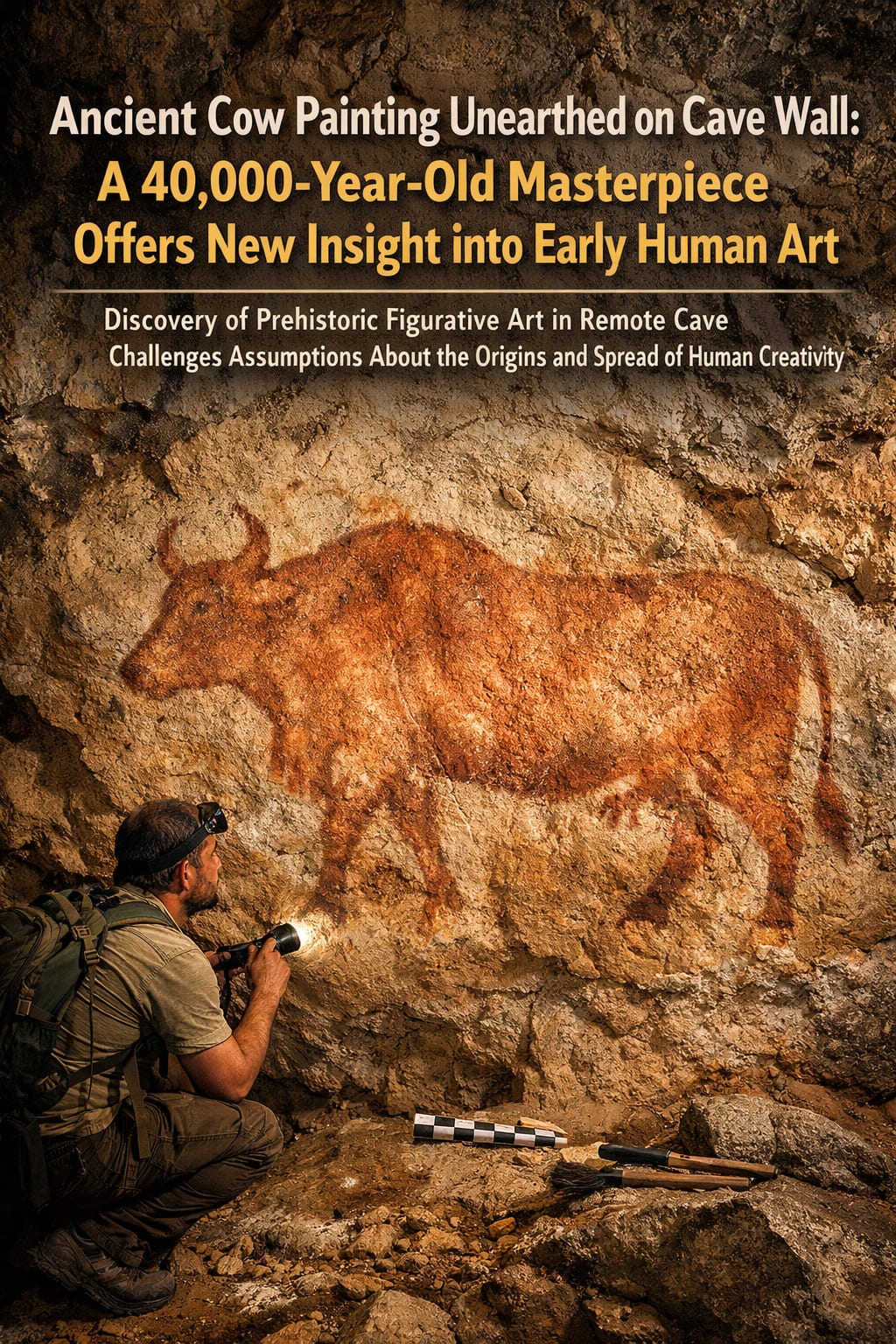
In a remarkable archaeological discovery that reshapes our understanding of early human creativity, scientists have identified a 40,000‑year‑old painting of a cow‑like animal on a cave wall, potentially making it one of the earliest examples of figurative art ever documented. The site — located deep within the dense forests of Indonesian Borneo — reveals that our distant ancestors were not merely marking surfaces with abstract symbols but were intentionally depicting real‑world animals tens of thousands of years ago.
The painting was discovered in Lubang Jeriji Saléh cave, a rugged limestone karst formation in East Kalimantan, Indonesia. The cave has long been known to archaeologists as a repository for ancient imagery, including hand stencils and abstract motifs, but recent scientific advances have allowed experts to confirm the extraordinary age of the cow depiction.
Using sophisticated uranium‑series dating techniques, researchers determined that the calcite crusts which formed over and around the painting indicate a minimum age of around 40,000 years. In some cases, older deposits suggest the image could be even older — possibly close to 50,000 years old. This places the artwork far beyond many previously recognized examples of prehistoric animal imagery, especially those found in Europe.
Unlike abstract handprints or simple geometric designs often associated with early cave art, this image depicts a recognisable animal — likely a species of wild cattle, such as the banteng still found in the region today. The figure is rendered using red‑orange ochre, a pigment derived from iron oxide, and spans several feet across the limestone surface.
Experts say that this discovery has profound implications for the study of human history. According to lead researchers, the find challenges longstanding theories that complex figurative art first developed in Europe and instead suggests that artistic expression arose simultaneously in multiple parts of the world. For decades, the earliest well‑dated European cave paintings — such as those in Chauvet and Lascaux caves — were thought to represent the pinnacle of prehistoric art. However, the age of the Borneo painting now rivals or exceeds those sites and reinforces evidence that early humans in Southeast Asia were equally capable of sophisticated visual representation.
“The discovery blows apart the idea that early art evolved only in Europe,” said one archaeologist involved in the research. “It shows that humans around the globe were painting figurative images at roughly the same time.”
The Lubang Jeriji Saléh cave complex itself is extraordinary, with multiple layers of artistic activity spanning thousands of years. Besides the cattle painting, hundreds of hand outlines in both red‑orange and purplish pigments are found throughout the cave. Some of the hand stencils have been dated to more than 50,000 years old, making them among the oldest known evidence of human presence on the island.
In addition to animal figures and handprints, later chronological phases of art found in the cave include human forms, geometric patterns, and motifs applied in different pigment colours. This variety suggests not only artistic evolution over time but also a dynamic prehistoric culture that engaged with visual storytelling, symbolism, and ritual.
Such discoveries are crucial to piecing together how early Homo sapiens expressed themselves and interacted with their environments. They also contribute to a broader understanding of how symbolic thought and communication developed in human societies. The act of painting a recognizable animal suggests not just aesthetic impulse, but also cognitive complexity — an ability to conceptualize, remember, and represent living creatures with meaning.
This cave art find is part of a broader trend in archaeology over recent decades, with numerous sites in Indonesia and neighbouring regions turning up ancient imagery that rivals or predates famous European examples. For instance, nearby islands have yielded paintings of hunts, handprints, and abstract shapes also dating back tens of thousands of years, emphasizing that prehistoric populations across Asia were actively documenting their world.
While the exact meaning of the cow painting remains speculative, some researchers believe it could have held symbolic significance — perhaps tied to hunting, spiritual beliefs, or cultural identity. Others caution against over‑interpretation, urging that the image should be understood as part of a complex web of social and environmental interactions. Regardless of interpretation, the sheer age and recognizability of the artwork make it an iconic testament to the artistic capacities of early humans.
As archaeologists continue to study Lubang Jeriji Saléh and other prehistoric sites, each new discovery contributes to a richer, more interconnected picture of early human life. This ancient cow painting, etched into stone millennia ago, offers a direct glimpse into a world of early imagination — one that resonates with the depth and continuity of human creativity.
About the Creator
Irshad Abbasi
Ali ibn Abi Talib (RA) said 📚
“Knowledge is better than wealth, because knowledge protects you, while you have to protect wealth.
Keep reading
More stories from Irshad Abbasi and writers in History and other communities.
Ancient Stone ‘Gates’ Unearthed in Saudi Arabia Rewrite Prehistoric History
Here’s a complete English article (approx. 700 words) with a title and subtitle based on the recent news about the discovery of thousands‑year‑old “gates” in Saudi Arabia’s desert Archaeologists and researchers have uncovered an astonishing prehistoric landscape hidden beneath the deserts and lava fields of western Saudi Arabia — one marked not by cities or temples, but by hundreds of enigmatic stone structures resembling monumental “gates.” These formations, visible in satellite imagery and confirmed through field surveys, offer fresh insight into ancient human activity on the Arabian Peninsula, challenging long‑held assumptions about where and how early peoples lived, traveled and interacted with their environment. 
By Irshad Abbasi about 18 hours ago in History
Gold-Guarding Griffins
Imagine standing at the foot of a vast mountain range, the air thin and cold, the peaks disappearing into cloud. Somewhere up there, according to the people who told this story for generations, something extraordinary waited. Not just gold.
By CurlsAndCommas4 days ago in History


Comments
There are no comments for this story
Be the first to respond and start the conversation.