
A World on Edge: Global Reactions to the Escalating U.S.–Iran Crisis
From Diplomatic Warnings to Strategic Alignments, the International Community Grapples with War and Stability

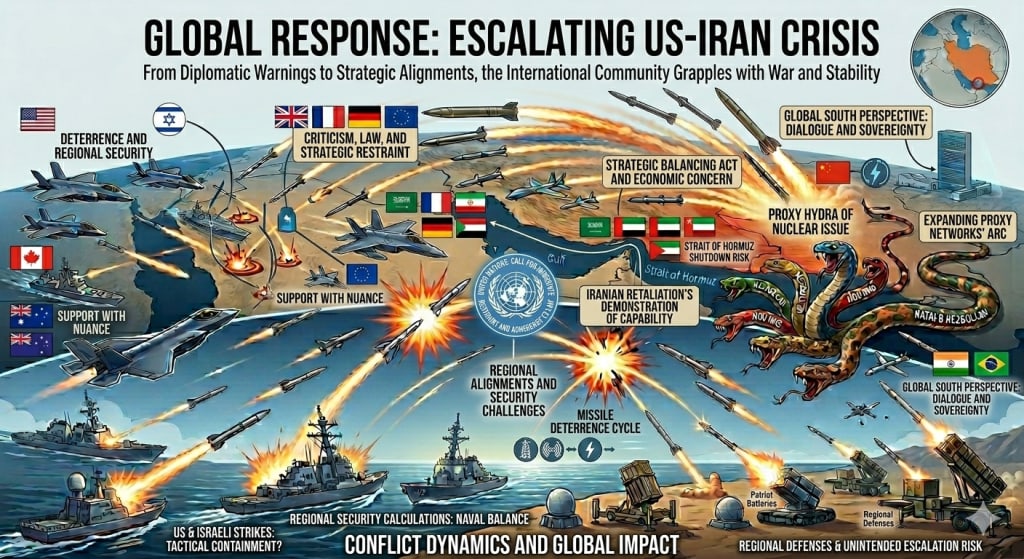
When tensions rise between major powers, the battlefield is never confined to one region. The growing confrontation between the United States and Iran — intensified by Israeli involvement and regional ripple effects — has triggered a wave of global reactions. Governments are issuing statements, diplomats are activating backchannels, and international institutions are urging restraint.
Yet beneath the formal language of “deep concern” and “calls for de-escalation,” the world appears divided.
Some nations emphasize international law and warn against unilateral military action. Others focus on deterrence and regional security. Many attempt to balance both — condemning escalation while avoiding full alignment with either side.
The result is a complex mosaic of criticism, caution, support, and strategic ambiguity.
The United Nations: Alarm Bells for Global Stability
At the center of diplomatic reaction stands the United Nations. UN Secretary-General António Guterres has warned that both U.S.–Israeli strikes and Iranian retaliation risk undermining international peace and security. His message has been consistent: immediate restraint, adherence to international humanitarian law, and a return to diplomatic dialogue.
The United Nations operates on a simple but fragile principle — that escalation between powerful states threatens global stability. When military actions bypass multilateral consensus, smaller states grow anxious. Energy markets react. Refugee flows become possible. Regional alliances tighten.
The UN’s language may sound procedural, but its concern is structural: once norms weaken, conflict becomes easier.
China and the Strategic Balancing Act
China expressed “deep concern” over the developments and called for an immediate halt to military operations. Beijing’s position reflects both principle and pragmatism.
On principle, China frequently emphasizes sovereignty and non-interference. On pragmatism, instability in the Middle East threatens global trade routes and energy supplies — areas central to China’s economic strategy.
China’s response also signals a broader geopolitical calculation. As U.S. involvement intensifies in one region, Beijing evaluates how global power balances shift elsewhere. In great-power politics, every crisis is both local and global.
Europe: Caution, Law, and Strategic Restraint
European leaders have reacted with a blend of concern and calibration.
The European Union’s major powers — France, Germany, and United Kingdom — have criticized retaliatory escalation while stopping short of endorsing broad military expansion.
French President Emmanuel Macron has emphasized the urgency of renewed nuclear negotiations and international oversight mechanisms. Germany has signaled that it will protect its forces stationed abroad but will not actively join offensive operations. The United Kingdom has echoed calls for restraint while maintaining its alliance commitments.
European governments face a dual challenge: uphold alliance solidarity with the United States while preventing a spiral that could destabilize Europe economically and politically. Energy dependency, migration flows, and domestic political polarization all influence their tone.
Europe’s approach can be summarized in one phrase: contain escalation without fracturing alliances.
Spain, Oman, and Brazil: Law and Sovereignty
Spain’s leadership criticized unilateral military action as escalatory. Oman described U.S. actions as violations of international norms, reflecting the Gulf region’s sensitivity to sovereignty and regional balance.
Meanwhile, Brazil condemned the strikes outright, aligning itself with a tradition of advocating diplomatic solutions and non-intervention.
These responses illustrate how mid-sized powers often emphasize legal frameworks and diplomatic channels. For them, predictability in international law serves as protection against dominance by stronger states.
The Arab League and Gulf States: Security Calculations
The Arab League and several Gulf countries framed Iranian missile activity as a violation of sovereignty and regional stability. For Gulf states, proximity matters. Escalation is not abstract — it is geographic.
These governments must weigh their security ties with the United States against regional dynamics involving Iran. Some emphasize deterrence. Others prefer quiet diplomacy. But all share a common fear: that miscalculation could transform proxy tensions into open regional war.
Canada and Australia: Support with Nuance
Canada voiced support for actions aimed at countering destabilizing behavior, characterizing Iran as a source of regional tension. Yet even supportive statements often include calls for proportionality.
Australia welcomed certain strategic outcomes but avoided unqualified praise for escalation.
These allied nations reveal an interesting diplomatic pattern: solidarity with Washington, combined with rhetorical restraint designed to avoid deeper entanglement.
India and the Non-Aligned Tone
India called for dialogue and de-escalation, reflecting its long-standing preference for strategic autonomy. India maintains relations with both the United States and regional Middle Eastern actors. Its cautious tone underscores a broader Global South perspective: avoid polarization and protect economic interests.
A Fragmented Consensus
Taken together, the global response forms neither a unified condemnation nor a unanimous endorsement. Instead, it reflects layered priorities:
• Western allies seek stability without abandoning security commitments.
• Emerging powers emphasize dialogue and sovereignty.
• Regional actors focus on immediate security risks.
• Multilateral institutions stress international law and humanitarian concerns.
The fragmentation is not accidental. It mirrors a world no longer defined by simple Cold War alignments. Today’s geopolitical landscape is multipolar, economically interdependent, and politically complex.
Energy, Economics, and Unseen Pressures
Behind diplomatic statements lies another powerful force: markets.
Middle Eastern instability influences oil prices, shipping lanes, and investor confidence. European economies remain sensitive to energy shocks. Asian manufacturing hubs depend on steady supply chains. Even distant economies feel tremors when the Gulf region destabilizes.
This economic interconnectedness amplifies the stakes. A missile launch or airstrike is not merely military; it becomes financial and political within hours.
The Nuclear Question
Central to international concern is the nuclear dimension.
European leaders, particularly France and Germany, have emphasized reviving frameworks to monitor Iran’s nuclear activities. Nuclear proliferation risk transforms regional rivalry into global anxiety.
When nuclear capabilities enter the equation, diplomatic urgency intensifies. Escalation carries risks that extend beyond conventional warfare.
Public Opinion and Political Pressure
Governments do not operate in isolation. Across North America and Europe, public demonstrations reflect domestic divisions over foreign policy.
Some citizens demand firm deterrence. Others call for immediate ceasefires. Policymakers must balance external threats with internal political realities.
This dynamic adds unpredictability. Elections, coalition politics, and media narratives can shift policy tone quickly.
A Tense Crossroads
The current situation is both dramatic and delicate. The international community broadly expresses a desire for peace, yet the mechanisms to guarantee de-escalation remain fragile.
Diplomacy competes with deterrence. Strategic signaling competes with humanitarian appeals.
The world stands at a crossroads: one path leads toward intensified confrontation and hardened alliances; the other toward cautious negotiation and incremental de-escalation.
History suggests that crises rarely resolve through emotion alone. They require sustained diplomatic engagement, credible security guarantees, and political courage.
For now, the global response reveals something deeply human about international politics: fear of instability, defense of interests, and hope — however cautious — that dialogue can still prevail.
Whether diplomacy ultimately prevails will depend not only on military calculations but on the willingness of leaders to choose restraint over retaliation.
In a multipolar world, every escalation echoes. And every act of restraint matters even more.
About the Creator
Amanullah
✨ “I share mysteries 🔍, stories 📖, and the wonders of the modern world 🌍 — all in a way that keeps you hooked!”
When the Shelter Closes
Across the street from my house, a man slept under a tree, his dog by his side. My first, naive thought: he must be traveling through. But he kept coming back, often sleeping there during the day. Then it hit me—that person might not have a home.
By Bride of Sound5 days ago in Humans


Comments
There are no comments for this story
Be the first to respond and start the conversation.