
Alexander the Great: The Young Conqueror Who Built the Largest Empire by the Age of 32
How a brilliant young king from Macedonia conquered vast lands from Greece to India and became one of history’s most legendary military leaders.

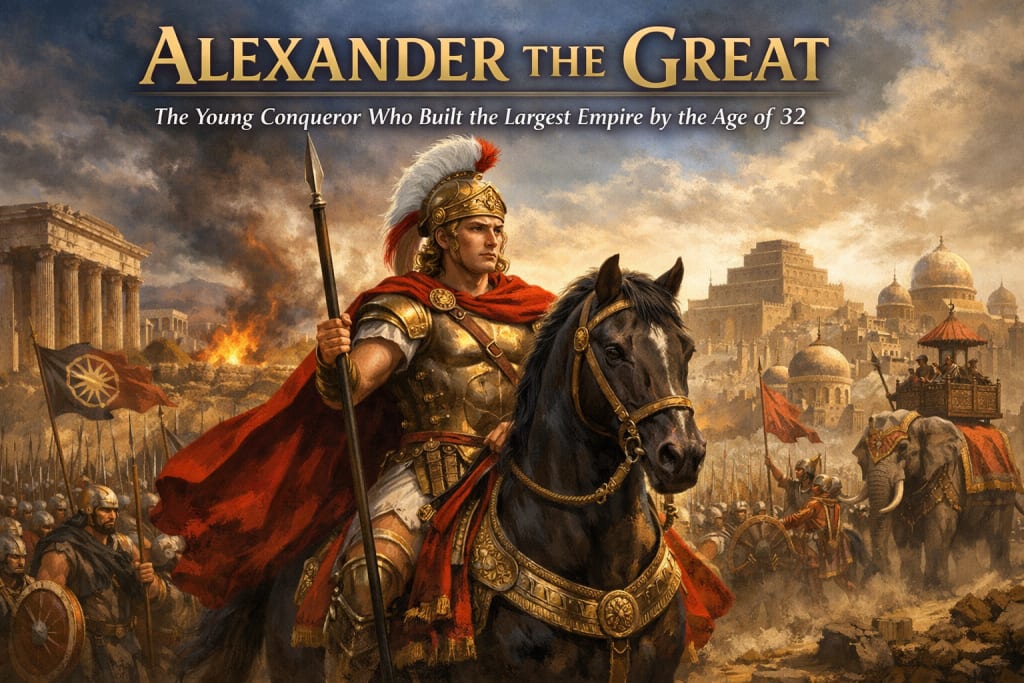
Throughout human history, only a few leaders have managed to reshape the world in a single lifetime. Among them stands Alexander the Great, a remarkable young ruler who created one of the largest empires the ancient world had ever seen—before dying at just 32 years old. His life was short but filled with extraordinary achievements that changed the course of history.
Early Life and Education
Alexander was born in 356 BCE in the kingdom of Pella, the capital of Macedon. He was the son of Philip II of Macedon, one of the most powerful kings of his time, and Olympias. From an early age, Alexander showed signs of intelligence, ambition, and courage.
One of the most important influences in Alexander’s life was his teacher, the famous Greek philosopher Aristotle. Under Aristotle’s guidance, Alexander studied philosophy, science, literature, and politics. These lessons helped shape his vision of leadership and his interest in spreading Greek culture across the world.
According to historical accounts, Alexander was also brave and confident as a child. A famous story tells how he tamed a wild horse named Bucephalus, something even experienced riders had failed to do. This moment impressed his father and hinted at the greatness that lay ahead.
Becoming King at a Young Age
In 336 BCE, King Philip II was assassinated, and Alexander became king of Macedon at only 20 years old. Many enemies believed the young king would not be able to hold his father’s kingdom together. Several Greek cities quickly rebelled against Macedonian rule.
However, Alexander acted swiftly. He crushed rebellions and reasserted control over Greece. His decisive actions showed that despite his youth, he was a capable and fearless leader.
The Campaign Against Persia
Alexander’s greatest ambition was to conquer the mighty Persian Empire, which had once threatened the Greek world. In 334 BCE, he crossed into Asia with an army of about 40,000 soldiers.
One of his first major victories came at the Battle of the Granicus, where his forces defeated Persian troops near modern-day Turkey. This victory opened the door for further conquests.
Over the next few years, Alexander achieved several stunning military successes. At the Battle of Issus, he defeated the Persian king Darius III despite being outnumbered. Later, at the Battle of Gaugamela, Alexander won a decisive victory that effectively destroyed Persian power.
After this triumph, he captured major Persian cities including Babylon, Susa, and Persepolis. The once-mighty Persian Empire fell into his hands.
Expansion Toward India
Not satisfied with conquering Persia, Alexander continued his campaign eastward into Central Asia and eventually toward the Indian subcontinent. In 326 BCE, he fought the famous Battle of the Hydaspes against King Porus.
Although Alexander won the battle, he was impressed by Porus’s bravery and allowed him to continue ruling his kingdom. This act demonstrated Alexander’s ability not only as a warrior but also as a pragmatic ruler.
However, by this time Alexander’s soldiers had grown exhausted after years of constant warfare. When they reached the Hyphasis River, they refused to march further east. Reluctantly, Alexander agreed to return west.
A Vision Beyond Conquest
Alexander was not only interested in conquering lands; he also aimed to unite different cultures. He encouraged marriages between his soldiers and local women and adopted some Persian customs. His goal was to create a blended empire combining Greek and Eastern traditions.
He founded many cities across his empire, the most famous being Alexandria in Egypt. These cities became centers of trade, culture, and learning, spreading Greek ideas throughout the region.
A Mysterious Death
In 323 BCE, while in Babylon, Alexander suddenly fell ill and died at the age of 32. The exact cause of his death remains a mystery, with historians suggesting possibilities ranging from illness to poisoning.
After his death, his vast empire quickly fragmented among his generals in a series of conflicts known as the Wars of the Diadochi.
A Lasting Legacy
Although Alexander’s empire did not survive long after him, his influence lasted for centuries. His conquests spread Greek language, culture, and ideas across a huge region, creating what historians call the Hellenistic Period.
Today, Alexander the Great remains one of history’s most fascinating figures—a young king whose ambition, courage, and military genius allowed him to build an empire stretching across three continents before his life ended far too soon.
About the Creator
Irshad Abbasi
Ali ibn Abi Talib (RA) said 📚
“Knowledge is better than wealth, because knowledge protects you, while you have to protect wealth.
Keep reading
More stories from Irshad Abbasi and writers in History and other communities.
"Research My Brain, I Am Sorry"
The heart of Manhattan is no stranger to the frantic energy of city life, but recently, the 44-story luxury towers of the New York skyline became the backdrop for a tragedy that has left investigators and the public grappling with a haunting mystery. After a calculated and violent shooting spree that sent residents scrambling for their lives, the discovery of the gunman’s body revealed a final, cryptic request scrawled on a piece of paper: **"Research my brain. I am sorry."**
By Irshad Abbasi 7 days ago in History
12 American Flag Designs That Almost Changed History
The American flag is one of history’s most iconic symbols. Its red, white, and blue stripes, along with fifty stars, instantly represent freedom, democracy, and national pride. But did you know that the flag we all recognize today didn’t become official until 1960?
By Areeba Umairabout 21 hours ago in History
Top tipple tricks
Been thinking a lot about drinking, lately. Not least because of a recent episode of over-indulgence and the inevitable after effects. Some readers may recall the earlier articles I wrote about beating the booze. Here I set out an experiment in techniques for cutting down on my alcohol intake. The experiment was successful, the techniques worked, and I have armed myself with an arsenal of weapons in the war against the demon drink. I have yet to fire the first round however. It's all a question of timing (perhaps procrastination).
By Raymond G. Taylor5 days ago in Psyche



Comments
There are no comments for this story
Be the first to respond and start the conversation.