
Ernest Hemingway Survived Two Plane Crashes in 48 Hours — Then Walked Into a Bar Like Nothing Happened
The unbelievable African safari story that shows how the legendary writer Ernest Hemingway lived with the same reckless courage that filled his novels

When people think of Ernest Hemingway, they usually imagine a rugged writer sitting at a wooden desk somewhere in Havana or Paris, typing sharp sentences about war, courage, and human endurance. His novels, including The Old Man and the Sea and A Farewell to Arms, made him one of the most famous literary figures of the twentieth century. He won the Nobel Prize in Literature in 1954 and became a symbol of toughness, adventure, and masculine resilience.
But what many readers don’t realize is that Hemingway didn’t merely write about danger. He seemed to pursue it relentlessly throughout his life. He covered wars as a journalist, hunted big game in Africa, fished for giant marlin in the Gulf Stream, boxed with friends, and lived with a level of physical intensity that bordered on reckless. Perhaps no story illustrates this better than the astonishing chain of events that happened during an African safari in 1954, when Hemingway survived not one but two plane crashes in less than two days.
The episode took place in East Africa while Hemingway was traveling with his fourth wife, Mary Welsh Hemingway. The couple had gone on safari to explore the wildlife and landscapes that fascinated the writer. Africa had long held a special place in his imagination. He had written about the continent before, and the raw, untamed environment perfectly matched his love of adventure.
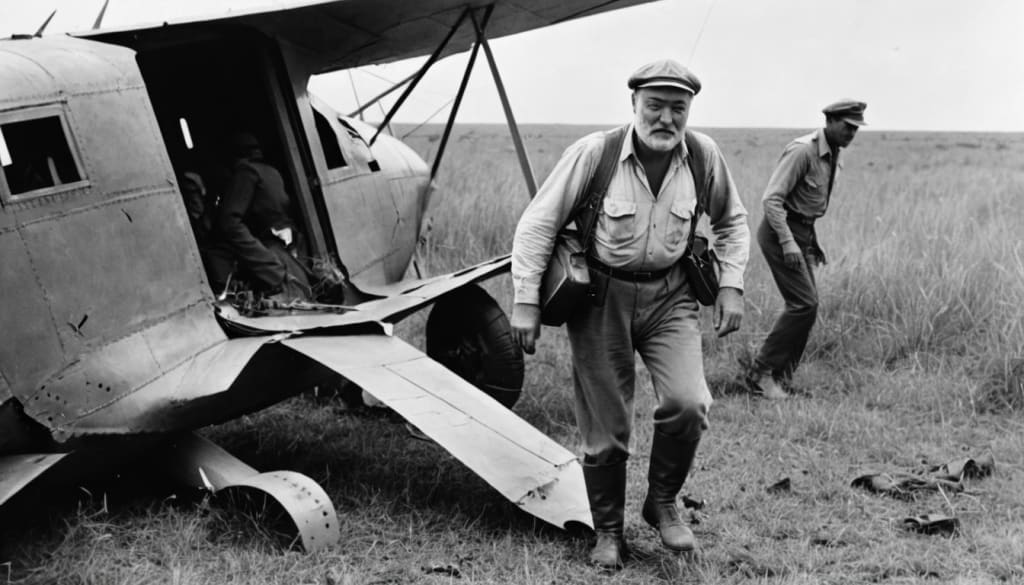
During the trip, Hemingway decided to take a sightseeing flight over the spectacular landscape near what is now Murchison Falls in Uganda. The aircraft was a small charter plane—hardly the safest machine for flying over rough terrain. As the plane descended over the dense jungle and powerful waterfall below, disaster struck. The aircraft collided with a telegraph wire and crashed violently into the bush.
Miraculously, Hemingway, his wife, and the pilot survived. The wrecked plane lay tangled in the vegetation, smoke drifting upward as the passengers struggled to escape. For a time, rescue teams even believed the famous writer had died. News of the crash spread quickly, and some newspapers prematurely reported his death.
Yet Hemingway walked away from the wreck alive. He suffered injuries—cuts, bruises, and a severe concussion—but nothing that appeared immediately life-threatening. The group eventually managed to reach safety after a difficult trek through the surrounding wilderness.
But the bizarre part of the story was only beginning.
The next day, arrangements were made for another aircraft to transport the shaken passengers away from the remote area. If Hemingway had been a cautious man, this would have been the moment to end the adventure and head home. Instead, he boarded the second plane.
During takeoff, catastrophe struck again.
The aircraft suddenly caught fire and crashed once more. Flames spread rapidly through the fuselage, forcing the passengers to escape through the wreckage. In the chaos, Hemingway reportedly used his head to smash through the aircraft door, helping himself and others escape the burning plane.
This second crash left him far more seriously injured. He suffered burns, internal injuries, a fractured skull, and damage to his spine. He also experienced ruptured organs and temporary loss of hearing and vision. The physical toll was enormous, even for a man known for his toughness.
When news of the second crash reached the outside world, journalists were stunned. It sounded almost impossible: one of the world’s most famous writers had survived two aviation disasters in less than 48 hours. The story became international news, reinforcing Hemingway’s growing reputation as a man who lived on the edge of danger.
But perhaps the most astonishing detail came afterward.
Despite his injuries, Hemingway reportedly returned to social life astonishingly quickly. According to accounts from people who knew him, the writer appeared in a bar not long after the crash—still bruised, bandaged, and clearly battered from the ordeal. Yet instead of quietly resting or recovering, he behaved exactly as one might expect from the larger-than-life personality he had cultivated for decades.
At some point during the evening, someone allegedly insulted one of Hemingway’s friends. In typical Hemingway fashion, the writer did not respond with words alone. He reportedly challenged the offender, and the situation escalated into a fistfight.
For many observers, the image was almost surreal: a man who had just survived two plane crashes, burned and injured, still willing to throw punches in defense of a friend. It was the kind of story that sounded less like reality and more like one of Hemingway’s own fictional scenes.
Whether every detail of the bar fight is perfectly documented or slightly exaggerated by retelling, the event fits seamlessly into the broader pattern of Hemingway’s life. He had boxed since his youth and believed strongly in physical courage. For him, standing up to an insult or defending a companion was part of a code of honor that shaped both his life and his writing.
The African safari crashes also had lasting consequences for Hemingway’s health. Although he survived the immediate injuries, the trauma worsened existing medical problems. Over the following years he suffered chronic pain, headaches, and physical complications linked to the crashes and earlier accidents he had endured.
These injuries, combined with depression and other struggles, contributed to the difficult final years of his life. Yet the legend of the crashes continued to grow. Newspapers and magazines repeated the story, sometimes embellishing it, turning it into one of the most dramatic survival tales associated with any writer in modern history.
In a strange way, the episode seemed to confirm the image Hemingway had created in his books: the idea that courage is measured not by avoiding danger but by facing it without fear. His characters often confront overwhelming odds, physical suffering, and the possibility of death. The African crash story made it seem as though the author himself lived by the same philosophy.
Today, historians and biographers look at the incident with a mixture of amazement and caution. Surviving two plane crashes in such a short time is statistically extraordinary. Yet for Hemingway, whose life included wars, injuries, accidents, and dangerous adventures across several continents, it was just another chapter in an already remarkable story.
The episode remains one of the most bizarre anecdotes in literary history. It captures the strange blend of bravery, recklessness, and stubborn pride that defined Ernest Hemingway as both a writer and a man.
The safari crashes did not diminish his legend—they intensified it. The image that remains is unforgettable: a battered survivor walking out of burning wreckage in the African wilderness, and not long afterward walking into a bar, ready for another fight if honor demanded it. For better or worse, that was the life of Ernest Hemingway—dangerous, dramatic, and impossible to separate from the stories he told.
About the Creator
Algieba
Curious observer of the world, exploring the latest ideas, trends, and stories that shape our lives. A thoughtful writer who seeks to make sense of complex topics and share insights that inform, inspire, and engage readers.


Comments
There are no comments for this story
Be the first to respond and start the conversation.