
Four Strategic Objectives: Understanding Trump’s Stated Goals in the U.S.–Iran Confrontation
Missile Deterrence, Naval Power, Nuclear Limits, and Proxy Networks at the Center of Washington’s Strategy

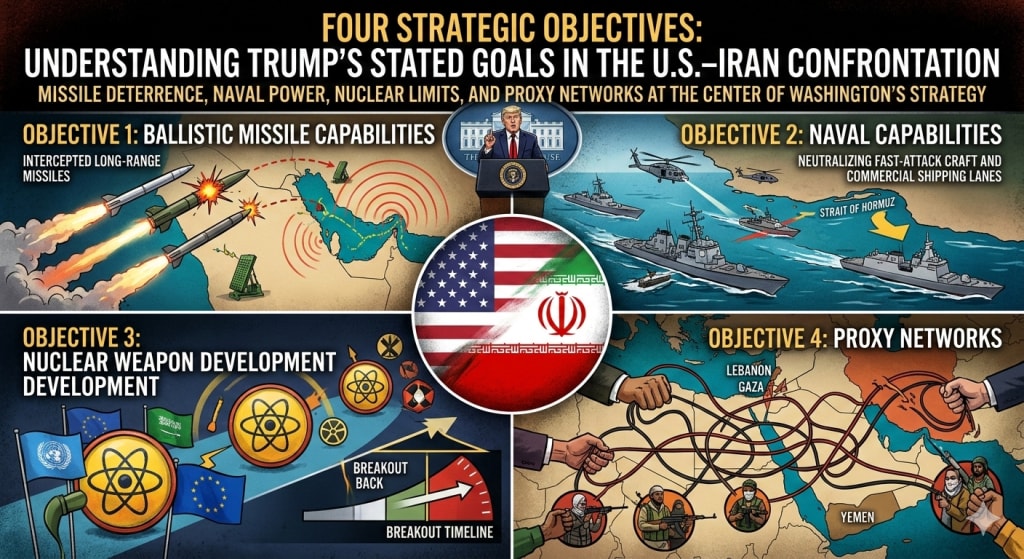
In a recent White House address, U.S. President Donald Trump outlined four major objectives in the ongoing confrontation with Iran. Framing the moment as a decisive opportunity, he described the campaign as focused, time-bound, and strategically necessary for American and allied security.
Whether one views the speech as firm leadership or risky escalation, it laid out a clear structure. The goals center on degrading Iran’s missile capabilities, weakening its naval forces, preventing nuclear weapon development, and curbing support for regional proxy groups.
Understanding these objectives requires stepping beyond rhetoric and examining the strategic logic behind them.
Objective One: Targeting Ballistic Missile Capabilities
The first and most emphasized goal involves dismantling Iran’s ballistic missile infrastructure.
Ballistic missiles are not merely weapons; they are strategic deterrence tools. Capable of traveling long distances at high speeds, they serve as both military assets and political signals. In modern warfare theory, missile stockpiles create what is called “second-strike credibility” — the ability to respond after being attacked.
By targeting missile factories and storage facilities, the U.S. objective appears aimed at limiting Iran’s capacity to project force across the region.
From a strategic standpoint, degrading missile infrastructure does three things:
Reduces immediate threat to U.S. forces stationed in the Gulf.
Signals resolve to allies such as Israel.
Attempts to reshape the regional balance of deterrence.
Critics, however, point out that missile programs are deeply embedded within national defense doctrines. Eliminating them entirely is extraordinarily difficult and may provoke further retaliation.
Objective Two: Neutralizing Naval Capabilities
The second goal focuses on Iran’s naval assets.
Iran’s navy operates both conventional vessels and fast attack craft designed for asymmetric tactics in narrow waterways like the Strait of Hormuz. These waters are strategically vital, carrying a significant portion of global oil shipments.
Weakening naval capacity serves a clear economic and security function: safeguarding shipping lanes and deterring maritime disruption.
Maritime strategy has long been central to global power. From Alfred Thayer Mahan’s 19th-century naval theories to modern carrier strike groups, sea control equals influence. In the Gulf, even small-scale naval skirmishes can affect global energy prices.
However, asymmetric naval tactics — such as swarm boats or coastal missile batteries — are difficult to eliminate completely. Maritime deterrence often becomes a continuous balancing act rather than a final victory.
Objective Three: Preventing Nuclear Weapon Development
The third objective addresses the nuclear question.
For years, Western policymakers have debated how to limit Iran’s nuclear capabilities. The core concern revolves around enrichment levels, monitoring mechanisms, and breakout timelines — the estimated time needed to produce a weapon if a decision were made.
President Trump reiterated a firm position: Iran must never obtain nuclear weapons.
This objective carries long-term strategic weight. Nuclear deterrence alters regional calculations permanently. Even the perception of near-nuclear capability shifts alliance behavior and military planning.
European leaders, including Emmanuel Macron, have emphasized diplomatic frameworks under the United Nations to address the issue through inspections and agreements.
Military pressure aims to reinforce diplomatic leverage — though history shows that pressure alone rarely resolves nuclear disputes without parallel negotiation channels.
Objective Four: Disrupting Proxy Networks
The fourth goal targets Iran’s support for regional armed groups such as Hezbollah, Houthis, and Hamas.
This dimension is perhaps the most complex.
Iran’s regional influence strategy relies not only on direct military capacity but also on allied non-state actors. These groups operate across Lebanon, Yemen, Gaza, and beyond. Through financial support, training, and weapons transfers, Tehran extends its strategic depth without direct confrontation.
Disrupting such networks is challenging because they are decentralized. Even if funding lines are interrupted, ideological alignment and local support structures often sustain them.
Strategically, this objective attempts to reduce what analysts call “horizontal escalation” — the spread of conflict across multiple theaters.
Timeframes and Realities
The White House speech suggested a defined operational window of several weeks. Military campaigns, however, rarely adhere strictly to projected timelines.
Conflict evolves through feedback loops:
• Action generates response.
• Response triggers counteraction.
• Political pressure reshapes military decisions.
Declaring goals is straightforward. Achieving them without unintended escalation is far more complex.
Support and Skepticism
International reactions have been mixed.
Some allies frame the objectives as necessary deterrence measures aimed at stabilizing the region. Others warn that broad military pressure risks deepening instability.
The United Nations has described the broader situation as a threat to international peace, emphasizing de-escalation and legal compliance.
Meanwhile, domestic debates within the United States reflect divisions about intervention, alliance commitments, and long-term strategy.
Strategic Logic vs. Strategic Risk
Each of the four objectives follows a recognizable military logic:
• Remove long-range strike capability.
• Secure maritime routes.
• Prevent nuclear escalation.
• Reduce proxy influence.
On paper, the strategy is coherent. In practice, implementation carries risk.
Military theorists often speak of the “security dilemma.” One state’s defensive move appears offensive to another. Deterrence can either stabilize or accelerate conflict, depending on perception.
The key question is whether the objectives aim at containment or transformation. Containment seeks to limit threat without fundamentally altering regime structure. Transformation implies reshaping a state’s regional posture entirely — a far more ambitious and uncertain endeavor.
The Broader Context
The Middle East has long been shaped by cycles of rivalry, deterrence, and negotiation. Superpower involvement adds layers of complexity.
Economic factors — particularly energy markets — amplify consequences. Diplomatic alignments shift. Domestic political pressures influence timelines.
In such environments, clarity of objectives can reduce uncertainty. Yet rigid framing can also narrow diplomatic flexibility.
What Comes Next?
The unfolding situation remains dynamic.
If the stated objectives are pursued primarily through calibrated deterrence and diplomatic backchannels, escalation may stabilize. If rhetoric hardens and retaliatory cycles intensify, regional spread becomes more likely.
History shows that conflicts rarely unfold exactly as planned. They respond to miscalculations, unexpected events, and political shifts.
What is certain is this: the four objectives outlined publicly have reshaped the conversation. They define the strategic narrative — whether ultimately fulfilled, revised, or replaced by negotiation.
In geopolitics, goals are declarations of intent. Outcomes depend on execution, reaction, and the unpredictable nature of international power.
The world now watches not only the battlefield but the diplomatic corridors behind it — where wars are sometimes ended long before the last missile is fired.
About the Creator
Amanullah
✨ “I share mysteries 🔍, stories 📖, and the wonders of the modern world 🌍 — all in a way that keeps you hooked!”
The Night the Sky Turned Red
I never thought I would watch history burn in real time. It was 2:17 a.m. in my small apartment in Chicago when my phone started buzzing nonstop. At first, I ignored it. Group chats are always loud at night. But then my mother called.
By Imran Ali Shahabout 10 hours ago in History
Review of 'Man on the Run'
My wife and I saw Man on the Run, a nearly 2-hour documentary on Amazon Prime, about Wings, Paul McCartney's group that flew around the world from shortly after The Beatles broke up in early 1970 to shortly after John Lennon was murdered at the end of 1980, making a Beatles reunion forever impossible.
By Paul Levinson2 days ago in Beat


Comments
There are no comments for this story
Be the first to respond and start the conversation.