
From Alexander to America: Afghanistan—Graveyard of Empires or Highway of Conquest?
A Strategic Post-Mortem of World Powers from the Macedonians to the Pentagon.

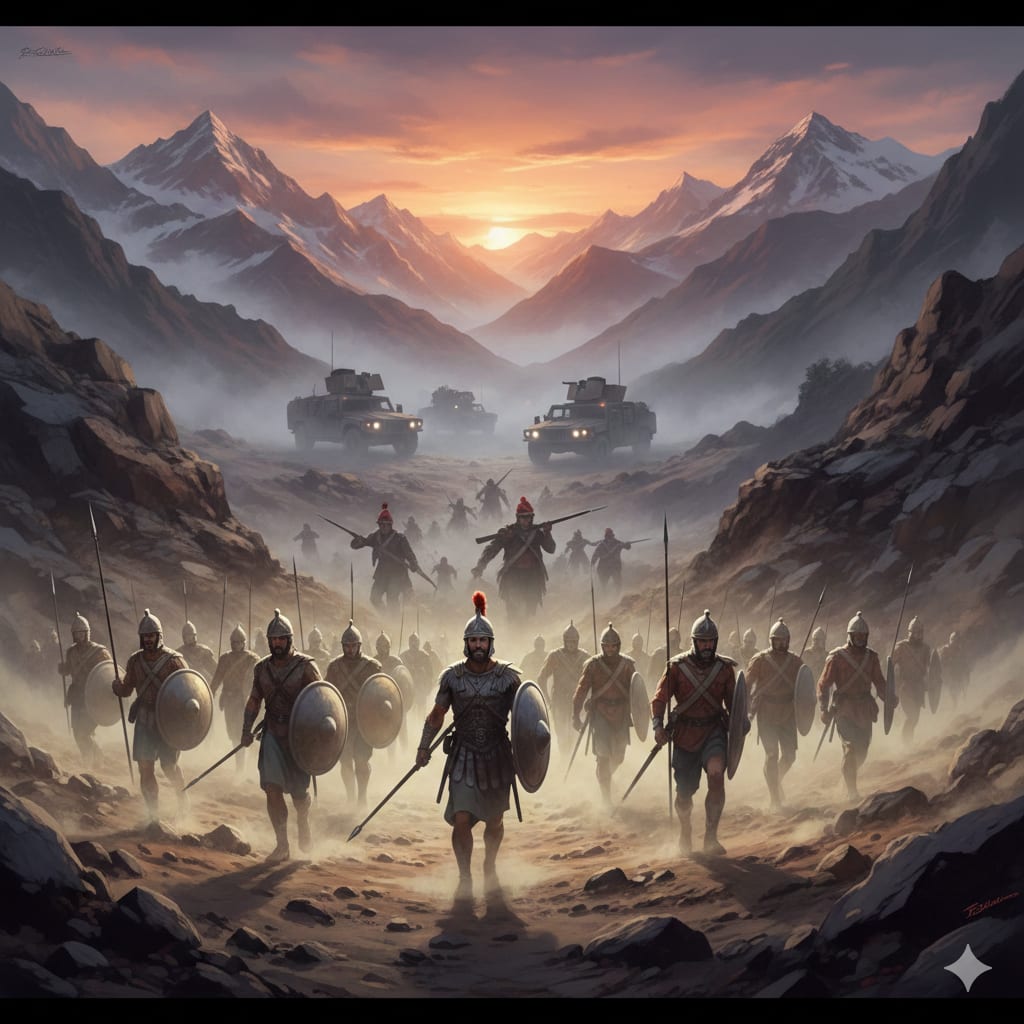
For centuries, the rugged peaks of the Hindu Kush have stood as silent witnesses to the greatest ambitions of mankind. From the bronze shields of Alexander the Great’s phalanxes to the high-tech drones of the United States military, Afghanistan has been the stage for a recurring historical drama. It is often labeled the "Graveyard of Empires," a place where superpowers go to bleed. Yet, a deeper look at history suggests a more complex reality: for many, it was also a "Highway of Conquest," a vital corridor that linked the civilizations of the East and West.
The Highway: A Gateway for Ancient Ambition
The narrative of Afghanistan as an impenetrable fortress is a relatively modern one. In antiquity, the region—then known as Bactria and Aria—was the ultimate "Crossroads of Asia."
When Alexander the Great arrived in 330 BCE, he did not find a graveyard; he found a gateway. While he faced fierce tribal resistance, he successfully integrated the region into his empire, marrying the Bactrian princess Roxana and founding cities like Alexandria on the Oxus (Ai-Khanoum). Following him, the Mauryans, the Kushans, and the Mughals all utilized the Afghan plateau as a strategic bridge to project power into India and Central Asia.
For these empires, Afghanistan was not a dead end; it was a Highway. It was the heart of the Silk Road, where Buddhism traveled to China and Greek art blended with Indian philosophy. To control Afghanistan was to hold the keys to the world’s most lucrative trade routes.
The Graveyard: The Modern Myth of Defiance
The shift in narrative from "Highway" to "Graveyard" began primarily in the 19th century during the "Great Game" between the British and Russian Empires. It was here that the legendary Afghan resistance began to dismantle the prestige of modern superpowers.
The British Empire: In 1842, the retreat from Kabul saw an entire British army decimated, leaving only one survivor to reach Jalalabad. Despite three Anglo-Afghan wars, the British eventually realized that while they could occupy the cities, they could never govern the mountains.
The Soviet Union: In 1979, the Red Army crossed the Amu Darya with modern tanks and scorched-earth tactics. Ten years later, they retreated in humiliation. The Afghan quagmire contributed significantly to the eventual collapse of the Soviet Union itself.
The United States: Following the 9/11 attacks, the US launched the longest war in its history. Despite spending over $2 trillion and deploying the most advanced military technology in human history, the 2021 withdrawal and the rapid return of the Taliban cemented the "Graveyard" label in the global consciousness.
The Paradox: Why Do Empires Fail?
The reason Afghanistan earns its fearsome reputation isn't just because of its geography, but because of a fundamental misunderstanding of its societal fabric.
Terrain as an Equalizer: The jagged mountains and hidden valleys allow local guerrillas to nullify the technological advantages of invaders.
The Cost of Governance: Empires often fail because they try to impose centralized rule on a fiercely decentralized, tribal society. The "conquest" is easy; the "occupation" is an economic and political sinkhole.
External Interference: Afghanistan is rarely a two-way fight. Whether it was the British arming tribes against the Russians or the US arming the Mujahideen against the Soviets, "The Graveyard" is often dug by the hands of rival superpowers.
The Verdict: A Highway or a Graveyard?
Is Afghanistan a Graveyard or a Highway? The answer depends on the era and the objective.
When treated as a cultural and economic bridge, as it was during the height of the Silk Road, Afghanistan flourished as a center of learning and trade. However, when foreign powers attempt to transform it into a military outpost or a puppet state, the terrain turns hostile.
History shows that while Afghanistan can be traversed, it can rarely be tamed. Alexander may have marched through it, but the British, Soviets, and Americans learned that the cost of staying is often the collapse of the empire itself. Today, as the world watches a new chapter of Afghan history unfold, the mountains remain, indifferent to the rise and fall of those who seek to claim them.
About the Creator
Irshad Abbasi
Ali ibn Abi Talib (RA) said 📚
“Knowledge is better than wealth, because knowledge protects you, while you have to protect wealth.
Keep reading
More stories from Irshad Abbasi and writers in History and other communities.
The Hitler Mystery: DNA Secrets and the Century-Old Rumor of the Dictator’s Anatomy
For over eighty years, one of the most persistent pieces of historical trivia has been a schoolyard rhyme and a medical mystery: the claim that Adolf Hitler suffered from a specific physical deformity. While once dismissed as mere British wartime propaganda, modern forensic science, rediscovered medical records, and DNA analysis have reignited the conversation. Was the "one testicle" myth a clever psychological warfare tactic, or was it a medical reality that shaped the psyche of the 20th century’s most notorious tyrant?
By Irshad Abbasi about 24 hours ago in History



Comments
There are no comments for this story
Be the first to respond and start the conversation.