
John Lennon And Blackpool: A Life Threaded Through A Seaside Town

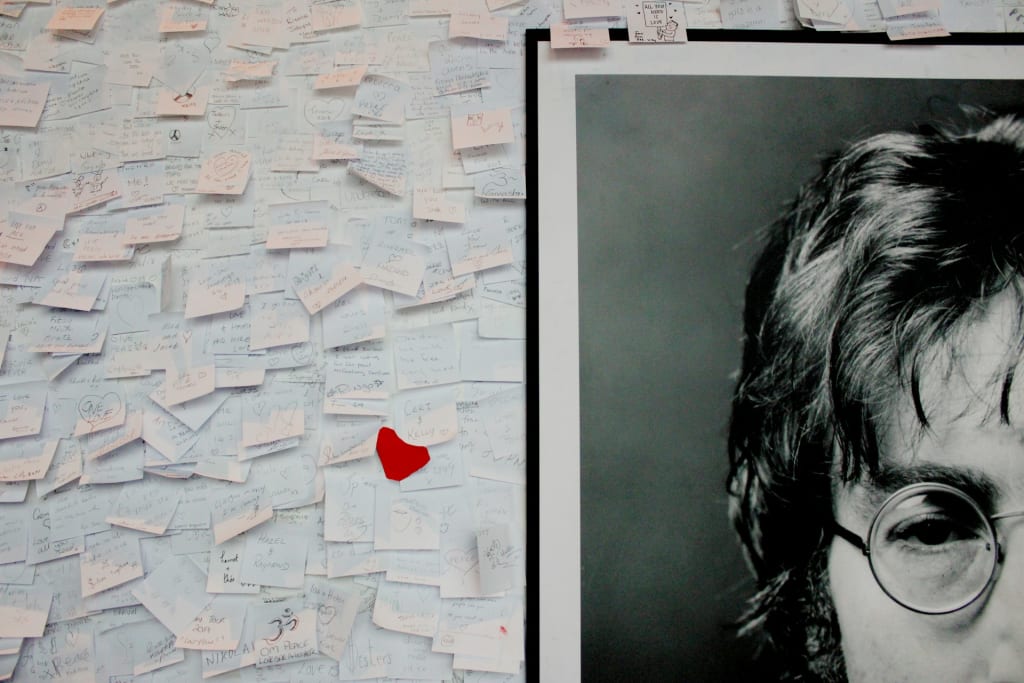
John Lennon’s connection to Blackpool begins long before the Beatles, long before the cameras and the roar of theatre crowds. It starts in the small, bright details of childhood holidays, in the smell of sea air and the glow of variety‑show stages, and it runs forward into one of the most painful scenes of his early life. Yet the story does not stop there. Blackpool also stands quietly at the origin of his first great love, his first wife, and the mother of his first child. The town becomes a kind of hidden axis in his life: a place of early joy, a site of rupture, a stage of triumph, and the birthplace of the woman who would share his formative years of fame.
Childhood summers on the Fylde coast gave Lennon a sense of freedom and belonging that contrasted sharply with the instability of his home life in Liverpool. His mother Julia’s family, the Stanleys, had roots in the area, and John spent long stretches of summer with his cousins, especially Stanley Parkes, who functioned as an older brother. Those holidays were not rare treats; they were recurring seasons that shaped his sense of the world. The boys moved between Fleetwood and Blackpool with the easy confidence of children who know the streets and the shoreline by heart.
Blackpool in the 1940s was a world built for spectacle. Variety theatres, comedians, singers, circus acts, and novelty performers filled the piers and the town’s grand venues. Lennon absorbed it all. His cousin Stan later recalled that they would take the tram into Blackpool two or three times a week during the summer to see different shows. They watched George Formby with his cheeky songs, Dickie Valentine with his smooth charm, Arthur Askey and Max Bygraves with their broad humour and timing. The boy in the audience was learning more than he realised. The quick, irreverent wit that would later define Lennon’s public persona had its roots in those seaside evenings, where the line between performer and crowd was thin and alive.
Away from the bright lights, quieter memories settled into him as well. Lennon learned to swim at Fleetwood’s open‑air baths, where the water was cold, the wind sharp, and the sense of accomplishment fierce. He spent long afternoons in the home of a Fleetwood solicitor who owned a professional snooker table. The boys were allowed to play on it, and world champion Joe Davis sometimes practised there. Lennon watched him with the focused attention of a child studying mastery. The calm precision, the unhurried movement around the table, the way each shot was both art and calculation—these impressions stayed with him. Later, his own creative life would carry a similar mixture of play and intensity, a willingness to experiment anchored by a deep respect for craft.
Those summers gave Lennon more than entertainment. They offered him a temporary refuge, a sense of extended family warmth that softened the edges of his more complicated life in Liverpool. Blackpool became a place where the world felt expansive rather than precarious, where the boy could simply be a boy, laughing with cousins and marvelling at performers who seemed larger than life.
The brightness of those early years throws the next chapter into sharper relief. In 1946, Blackpool became the setting for one of the most painful episodes of Lennon’s childhood. When John was five, his father, Alfred Lennon, took him to the seaside under the pretext of a holiday. In reality, Alfred intended to emigrate to New Zealand and take the boy with him. John stayed for two months at 25 Ivy Avenue in South Shore, close to the beach, unaware that his future was being quietly negotiated without him.
When Julia discovered what Alfred planned, she travelled to Blackpool with her partner to confront him. The scene that followed has been told in several versions. The most dramatic account describes Alfred forcing John to choose between his parents, with the boy initially choosing his father twice before breaking down in tears and running to his mother. Later research has suggested that some of these details may have been exaggerated or misremembered, yet the emotional truth remains: Blackpool became the place where the fragile balance of Lennon’s family life shattered.
That rupture left deep marks. Themes of abandonment, divided loyalty, and the longing for a secure home echo through Lennon’s later work, from the raw cry of “Mother” to the haunted tenderness of “Julia” and the stark honesty of “Working Class Hero.” The 1946 Blackpool crisis sits behind those songs like a shadowed backdrop. Whether or not every detail of the famous story is exact, the experience of being pulled between parents, of feeling the ground of family give way, shaped his emotional landscape. Blackpool, once a playground, became a crossroads of loss.
The town’s significance, however, does not end with childhood. It reappears in a quieter but equally important way through Cynthia Powell, the woman who would become Lennon’s first wife and the mother of his son Julian. Cynthia was born in Blackpool in 1939, into a family that, like many others, moved with the shifting tides of work and war. Her early years were marked by the same post‑war British atmosphere that shaped Lennon’s childhood, though her family later relocated to the Wirral, settling in Hoylake. The Blackpool of her infancy was not the same as the Blackpool of Lennon’s holidays, yet the town stands at the origin of her story.
By the time John and Cynthia met at the Liverpool College of Art, the geographical distance from Blackpool was real, but the cultural threads were not so far apart. Both came from families shaped by the working‑ and lower‑middle‑class realities of the North West. Both carried memories—direct or inherited—of seaside towns, variety shows, and the modest aspirations of post‑war Britain. Cynthia’s Blackpool birth is easy to overlook in the larger narrative of the Beatles, yet it matters. The town that had already marked Lennon’s childhood also quietly gave the world the woman who would share his early fame, his first marriage, and the birth of his first child.
Their relationship unfolded in Liverpool, not on the Fylde coast, but the symbolic resonance remains. Blackpool sits at the root of both their stories, even if in different ways. For Lennon, it was the place of childhood joy and trauma. For Cynthia, it was the place where her life began, before her family moved on. When they married in 1962, just as Beatlemania was beginning to stir, the union carried within it these layered geographies: Liverpool, the Wirral, and, in the background, Blackpool.
As the Beatles’ fame exploded, Blackpool returned to Lennon’s life in yet another form: as a stage on which the band’s mid‑sixties brilliance was broadcast to the nation. The Beatles performed at the ABC Theatre in Blackpool several times, and the town became one of the key sites for their televised appearances. The boy who had once sat in the audience now stood under the lights, guitar in hand, facing a sea of faces and a wall of sound.
Blackpool’s long tradition of variety entertainment made it a natural fit for the Beatles. The band’s humour, their quick banter, their willingness to play with the conventions of performance—all of it resonated with audiences steeped in the same comedic and musical heritage Lennon had absorbed as a child. The theatres were familiar ground, not just architecturally but culturally. Lennon understood the rhythm of a Blackpool crowd, the timing of a joke, the way to lean into the absurdity of fame without losing control of the room.
The most iconic of these appearances came on the television show Blackpool Night Out. On 1 August 1965, the Beatles performed a set that included “I Feel Fine,” “I’m Down,” “Act Naturally,” “Ticket to Ride,” and “Help!” In the same broadcast, Paul McCartney delivered the first British television performance of “Yesterday,” a moment that would become one of the most replayed and remembered in the band’s history. Lennon, never one to let sentimentality go unpunctured, followed it with a dry quip: “Thank you Ringo, that was wonderful.” The line landed perfectly, a small example of how his Blackpool‑honed sense of humour could cut through the intensity of the moment.
These performances captured the Beatles at the height of their British fame. The energy in the theatre was almost feral. Screams rose and fell like waves, and the band played with a mixture of tight professionalism and loose, almost chaotic joy. Lennon seemed entirely at ease. He was back in a town whose stages had once seemed impossibly grand, now commanding them with the authority of someone who had learned, long ago, how an audience breathes.
Behind the noise and the lights, the emotional geography of Blackpool remained complex. This was the town where he had run along the promenade as a child, where he had watched comedians and singers with wide‑eyed fascination, where his parents’ conflict had erupted into a scene that would haunt him for years. It was also, indirectly, the town that had given him Cynthia, whose Blackpool birth tied her story to his in a way neither of them could have predicted. The layers of meaning were not something he spoke about publicly, but they were there, woven into the fabric of his life.
Looking at Lennon’s story through the lens of Blackpool reveals a pattern that is easy to miss if the town is treated merely as a tour stop. It appears at moments of innocence, crisis, love, and triumph. It is the place of childhood summers and family fracture, the birthplace of his first wife, and the stage for some of the Beatles’ most memorable performances. The arc is not a straight line but a circle, returning again and again to the same stretch of coastline, each time with a different emotional charge.
Blackpool also reflects the broader story of post‑war Britain that shaped both Lennon and Cynthia. It was a town where working‑class and lower‑middle‑class families went for holidays, where entertainment was accessible, and where the distance between performer and audience felt small. The culture of the variety show, the pier, the cheap seats, and the shared laughter formed part of the background against which both of them grew up. Even as their lives moved into the rarefied air of global fame, those early influences remained.
In Lennon’s later years, the direct ties to Blackpool faded from public view, overshadowed by the larger narratives of New York, activism, and his evolving spiritual and artistic life. Yet the town’s imprint did not disappear. It lived on in his humour, in his instinctive understanding of performance, in his sensitivity to abandonment and loyalty, and in the quiet fact that the mother of his first child had begun her life there. Blackpool was not the centre of his universe, but it was one of its enduring constellations.
Seen this way, Blackpool becomes more than a backdrop. It is a key to understanding the emotional and cultural forces that shaped John Lennon. It holds the laughter of his early summers, the wound of his family’s fracture, the origin of his first great love, and the exhilaration of his rise to fame. It is a place where he was both child and star, both vulnerable and untouchable. The town’s presence in his story is subtle but persistent, like the sound of the sea behind the noise of the fairground.
In the end, Lennon’s life cannot be told without Liverpool, but it also cannot be fully understood without Blackpool. The town stands as one of the quiet threads running through his story, binding together childhood, love, and performance in ways that are easy to overlook but impossible to erase. Its significance lies not in how often it is mentioned, but in how deeply it is woven into the fabric of who he became.
References
Mersey Beat archives on Lennon’s childhood holidays and family accounts.
Stanley Parkes interviews and memoir excerpts regarding summers in Blackpool and Fleetwood.
Historical documentation and biographical analyses of the 1946 custody incident in Blackpool.
Television archives of Blackpool Night Out (1964–1965) and Beatles performance records at the ABC Theatre, Blackpool.
Biographical sources on Cynthia Lennon (née Powell), including her Blackpool birth and family relocation to the Wirral.
About the Creator
Julie O'Hara - Author, Poet and Spiritual Warrior
Thank you for reading my work. Feel free to contact me with your thoughts or if you want to chat. [email protected]
Keep reading
More stories from Julie O'Hara - Author, Poet and Spiritual Warrior and writers in History and other communities.
The Clinton Record: A Fierce Examination of Power, Secrecy, and the Women Caught in the Crossfire
Hillary Clinton is cut from the same cloth as Donald Trump. Don't for a minute think otherwise. She only succeeds at being more intelligent and sneaky than Trump. But at their core, they are the same.
By Julie O'Hara - Author, Poet and Spiritual Warrior3 days ago in History




Comments
There are no comments for this story
Be the first to respond and start the conversation.