
Modernizing India through Rails, Canals, and Conquest
The Youngest Governor-General Who Shaped Modern India’s Infrastructure

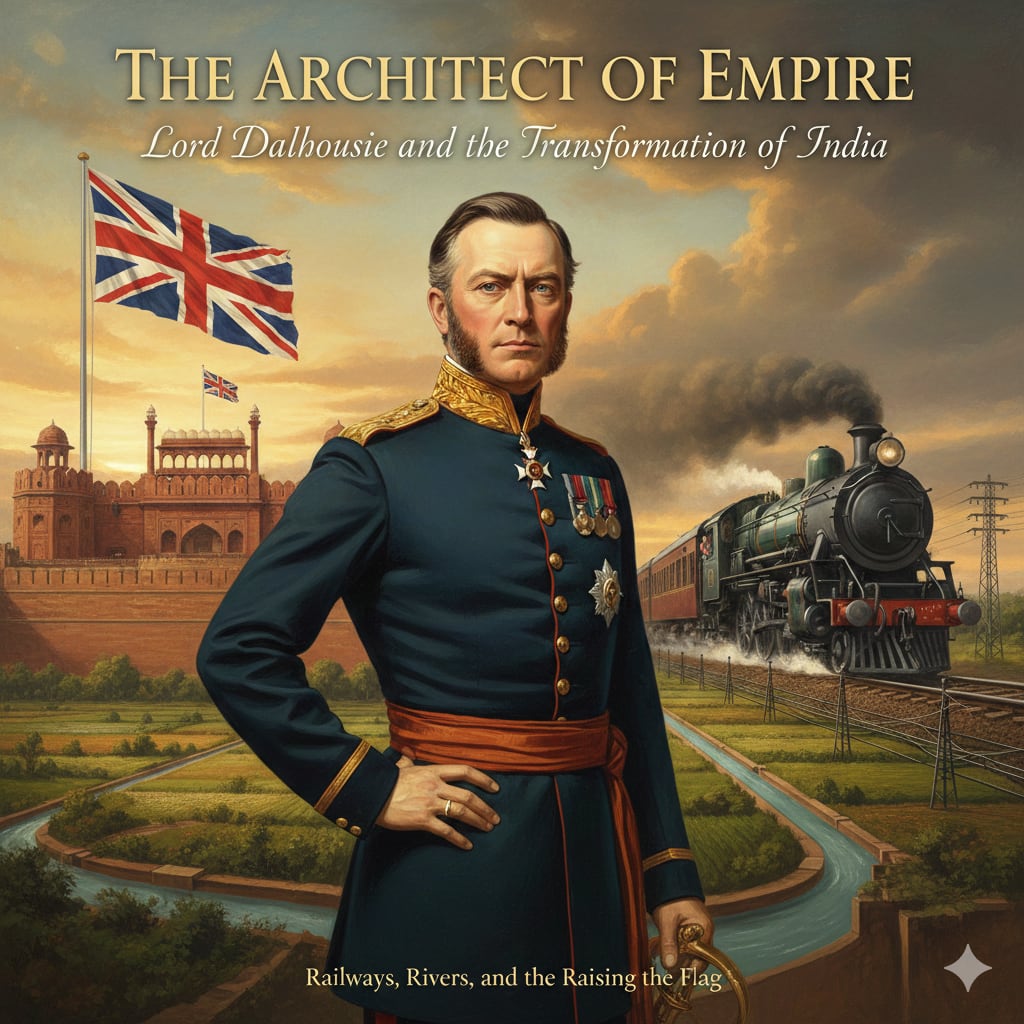
History often remembers the British Raj through the lens of conflict and colonization, but few figures embody the complex duality of "modernizer" and "conqueror" as starkly as James Broun-Ramsay, the 1st Marquess of Dalhousie. Appointed as the Governor-General of India in 1848 at the remarkably young age of 35, Dalhousie commanded a staggering annual salary of £25,000—a fortune at the time. His eight-year tenure would fundamentally alter the physical and political geography of the Indian subcontinent.
The Conquest of Punjab and the Lahore Fort
When Dalhousie arrived, the frontiers of British India were still volatile. His most significant military achievement was the total annexation of the Punjab following the Second Anglo-Sikh War. In 1849, after the fall of the Sikh Empire, Dalhousie ordered the British Union Jack to be hoisted over the Lahore Fort, signaling the end of sovereign Sikh rule and the expansion of the British Empire to the natural borders of the Indus River.
This move was not merely symbolic. By securing Lahore, Dalhousie gained control of one of the most strategic regions in Asia. It was during this period that the world-famous Koh-i-Noor diamond was taken from the young Maharaja Duleep Singh and sent to Queen Victoria, marking a definitive shift in the history of the region.
The Father of the Indian Railways
While his military conquests were swift, Dalhousie’s most enduring legacy is the "Iron Horse." He realized that for the British to effectively govern and extract resources from a land as vast as India, they needed speed. In his famous Railway Minute of 1853, he laid out a comprehensive plan for a trunk line system connecting the interior of India with its major ports.
1853: The first passenger train steamed from Bombay to Thane.
Infrastructure: He promoted the "Standard Gauge" which is still used in much of the world today.
Economic Impact: The railways revolutionized trade, allowing cotton and grains to reach global markets faster than ever before.
The Lifeblood of Agriculture: The Canal System
Dalhousie understood that a hungry population was a rebellious one, and an arid land was an unprofitable one. He turned his attention to the Ganges Canal, a massive engineering feat that remains one of the largest irrigation projects in the world.
By diverting water to the parched lands of the Doab region, he transformed millions of acres into fertile farmland. In the Punjab, he initiated the Bari Doab Canal, ensuring that the newly conquered territory would become the "breadbasket" of India. These canals didn't just prevent famine; they tethered the local peasantry to the colonial administration through economic dependency and agricultural prosperity.
A Network of Communication: The Telegraph and Post
To complement the physical speed of the railways, Dalhousie introduced the Electric Telegraph. Before his arrival, a message from Calcutta to London could take months; with the telegraph, internal communication across India became near-instantaneous.
He also overhauled the postal system. Before 1854, sending a letter was an expensive luxury. Dalhousie introduced the Post Office Act, which established uniform postage rates (the half-anna stamp) regardless of distance. This "democratization" of communication accidentally laid the groundwork for Indian nationalism, as it allowed people from different provinces to communicate and organize more easily.
Getty Images
The Doctrine of Lapse: A Controversial Legacy
Dalhousie’s modernization came with a heavy political price. He implemented the Doctrine of Lapse, a policy stating that if an Indian ruler died without a natural heir, their kingdom would "lapse" into British hands. This led to the annexation of states like Satara, Jhansi, and Oudh.
+1
While Dalhousie saw this as a way to consolidate "misgoverned" states into a modern, unified administration, it created deep-seated resentment among the Indian nobility and peasantry alike. Many historians point to these aggressive annexations as a primary catalyst for the Great Revolt of 1857, which broke out just a year after he left India.
Conclusion
James Broun-Ramsay, Lord Dalhousie, was a man of immense energy and a singular vision. He entered India as a young aristocrat with a high salary and left it as a weary statesman who had laid the skeletal structure of a modern nation. By the time he departed in 1856, he had given India its first railways, its first telegraph lines, and its modern postal system.
However, his legacy remains a paradox. He was the "Architect of Modern India" who built the roads and rails that eventually helped the country unite against colonial rule. He was the man who raised the flag at Lahore, but in doing so, he planted the seeds of a resistance that would eventually see that same flag lowered a century later.
About the Creator
Irshad Abbasi
Ali ibn Abi Talib (RA) said 📚
“Knowledge is better than wealth, because knowledge protects you, while you have to protect wealth.
Keep reading
More stories from Irshad Abbasi and writers in History and other communities.
Zulqarnain and Yajuj & Majuj: A Timeless Proof of the Qur’an’s Divine Revelation
The story of Dhul-Qarnayn and Gog and Magog stands as one of the most fascinating and thought-provoking narratives in the Qur’an. Found in Surah Al-Kahf (18:83–98), this account combines history, prophecy, morality, and eschatology in a way that has inspired reflection for centuries. For many believers, it serves as a powerful sign of the Qur’an’s divine origin—revealing knowledge, wisdom, and foresight that transcend the limits of seventh-century Arabia.
By Irshad Abbasi about 23 hours ago in History
The Tidewater Creole People
The Tidewater Creole people are descendants of early Black communities of the Tidewater Region from the 1620s and onwards into the future in coastal Virginia, the Carolina Coast, coastal Georgia, coastal Maryland and Delaware, and the Southern New Jersey Shore.
By Gracebelle White5 days ago in History



Comments
There are no comments for this story
Be the first to respond and start the conversation.