
Shaping South Asia’s Historical Narrative
How a 11th-century invasion became a symbol of conquest, religion, and historical memory in the Indian subcontinent.

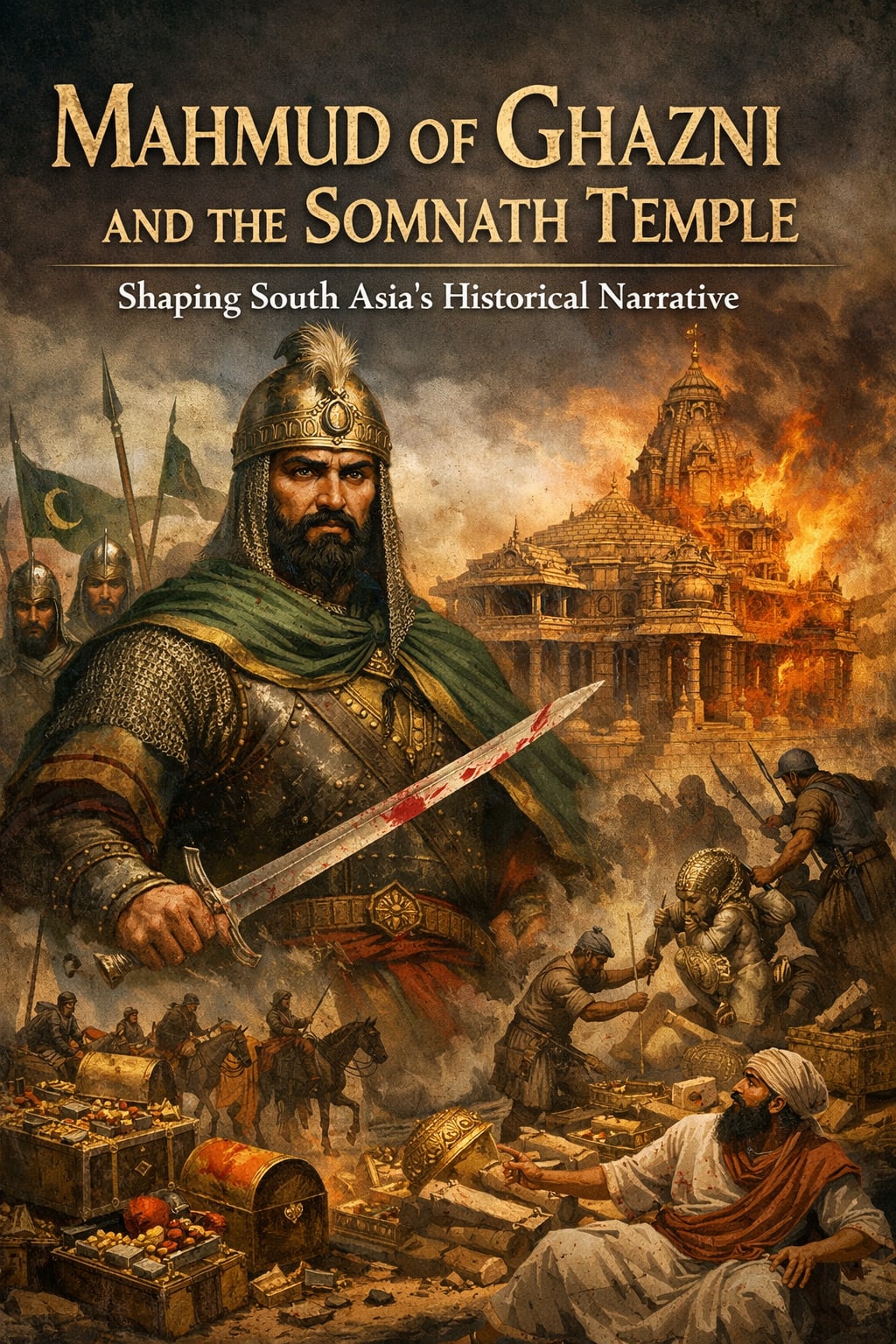
In the annals of South Asian history, few figures evoke as much discussion and debate as Mahmud of Ghazni. The ruler of the Ghaznavid Empire, Mahmud (971–1030 CE), is remembered not only for his military campaigns but also for his repeated raids into the Indian subcontinent, culminating in the infamous attack on the Somnath Temple in 1025 CE. This episode has become a central reference point in the region’s historical narrative, influencing perceptions of conquest, religion, and politics for centuries.
Mahmud ascended the Ghaznavid throne in 998 CE and embarked on a series of campaigns into northern India. These raids were motivated by multiple factors: the expansion of political power, the accumulation of wealth, and the promotion of Islam. Among the numerous temples he targeted, the Somnath Temple—located on the western coast of present-day Gujarat—stood out for its grandeur, wealth, and religious significance. Dedicated to Lord Shiva, Somnath was one of the most revered Hindu pilgrimage sites, renowned for its massive treasury.
The attack on Somnath is often portrayed in historical chronicles as a symbol of Mahmud’s ambition and military prowess. According to contemporary Persian accounts, Mahmud looted vast amounts of gold, silver, and precious stones, which he transported back to Ghazni, using part of the wealth to fund his empire and further military campaigns. Beyond material gain, the destruction of the temple represented a symbolic assertion of political and religious authority. For Mahmud, the conquest of Somnath served as a demonstration of Ghaznavid power and as a warning to other rulers and religious institutions in the region.
Over the centuries, Mahmud’s raids, and particularly the Somnath episode, have been interpreted in divergent ways. In Indian historiography, colonial and post-colonial narratives often highlighted the temple’s destruction as a moment of foreign aggression against native culture and religion. British colonial historians, for instance, sometimes framed Mahmud’s campaigns as precursors to later invasions, using the Somnath episode to underscore the theme of external threats to Indian civilization.
In modern times, the Somnath Temple has been reconstructed several times, each rebuilding carrying political and symbolic weight. The 1951 reconstruction under independent India, led by Prime Minister Jawaharlal Nehru, transformed the temple into a symbol of resilience and cultural continuity. Today, it serves not only as a site of worship but also as a historical reminder of the complex interactions between invaders and the indigenous population.
Mahmud’s campaigns also contributed to the evolving perception of South Asia as a region marked by repeated invasions and cultural interactions. His attacks, while militarily motivated, inadvertently facilitated the exchange of ideas, art, and technology between Central Asia and the Indian subcontinent. The resulting historical narrative is multifaceted: Mahmud is remembered both as a ruthless invader and as a figure whose campaigns reshaped the region’s political landscape.
The Somnath episode also raises questions about how history is remembered and interpreted. In addition to military conquest, it symbolizes the enduring tension between religious communities and the narratives constructed around identity, memory, and power. Mahmud’s legacy is thus inseparable from the story of Somnath; the temple itself became a canvas onto which generations projected ideas of loss, recovery, and historical consciousness.
In conclusion, Mahmud of Ghazni and the Somnath Temple remain intertwined in South Asia’s collective memory. Mahmud’s campaigns left a tangible mark on the subcontinent, not only through plunder and destruction but also by influencing political, religious, and cultural discourses. Somnath’s story serves as a lens through which historians, politicians, and communities examine broader themes of conquest, resilience, and identity, making it an enduring symbol in the historical narrative of the region.
Make cover pic
About the Creator
Irshad Abbasi
Ali ibn Abi Talib (RA) said 📚
“Knowledge is better than wealth, because knowledge protects you, while you have to protect wealth.
Keep reading
More stories from Irshad Abbasi and writers in History and other communities.
When Hundreds of Khudai Khidmatgars Were Slaughtered in Charsadda
The Babra Massacre stands as one of the most harrowing episodes in the history of the Indian subcontinent’s struggle against colonial oppression. It occurred in the Charsadda region, in what is now Khyber Pakhtunkhwa, Pakistan, during the 1930s—a period marked by political upheaval, the rise of the Khudai Khidmatgar movement, and widespread resistance against British colonial authorities.
By Irshad Abbasi about 12 hours ago in History


Comments
There are no comments for this story
Be the first to respond and start the conversation.