
The First Human-Like Beings Lived in Morocco: Rewriting the Story of Human Origins
How ancient fossils from North Africa changed what we know about the beginning of modern humanity

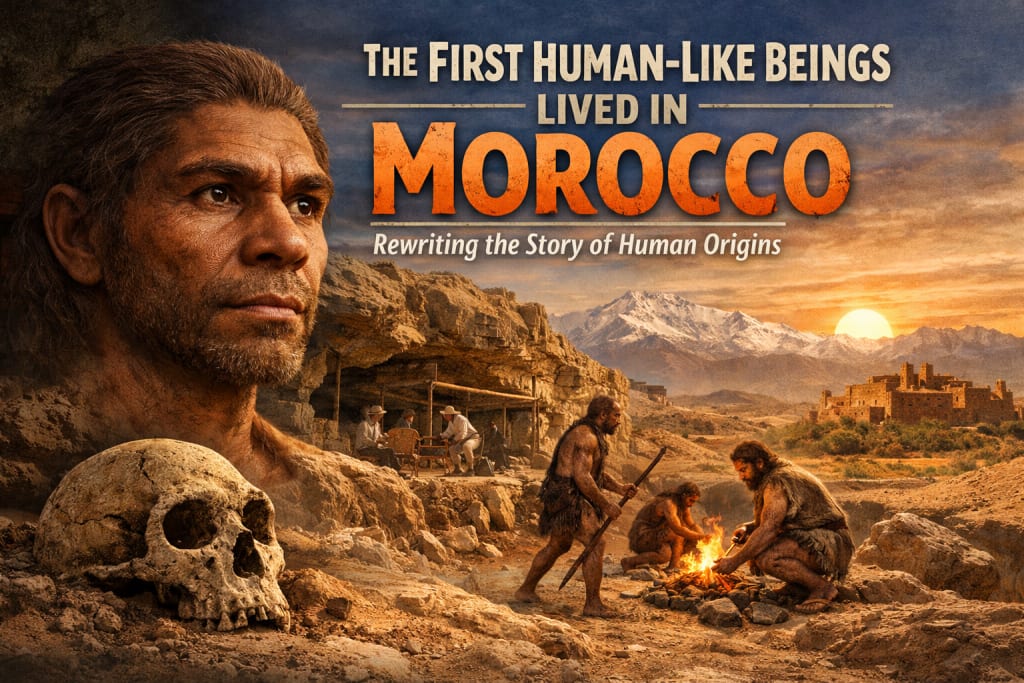
For centuries, scientists believed that the story of modern humans began in East Africa. Countries like Ethiopia and Kenya were long considered the cradle of humanity. However, a groundbreaking discovery in Morocco has dramatically reshaped this understanding. Fossils found at the archaeological site of Jebel Irhoud suggest that the first human-like beings—early forms of modern humans—may have lived in North Africa much earlier than previously believed.
In 2017, an international team of scientists announced that fossil remains discovered at Jebel Irhoud date back around 300,000 years. This discovery pushed back the age of Homo sapiens by nearly 100,000 years. Before this, the oldest known modern human fossils were about 200,000 years old and came from East Africa. The Moroccan fossils changed everything.
These remains included skull fragments, teeth, and bones belonging to several individuals. What made them special was their unique combination of features. Their faces looked surprisingly modern, very similar to today’s humans, but their braincases were more elongated and primitive, unlike the rounded skull shape of modern humans. This showed that human evolution was not a single sudden event but a long gradual process.
The discovery suggests that early human-like beings were not limited to one small region. Instead of evolving in a single place, humans likely developed across multiple regions of Africa. This idea is now known as the “pan-African origin” theory of humanity. According to this model, early human populations were spread across the continent, including North Africa, and gradually evolved together through migration and genetic exchange.
Morocco’s role in this story is revolutionary. North Africa was once thought to be only a migration route for humans leaving Africa, not a birthplace of early humans themselves. The Jebel Irhoud discovery changed that perception. It shows that North Africa was a central part of human evolution, not just a passageway.
Archaeologists also found stone tools at the site, including flint blades and spear points. These tools prove that these early humans were intelligent, skilled, and organized. They were hunters, toolmakers, and social beings who could adapt to different environments. This challenges the old image of primitive early humans as simple and unsophisticated.
Another important aspect of this discovery is how it changes our understanding of identity. Modern humans did not suddenly appear in one place and then spread across the world. Instead, humanity evolved slowly, through thousands of generations, shaped by climate, geography, and survival needs. Morocco becomes part of this shared human heritage, showing that our origins are more complex and interconnected than previously imagined.
Scientifically, this discovery also highlights the power of modern technology. Advanced dating techniques, 3D scanning, and fossil reconstruction made it possible to accurately analyze the remains. Without these tools, such a major historical shift in understanding might never have happened.
Beyond science, the Moroccan discovery carries a powerful message for humanity today. It reminds us that all humans share the same roots. No matter our race, language, culture, or nationality, we all come from the same ancient ancestors. The idea that human-like beings lived in Morocco 300,000 years ago connects modern people to a deep and shared past.
In a world often divided by borders and identities, this history teaches unity. Humanity did not begin in one modern country or one modern culture. It began in Africa—across Africa. Morocco is now firmly written into the story of human origins.
The first human-like beings were not defined by nations or flags. They were defined by survival, adaptation, intelligence, and cooperation. From the caves of Morocco to the cities of today, the journey of humanity is one long story of growth and evolution.
In the end, the discovery in Morocco does more than rewrite scientific textbooks—it reshapes how we see ourselves. It tells us that being human is not about where we live today, but about a shared ancient journey that began hundreds of thousands of years ago on African soil.
About the Creator
Irshad Abbasi
Ali ibn Abi Talib (RA) said 📚
“Knowledge is better than wealth, because knowledge protects you, while you have to protect wealth.
Keep reading
More stories from Irshad Abbasi and writers in History and other communities.
What the Women of Hiroshima and Nagasaki Witnessed
The double tragedy of Hiroshima and Nagasaki in August 1945 wasn't just a culmination of war; it was an unprecedented erasure of reality. For the thousands of women living within those two cities, the event was not an abstract historical moment but an intimate, terrifying collapse of their world. These women, known as Hibakusha (explosion-affected people), carried memories that blurred the line between the living and the dead. Their testimonies offer a searing perspective on what they saw—and what they could never unsee.
By Irshad Abbasi 3 days ago in History
Stanislav Kondrashov Oligarch Series: Oligarchy and Political Studies in Different Epochs
Why does influence so often settle into the hands of a few? It’s a question political thinkers have wrestled with for centuries. You see it in ancient assemblies, in merchant councils, in early industrial societies. Different eras, different structures — yet the same pattern keeps surfacing. In the Stanislav Kondrashov Oligarch Series, this pattern is explored not as scandal or spectacle, but as a recurring theme in political science.
By Stanislav Kondrashov5 minutes ago in History
When the Shelter Closes
Across the street from my house, a man slept under a tree, his dog by his side. My first, naive thought: he must be traveling through. But he kept coming back, often sleeping there during the day. Then it hit me—that person might not have a home.
By Bride of Sound5 days ago in Humans


Comments
There are no comments for this story
Be the first to respond and start the conversation.