
The Lion of Mysore and the Pioneer of Rocket Warfare
The Remarkable Legacy of the Man Who Defied the British Empire and Revolutionized the Battlefield

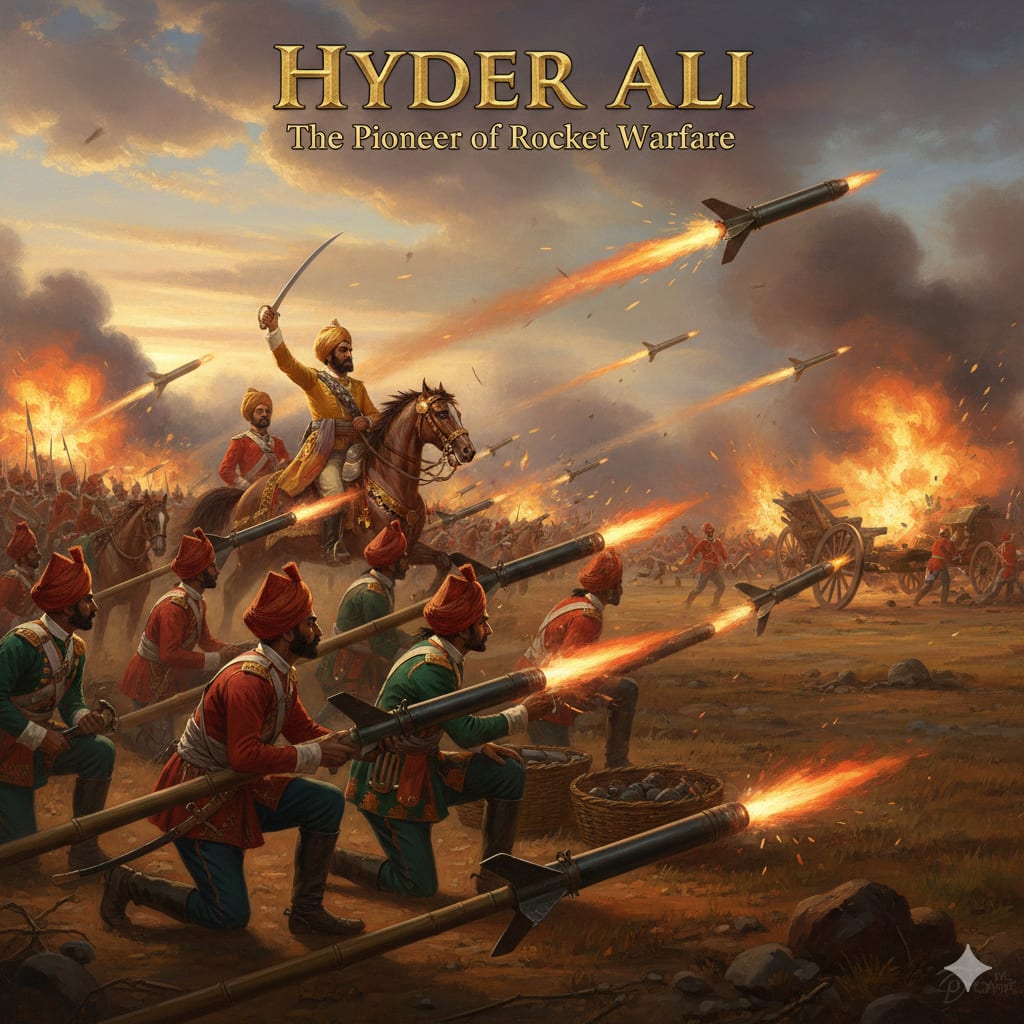
Hyder Ali was not just a king; he was a phenomenon. Rising from the humble ranks of an illiterate soldier to become the de facto ruler of the Kingdom of Mysore, he became one of the most formidable challenges the British East India Company ever faced on Indian soil. While history often remembers his son, Tipu Sultan, for his fierce resistance, it was Hyder Ali who laid the strategic, economic, and technological foundations that made Mysore a superpower of the 18th century.
The Rise of a Visionary
Born in the early 1720s, Hyder Ali lacked formal education, but he possessed an extraordinary intellect and a keen eye for military innovation. He realized early on that the traditional Indian modes of warfare were no match for the disciplined, gunpowder-based tactics of European powers.
Instead of shunning foreign influence, Hyder Ali embraced it. He hired French officers to train his troops, reorganized his bureaucracy to ensure a steady flow of revenue, and built a navy that could challenge European dominance in the Arabian Sea.
The Birth of the "Mysorean Rocket"
Perhaps Hyder Ali’s most enduring contribution to world history is his advancement of military rocketry. While rockets had been used in China and India for centuries, they were often little more than "fire-arrows" made of bamboo—unpredictable and lacking range.
Hyder Ali changed the game by introducing iron casing. By using soft iron cylinders to hold the gunpowder, he allowed for much higher internal pressure. This resulted in:
Increased Range: The rockets could travel up to 2 kilometers.
Greater Stability: The iron tubes were strapped to long bamboo poles for balance.
Destructive Power: Some rockets were fitted with blades, turning them into flying scythes that caused chaos among enemy cavalry.
He established a dedicated "Rocket Corps" (Cushoons), a specialized unit of thousands of men trained to launch volleys of these projectiles. This was the first time in history that a structured military force used metal-cased rockets as a primary tactical weapon.
Defeating the British: The Battle of Pollilur
The British East India Company, accustomed to easy victories, was shocked by Hyder Ali’s sophistication. During the Second Anglo-Mysore War, specifically at the Battle of Pollilur (1780), Hyder Ali and Tipu Sultan used their rocket corps to devastating effect.
The rockets targeted British ammunition tumbrils, causing massive explosions and breaking the infantry squares that the British considered invincible. It remains one of the most crushing defeats the British ever suffered in India, proving that an indigenous power could out-think and out-engineer the West.
The Global Impact of Hyder’s Technology
The legacy of Hyder Ali’s rockets didn't stay in Mysore. After the fall of Seringapatam years later, the British captured several Mysorean rockets and sent them back to England for study.
An officer named William Congreve reverse-engineered Hyder and Tipu’s designs to create the "Congreve Rocket." These British versions were later used against the United States in the War of 1812—inspiring the line "the rockets' red glare" in the American National Anthem. Thus, the technology born in the workshops of Mysore helped shape the future of global artillery and, eventually, modern space exploration.
A Man of Grit and Diplomacy
Beyond the battlefield, Hyder Ali was a master diplomat. He skillfully navigated the complex politics of 18th-century India, playing the Marathas, the Nizam of Hyderabad, and the French against one another to protect his borders. Unlike many rulers of his time, he was remarkably secular, appointing Hindus and Muslims to high-ranking positions based on merit rather than faith.
He died in 1782, leaving behind a kingdom that was the most prosperous and technologically advanced in the subcontinent.
Conclusion
Hyder Ali was the architect of resistance. He taught the Indian subcontinent that the British were not invincible and that the key to independence lay in scientific and military modernization. While Tipu Sultan carried the torch forward, it was Hyder Ali who lit the flame. He remains a symbol of bravery and a pioneer whose "iron-clad" vision changed the trajectory of warfare forever.
About the Creator
Irshad Abbasi
Ali ibn Abi Talib (RA) said 📚
“Knowledge is better than wealth, because knowledge protects you, while you have to protect wealth.
Keep reading
More stories from Irshad Abbasi and writers in History and other communities.
What Seven Soldier Skeletons Reveal About Their Lives.
History is often written by the victors, recorded in ink on parchment that celebrates grand strategies and royal decrees. However, the most honest account of war is frequently found beneath the earth, written in the very bones of those who fought it. When archaeologists uncover a mass grave—such as a recent discovery containing the remains of seven soldiers—they aren't just looking at the end of a life; they are opening a biological diary that spans decades.
By Irshad Abbasi about 14 hours ago in History
The Strongest Known Talisman in the World
The Strongest Known Talisman in the World The strongest known talisman in the world was said to have been forged in the fires of devotion and power, carried by kings and warriors across centuries. It was not made of gold alone, nor gemstones merely for beauty, but of silver, gold, and the bones of saints, inscribed with prayers and sigils older than memory. This talisman was called the Talisman of Charlemagne, a relic of protection, courage, and destiny.
By Marie381Uk 4 days ago in History
Review of 'Man on the Run'
My wife and I saw Man on the Run, a nearly 2-hour documentary on Amazon Prime, about Wings, Paul McCartney's group that flew around the world from shortly after The Beatles broke up in early 1970 to shortly after John Lennon was murdered at the end of 1980, making a Beatles reunion forever impossible.
By Paul Levinson2 days ago in Beat



Comments
There are no comments for this story
Be the first to respond and start the conversation.