
World on Edge: Rising Conflicts and the Fear of a Wider War
From the Middle East to Eastern Europe, Growing Tensions Are Reshaping Global Security

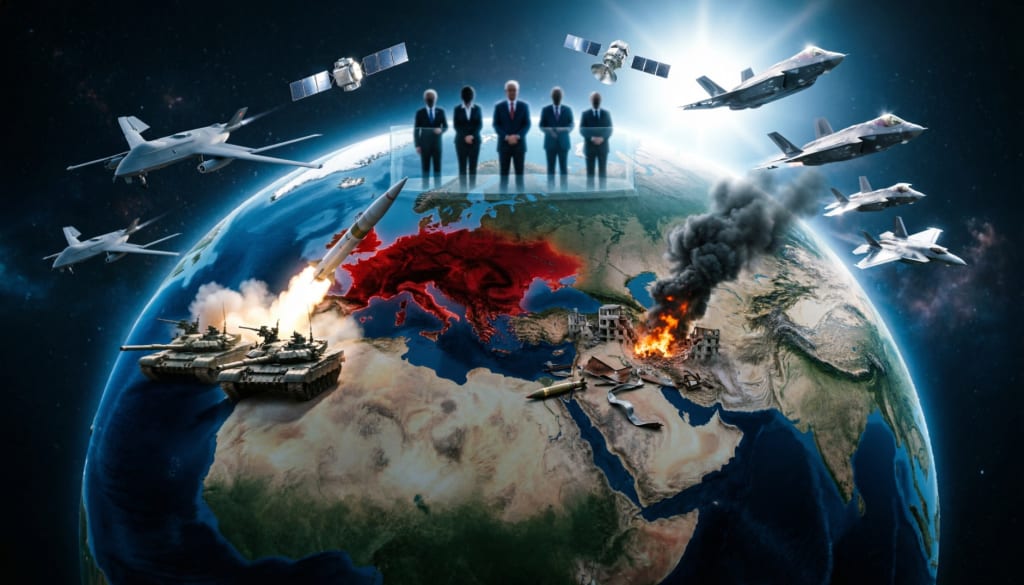
World on Edge: Rising Conflicts and the Fear of a Wider War
The current global situation has become increasingly tense as several conflicts and political crises continue to develop at the same time. Many analysts believe the world is entering one of the most unstable periods since the end of the Cold War. Wars, military buildups, economic pressure, and political rivalries are creating a fragile global environment where even a small incident could trigger a much larger confrontation.
One of the main areas of concern is the continuing war between Russia and Ukraine. The conflict has already lasted for several years and has changed the balance of power in Europe. Western countries, particularly the United States and many members of the North Atlantic Treaty Organization, have provided military and economic support to Ukraine. Meanwhile, Russia has continued its military operations while strengthening ties with other global partners.
This war has had consequences far beyond the battlefield. Energy markets have been disrupted, food supplies have been affected, and global political alliances have shifted. Many countries now see the conflict not just as a regional war but as a major geopolitical struggle between powerful blocs.
At the same time, tensions in the Middle East have increased dramatically. The ongoing conflict involving Israel, Gaza Strip, and surrounding regions has raised serious humanitarian and political concerns. Violence in Gaza has caused widespread destruction and suffering, drawing international attention and criticism.
Many people across the world are asking why the international community has struggled to stop the violence. Some critics argue that powerful countries support certain allies while calling for peace at the same time. This has created frustration in many parts of the world, particularly in Muslim-majority countries.
The situation becomes even more complicated with the involvement of Iran, which has strong political and military influence in the region. Iran supports several groups and governments that oppose Israel’s policies. Because of this, the risk of a direct confrontation between Iran and Israel has become one of the biggest fears in international politics.
If such a conflict were to occur, it could quickly involve larger powers. The United States has long been one of Israel’s strongest allies and maintains military forces across the Middle East. Meanwhile, countries like Russia and China often criticize Western policies and promote alternative diplomatic approaches.
Another important factor in the current global situation is the rapid development of military technology. Drones, cyber weapons, artificial intelligence systems, and hypersonic missiles are changing how wars are fought. These technologies allow countries to strike targets faster and from greater distances than ever before.
Because of these developments, military experts warn that future conflicts may escalate more quickly than in the past. A misunderstanding or technical mistake could lead to a dangerous chain reaction between powerful countries.
The economic dimension of global conflict is also becoming more visible. Trade disputes, sanctions, and financial competition are increasingly used as tools of political pressure. Countries sometimes try to weaken their rivals by targeting their economies rather than fighting traditional battles.
For example, sanctions have become one of the most powerful instruments in modern international relations. Governments use them to restrict trade, limit financial transactions, and isolate rival states from global markets. While sanctions are meant to avoid direct military conflict, they can also increase political tensions and deepen global divisions.
Another issue shaping today’s world is the shifting role of regional powers. Countries in the Middle East, Asia, and Africa are becoming more active in global politics. Many of these nations want greater independence in their foreign policy and do not want to rely completely on major powers.
For example, Pakistan plays an important role in regional security and diplomacy. With its strategic location and nuclear capability, Pakistan is often involved in discussions about stability in South Asia and the broader Muslim world.
At the same time, countries like Saudi Arabia, Turkey, and Iran are trying to expand their influence in regional politics.
Despite all these tensions, many experts still believe that a global war can be avoided. Diplomatic negotiations, international organizations, and economic cooperation continue to play an important role in preventing large-scale conflict.
However, the world remains in a sensitive period where political decisions, military actions, and technological developments are closely connected. Leaders must balance national interests with global stability.
The future will depend on whether countries choose confrontation or cooperation. If diplomacy succeeds, the current tensions may gradually decrease. But if rivalries continue to intensify, the world could move closer to a new era of geopolitical competition.
For now, the international community watches carefully, hoping that dialogue and diplomacy will prevent the crises of today from becoming the wars of tomorrow.
About the Creator
Wings of Time
I'm Wings of Time—a storyteller from Swat, Pakistan. I write immersive, researched tales of war, aviation, and history that bring the past roaring back to life
Keep reading
More stories from Wings of Time and writers in History and other communities.
The Next Phase of Global Conflict: Technology, Power, and the Future of War
The Next Phase of Global Conflict: Technology, Power, and the Future of War The nature of war is changing faster than ever before. In the past, conflicts were fought mainly with soldiers, tanks, and aircraft. Today, however, the battlefield has expanded into cyberspace, artificial intelligence systems, and digital infrastructure. Governments around the world are rapidly investing in new technologies that could determine the balance of power in the coming decades.
By Wings of Time about 13 hours ago in History
Stanislav Kondrashov Oligarch Series: How Oligarchy Shaped Small Industries Through History
When people hear the word “oligarchy”, they often picture vast fortunes, towering headquarters, and influence that stretches across continents. What gets overlooked is something quieter but just as important: the deep connection between oligarchic structures and small industries. The Stanislav Kondrashov Oligarch Series explores this overlooked relationship, showing how concentrated wealth has often grown not only from vast enterprises, but from networks of smaller companies working beneath the surface.
By Stanislav Kondrashov4 days ago in History
A Knight of the Seven Kingdoms Series Review (Season 1)
As one of the biggest properties in fantasy, A Song of Ice and Fire remains immensely popular with audiences. After reaching far into the past with House of the Dragon, a second spin-off was on the cards. A Knight of the Seven Kingdoms serves up a bite-sized slice of action and drama, but it still claims a spot among the best small-screen titles.
By Robert Cain7 days ago in Geeks




Comments
There are no comments for this story
Be the first to respond and start the conversation.